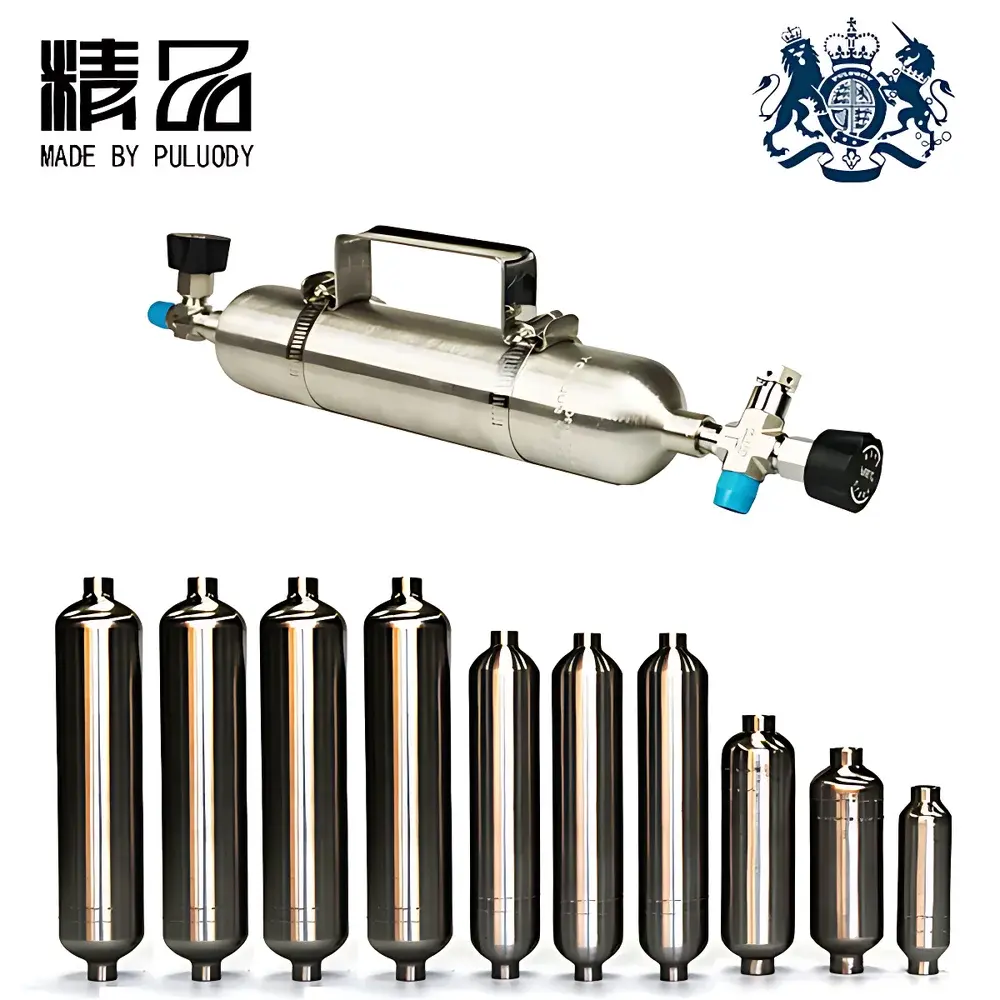
PULL PULL-316L Series High-Pressure Liquefied Gas Sampling Cylinder
| Brand | PULL |
|---|---|
| Material | 316L Stainless Steel (ASTM A240/A276) |
| Working Pressure | 4–20 MPa |
| Burst Pressure | 7–38 MPa |
| Operating Temperature Range | −60 °C to +80 °C |
| Volume Options | 100–5000 mL |
| Compliance | SH/T 0233–92, SY/T ZJ1045, ASTM D1265, IP 191, ISO 4256 |
| Valve Configuration | Dual-end (single- or double-valve variants), equipped with explosion-proof rupture disc and precision needle valves |
| Optional Internal Coating | PTFE (per ASTM D7415) |
| Pressure Gauge | Bourdon-type, 0–25 MPa, Class 1.6 accuracy |
| Accessories | 304 Stainless Steel Support Stand, High-Pressure Flexible Hoses (Nylon or SS-braided) |
Overview
The PULL PULL-316L Series High-Pressure Liquefied Gas Sampling Cylinder is an engineered solution for the safe, representative, and contamination-controlled collection, containment, and transport of volatile hydrocarbon gases and liquefied petroleum products under elevated pressure conditions. Designed in strict accordance with SH/T 0233–92 (Chinese Standard for Liquefied Petroleum Gas Sampling), SY/T ZJ1045 (Petroleum Industry Standard for Gaseous Hydrocarbon Sampling), and internationally harmonized protocols including ASTM D1265 (Standard Practice for Sampling Liquefied Petroleum (LP) Gases), IP 191 (Institute of Petroleum Method), and ISO 4256 (Petroleum Products — Sampling of Liquefied Gases), this cylinder ensures metrological integrity from point-of-source acquisition through laboratory analysis. Its core function relies on passive phase equilibrium sampling: the cylinder is evacuated prior to filling, then pressurized via direct connection to the process stream—enabling thermodynamic equilibrium between vapor and liquid phases to be preserved during transfer and storage. This principle is critical for accurate compositional analysis by gas chromatography (GC), Fourier-transform infrared spectroscopy (FTIR), or mass spectrometry (MS), where phase segregation or adsorption-induced bias must be eliminated.
Key Features
- Material Integrity: Constructed from seamless, cold-drawn 316L stainless steel (ASTM A240/A276), offering superior resistance to chloride-induced stress corrosion cracking and pitting—essential for handling sulfur-containing, acidic, or halogenated hydrocarbons commonly found in refinery off-gas, FCC units, and natural gas processing streams.
- Pressure & Thermal Robustness: Rated for continuous service at working pressures up to 20 MPa and validated burst pressures exceeding 38 MPa; certified for operation across a full industrial thermal envelope (−60 °C to +80 °C), enabling cryogenic ethylene sampling and high-temperature refinery gas capture without mechanical degradation.
- Explosion-Proof Safety Architecture: Integrated ASME BPVC Section VIII-compliant rupture disc assembly with calibrated burst pressure margin (typically 1.5× maximum allowable working pressure), coupled with dual precision needle valves—one standard and one explosion-relief configured—to prevent over-pressurization during thermal expansion or accidental valve misoperation.
- Surface Contamination Control: Optional electropolished internal surface finish (Ra ≤ 0.4 µm) and PTFE lining (per ASTM D7415) minimize active site adsorption of trace components such as mercaptans, hydrogen sulfide, carbonyl sulfide, and light olefins—preserving sample fidelity for ultra-low-level impurity quantification (ppb-level detection).
- Modular Interface Design: Standard 1/4″ NPT or BSPP female inlet/outlet ports accommodate interchangeable high-pressure fittings; compatible with both nylon-reinforced transparent hose (for visual flow monitoring) and SS-braided flexible hose (rated to 40 MPa) per EN 13803 and SAE J517.
Sample Compatibility & Compliance
This sampling cylinder is validated for use with saturated and unsaturated C₂–C₄ hydrocarbons—including ethylene, propylene, butadiene, propane, butane, isobutane—and multi-phase mixtures such as LPG, LNG boil-off gas, and sour natural gas within defined pressure–temperature envelopes. It meets material compatibility requirements per NACE MR0175/ISO 15156 for sour service (H₂S ≤ 100,000 ppm, pH ≥ 3.5). All units undergo hydrostatic proof testing at 1.5× MAWP and helium leak testing (<1 × 10⁻⁹ mbar·L/s) prior to shipment. Documentation includes full traceability to mill test reports (MTRs), pressure test certificates, and third-party verification reports aligned with ISO/IEC 17025-accredited calibration practices.
Software & Data Management
While the cylinder itself is a passive mechanical device, it integrates seamlessly into digital laboratory workflows. Each unit carries a unique serialized QR code linked to a secure cloud-based asset register containing manufacturing date, test records, calibration history, and maintenance logs. When used with PULL’s optional digital pressure transducer module (model PT-DIG-316L), real-time pressure and temperature data are timestamped and exported in CSV or ASTM E2500-compliant XML format, supporting 21 CFR Part 11 audit trails and GLP/GMP electronic record retention. The system supports automated import into LIMS platforms via HL7 or ASTM E1384 interfaces.
Applications
- Refinery process gas monitoring (FCC, hydrotreater, alkylation unit off-gas)
- Quality control of commercial LPG and propane-butane blends per GB 11174 or ASTM D1835
- Trace sulfur speciation (e.g., COS, MeSH, DMS) in pipeline natural gas per ISO 6974
- Reaction mixture sampling in petrochemical pilot plants (ethylene oxide, polyolefin synthesis)
- Calibration gas preparation and certified reference material (CRM) dispensing
- Environmental emissions testing per EPA Method 18 and ISO 10156
FAQ
What standards does this cylinder comply with?
It conforms to SH/T 0233–92, SY/T ZJ1045, ASTM D1265, IP 191, ISO 4256, and ASME BPVC Section VIII Division 1 for pressure vessel design and testing.
Can it be used for hydrogen sulfide-containing streams?
Yes—when constructed from 316L and operated within NACE MR0175/ISO 15156 limits (pH ≥ 3.5, H₂S ≤ 100,000 ppm); optional PTFE lining further enhances compatibility.
Is cleaning validation supported?
Each cylinder includes a cleaning protocol compliant with ASTM E3079 and USP , with residual solvent testing (acetone, methanol) documented in the certificate of conformance.
How is traceability maintained across its lifecycle?
Serialized QR code, MTR linkage, hydrostatic test report, and optional digital pressure logging ensure full chain-of-custody compliance for ISO/IEC 17025 and API RP 1172 audits.
What accessories are included by default?
Standard configuration includes dual needle valves, integrated rupture disc, pressure gauge (0–25 MPa), and protective cap; stand, hoses, and PTFE coating are configurable options.