
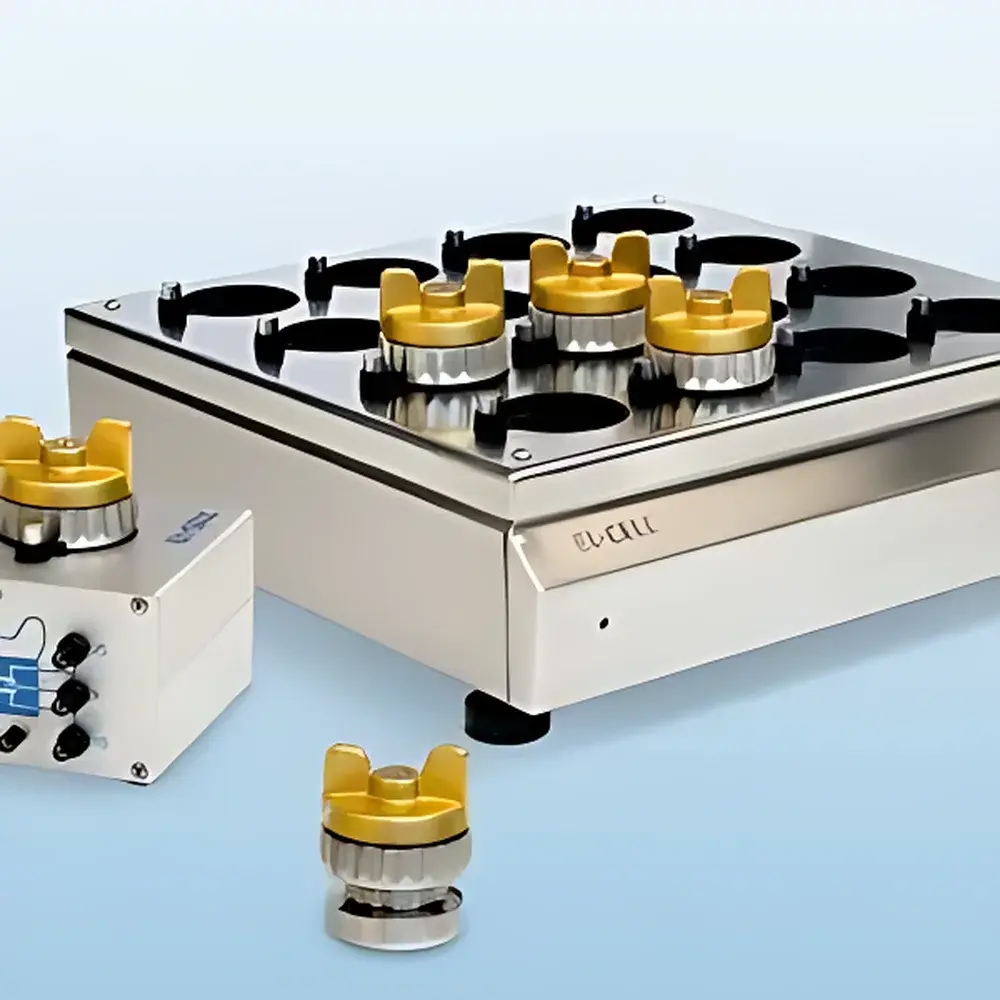
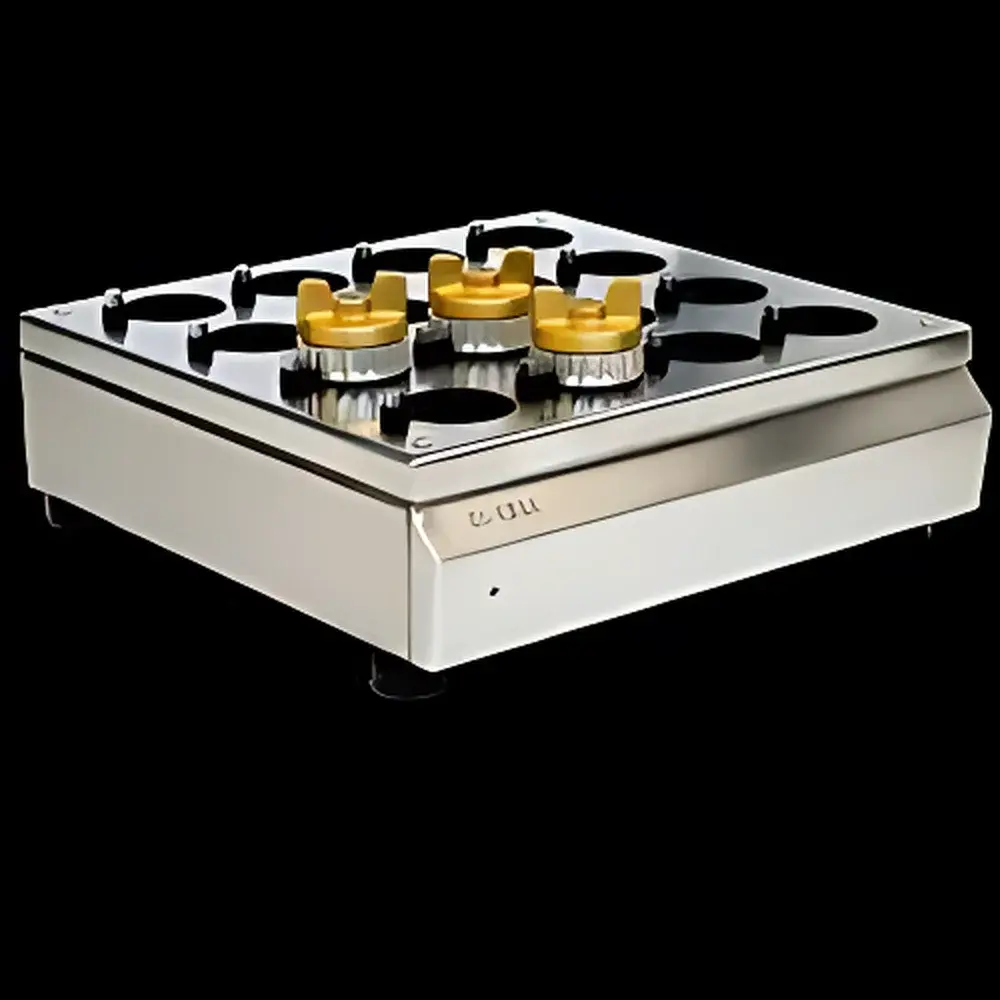
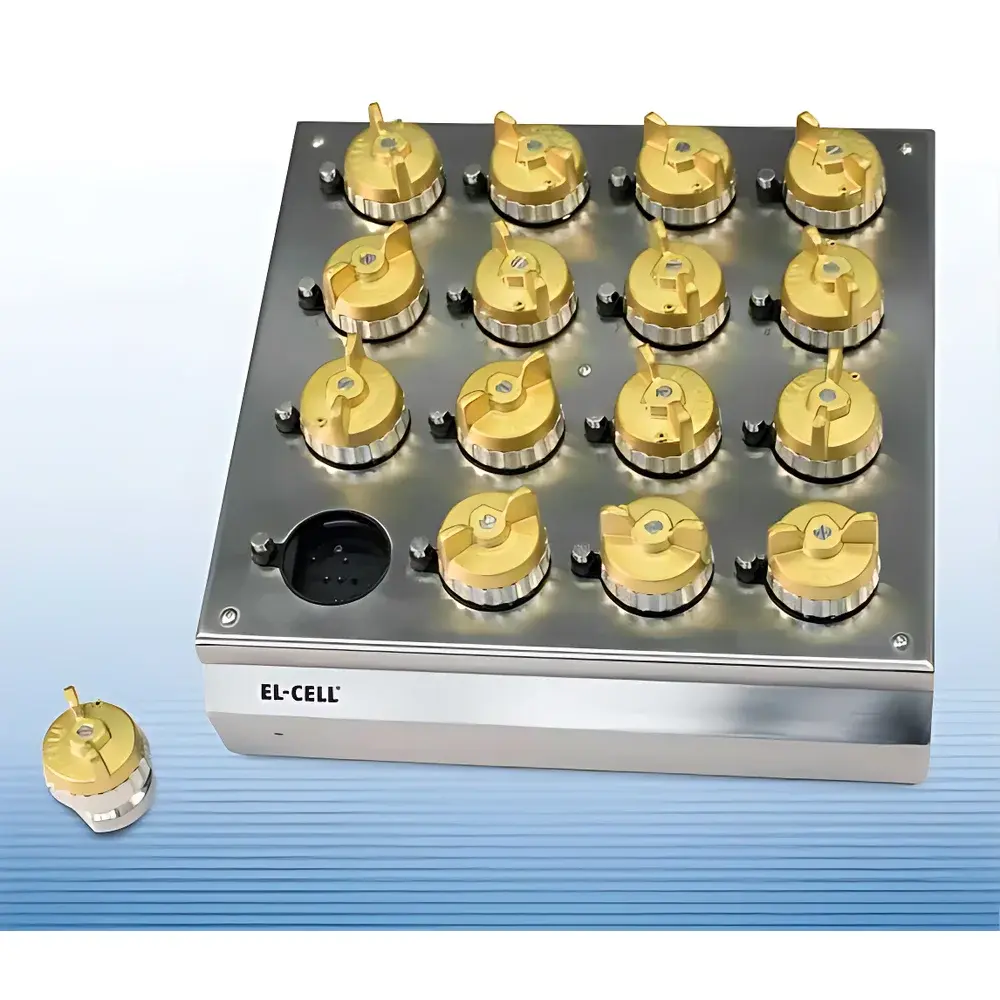
EL-Cell PAT-Tray 16-Channel Parallel Battery Testing Platform
| Brand | EL-Cell |
|---|---|
| Origin | Germany |
| Model | PAT-Tray |
| Dimensions (W × D) | 315 mm × 315 mm |
| Height | 120 mm (empty) / 148 mm (loaded) |
| Weight | 6.9 kg (empty) |
| Channel Capacity | 16 (4 × 4 matrix) |
| Integrated Data Logger | Voltage (half-cell & full-cell), Current, Time, Temperature |
| Compatibility | Gamry Reference 3000, BioLogic VMP-3, Arbin BT2000, and other standard potentiostats/galvanostats |
| Material | Battery-grade Al (lower plunger), Cu (upper plunger), PP insulation sleeve |
| Operating Environment | Compatible with Binder KB53 and equivalent climate chambers |
Overview
The EL-Cell PAT-Tray is a modular, 16-channel parallel battery testing platform engineered for high-throughput electrochemical characterization of coin cells, pouch cells, and custom half-cell configurations. It serves as the mechanical and electrical backbone of the PAT-Series ecosystem—designed specifically to support statistically robust screening of electrode materials, electrolytes, and interfacial stability under controlled thermal conditions. Unlike conventional single-cell test rigs, the PAT-Tray implements a centralized current distribution architecture grounded in four-quadrant potentiostatic control principles. Each channel operates independently yet synchronously, enabling true parallel galvanostatic cycling, voltage-controlled hold, and impedance spectroscopy (EIS) acquisition without crosstalk. Its structural design adheres to fundamental electrochemical cell geometry standards defined in ASTM D1148 and IEC 62660-1, ensuring reproducible electrode compression, uniform current density distribution, and minimized ohmic drop across terminals.
Key Features
- 16-channel capacity arranged in a rigid 4 × 4 matrix—optimized for spatial consistency and thermal homogeneity during chamber-based testing
- Integrated data logger with synchronized timestamping records voltage (±5 V range, 16-bit resolution), current (±5 A range, 16-bit resolution), temperature (via embedded Pt100 sensors, ±0.2 °C accuracy), and elapsed time for all channels simultaneously
- Unified bus interface eliminates individual cable routing: single analog/digital connector links all 16 channels to external potentiostats (e.g., Gamry Reference 3000, BioLogic SP-300) or battery cyclers (e.g., Arbin BT2000)
- PAT-Core compatible mechanical interface—accepts reusable stainless-steel plungers (316L option available), battery-grade aluminum lower pistons, copper upper plungers, and polypropylene insulating sleeves pre-fitted with optional ring-type reference electrodes for three-electrode configuration
- Thermally neutral footprint: compact form factor (315 × 315 × 148 mm max) certified for insertion into standard Binder KB53, Memmert IPP, or Vötsch VT4004 environmental chambers without obstruction to airflow or sensor placement
- Modular scalability: multiple PAT-Tray units can be daisy-chained via RS-485 or Ethernet (with optional firmware upgrade) for expanded channel counts up to 64+ while maintaining synchronized trigger logic
Sample Compatibility & Compliance
The PAT-Tray supports standardized CR2032, CR2025, and custom-diameter coin cells (10–25 mm), as well as thin-film symmetric cells and Swagelok-style half-cells when used with appropriate PAT-Core variants. All wetted components meet ISO 14644-1 Class 5 cleanroom compatibility requirements and are free of halogenated solvents or heavy-metal contaminants per RoHS Directive 2011/65/EU. Electrical isolation between channels exceeds 1 GΩ at 500 VDC, satisfying IEC 61010-1 safety thresholds for laboratory instrumentation. The system architecture enables audit-ready data capture compliant with FDA 21 CFR Part 11 when paired with validated EL-Cell ControlSuite software (v4.2+), including electronic signatures, change logs, and immutable file hashing.
Software & Data Management
Raw telemetry from the integrated logger is written to timestamped .csv files within a hierarchical folder structure: /Year/Month/Day/Experiment_ID/. Each file contains aligned columns for Channel ID, Epoch Time (UTC), Voltage (V), Current (A), Temperature (°C), and Status Flag (e.g., “OCV”, “CC”, “CV”, “EIS”). EL-Cell ControlSuite provides real-time visualization, batch export to MATLAB (.mat) or Python (HDF5), and automated QC flagging based on user-defined thresholds (e.g., >5 mV deviation from nominal OCV after rest). Metadata embedding supports MIAME-compliant archiving, and optional integration with LabArchives ELN ensures traceability from raw signal to publication-ready figures.
Applications
- High-throughput screening of cathode/anode material libraries under identical thermal and current-load profiles
- Electrolyte decomposition onset mapping via long-term floating tests at fixed potentials (e.g., 4.3 V vs. Li/Li⁺)
- Interfacial resistance evolution tracking using periodic low-amplitude EIS (10 mHz–100 kHz) across 16 cells in parallel
- Calendric and cycle-life benchmarking of solid-state composite electrodes under controlled humidity and temperature ramps
- Validation of SEI formation kinetics using differential voltage analysis (dV/dQ) derived from synchronized multi-channel charge/discharge curves
FAQ
Can the PAT-Tray operate without an external potentiostat?
No—the PAT-Tray is a passive electromechanical interface and requires connection to a compatible bipotentiostat or battery cycler for current/voltage control and EIS excitation.
Is the built-in data logger capable of recording impedance spectra?
No—EIS acquisition must be performed by the connected electrochemical workstation; the logger captures only DC parameters and temperature.
What is the maximum recommended current per channel?
5 A continuous, with peak pulses up to 10 A for ≤100 ms, provided thermal management (e.g., chamber setpoint ≤45 °C) is maintained.
Are PAT-Core components autoclavable?
No—PP sleeves and metal plungers are chemically resistant but not rated for steam sterilization; cleaning is performed with anhydrous ethanol and nitrogen purge.
Does the system support active temperature control beyond chamber integration?
Not natively—the PAT-Tray lacks Peltier elements or fluidic ports; precise thermal regulation relies entirely on external environmental chamber performance.
Related Products






