
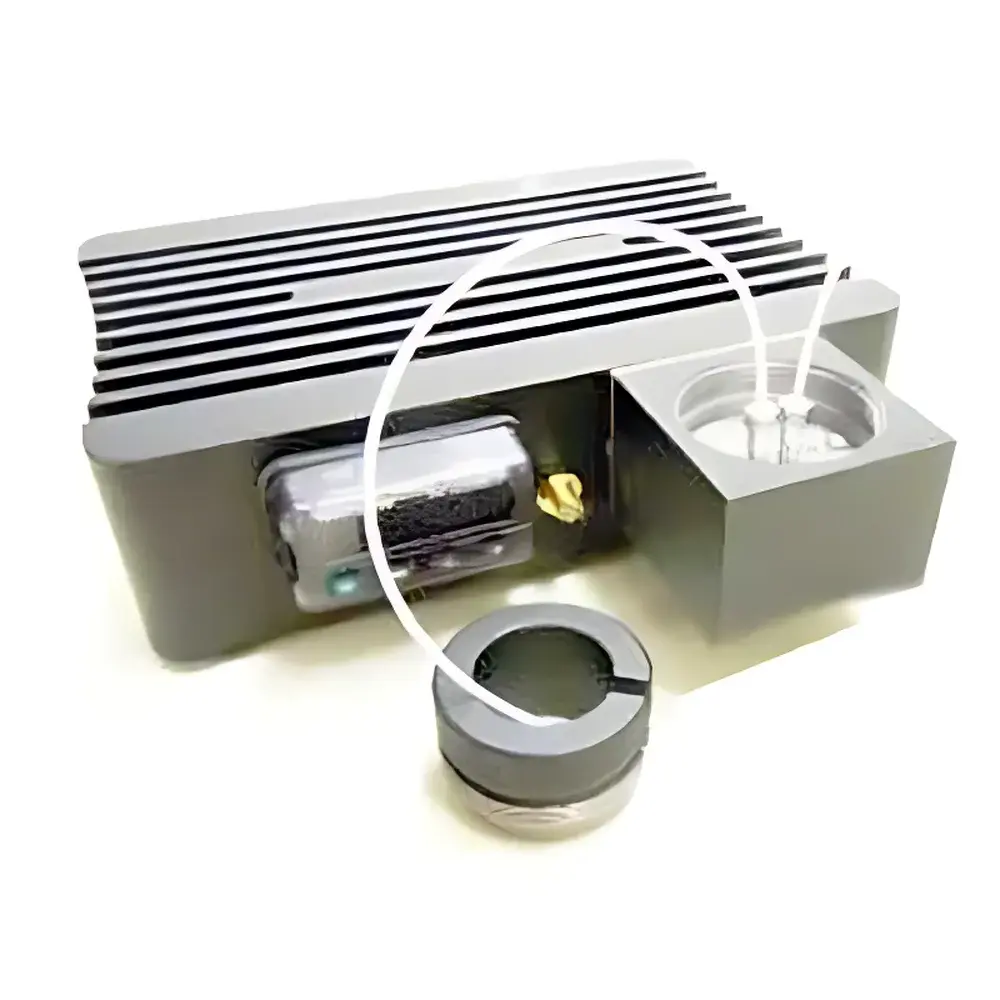
Gamry eQCM-I Mini Quartz Crystal Microbalance
| Brand | Gamry |
|---|---|
| Origin | USA |
| Model | eQCM-I Mini |
| Temperature Control Range | 4–80 °C (±0.02 °C) |
| Harmonic Measurement Capability | Up to 13th harmonic on 5 MHz crystals |
| Frequency Sweep Bandwidth | Up to 70 MHz |
| Channels | 2 (1 temperature-controlled) |
| Interface | USB |
| Software | BioSense EC 3.xx (single-user license) |
| Compliance | Designed for electrochemical QCM (EQCM) applications per ASTM D7986, ISO 11357-4, and GLP/GMP-aligned data integrity workflows |
Overview
The Gamry eQCM-I Mini is a compact, high-precision electrochemical quartz crystal microbalance engineered for real-time, in situ mass and viscoelastic monitoring during electrochemical processes. It operates on the fundamental principle of piezoelectric resonance: when a thin-film quartz crystal oscillator (typically AT-cut, 5 MHz nominal frequency) is subjected to an alternating voltage, it vibrates at its fundamental resonant frequency; any mass change on the electrode surface—such as adsorption, deposition, or swelling—alters this frequency according to the Sauerbrey equation (Δf = −Cf·Δm), where Cf is the crystal’s sensitivity constant. Critically, the eQCM-I Mini extends beyond simple frequency tracking by acquiring full conductance spectra (G–f) across user-defined bandwidths up to 70 MHz, enabling simultaneous quantification of resonance frequency shift (Δf), half-power bandwidth (ΔΓ, or FWHM), and dissipation factor (D = ΔΓ/f0). This dual-parameter acquisition supports both rigid-film (Sauerbrey) and soft/filmy (Voigt-based) modeling—essential for characterizing polymer films, biomolecular layers, corrosion products, or battery interphases under potentiostatic or galvanostatic control.
Key Features
- High-resolution impedance spectroscopy mode: Measures full conductance vs. frequency curves to extract f0, ΔΓ, and Q-factor with sub-Hertz frequency resolution and <0.01 Hz RMS noise floor
- Multi-harmonic capability: Supports sequential or simultaneous resonance tracking from 1st to 13th overtone on standard 5 MHz crystals—enabling thickness gradient analysis and viscoelastic decoupling
- Precise thermal regulation: Integrated Peltier stage maintains sensor temperature between 4 °C and 80 °C with ±0.02 °C stability—critical for thermally sensitive redox reactions and hydration studies
- Modular dual-channel architecture: One channel includes active temperature control; second channel supports parallel reference or comparative measurements (e.g., blank vs. functionalized sensor)
- Interoperable EC integration: Designed for seamless synchronization with external potentiostats via TTL triggers and analog voltage inputs—no proprietary electrochemical hardware required
- Robust mechanical design: QSH-104 and QSHE-104 flow-cell compatible sensor holders ensure leak-free operation with ITO-coated or gold-coated QCM crystals (standard 14 mm diameter)
Sample Compatibility & Compliance
The eQCM-I Mini accommodates standard 14 mm diameter AT-cut quartz crystals with Au, Pt, or ITO electrodes—compatible with aqueous, non-aqueous, and ionic liquid electrolytes. Its flow-cell configuration (QSH-104/QSHE-104) supports continuous-flow EQCM experiments, including electropolymerization, SEI formation in Li-ion batteries, and protein adsorption kinetics. All measurement metadata—including timestamp, temperature, applied potential, and raw G–f spectra—are logged with immutable audit trails. BioSense EC 3.xx software complies with ALCOA+ principles and supports 21 CFR Part 11–ready configurations (electronic signatures, role-based access, and operation logs) when deployed in regulated environments (e.g., pharmaceutical QC or battery R&D labs). The system meets mechanical and electrical safety requirements per IEC 61010-1 and electromagnetic compatibility standards per EN 61326-1.
Software & Data Management
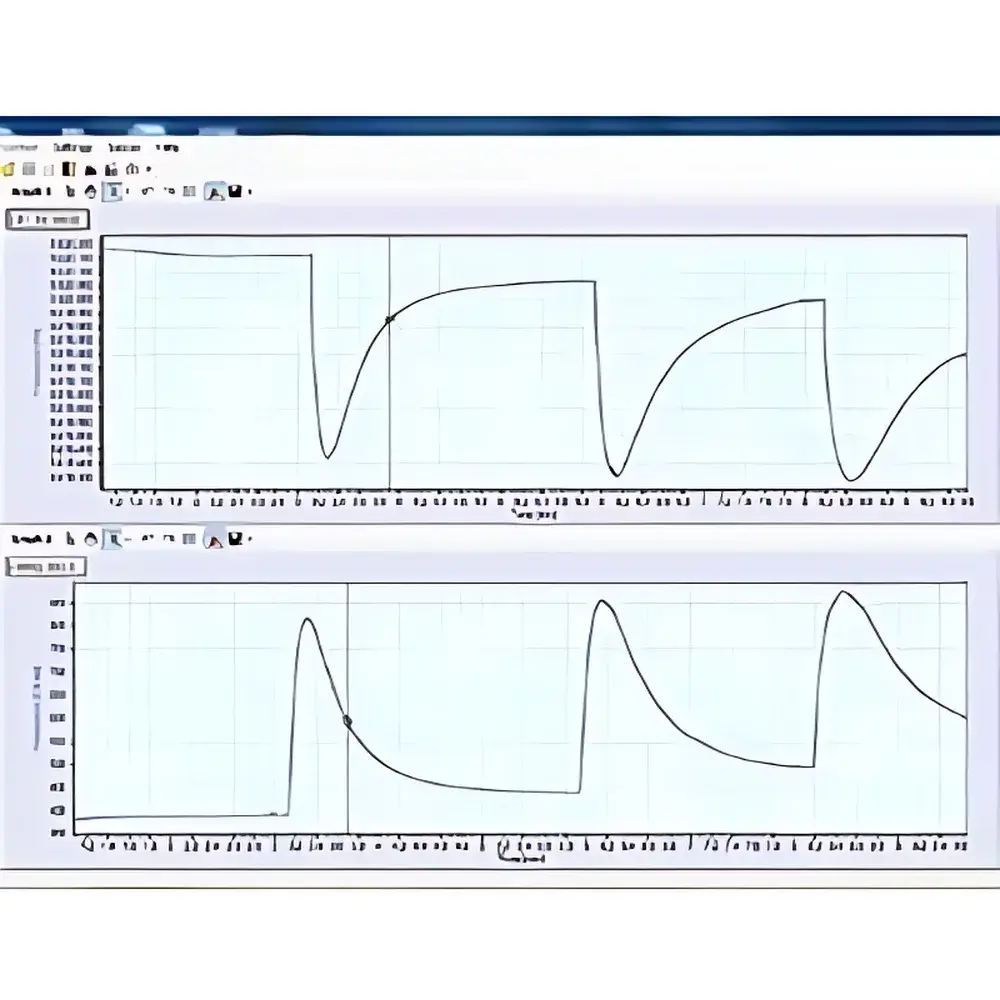
BioSense EC 3.xx is a Windows® 10 Pro–native application providing full instrument control, real-time visualization, and advanced post-processing. Two primary acquisition modes are implemented: Resonance Mode, for high-resolution conductance sweeps yielding f0 and ΔΓ; and QCM-t Mode, for high-speed time-series tracking of resonance parameters at user-defined intervals (down to 100 ms per point). Built-in calculation modules support Sauerbrey mass conversion, Voigt viscoelastic modeling, and custom layer parameter fitting (e.g., shear modulus, viscosity, film thickness). Data export options include CSV, HDF5, and MATLAB-compatible .mat files. All plots are publication-ready with vector-based rendering, customizable axis scaling, and batch annotation tools. Software updates are delivered via secure Gamry-hosted repositories with SHA-256 checksum verification.
Applications
- Electrodeposition and stripping kinetics of metals (Cu, Ni, Zn) in microelectronics plating baths
- In situ characterization of solid-electrolyte interphase (SEI) evolution on anode materials during Li-ion battery cycling
- Real-time monitoring of antibody–antigen binding, DNA hybridization, or enzyme immobilization on biosensor surfaces
- Swelling/deswelling dynamics of conducting polymers (e.g., PEDOT, polyaniline) under redox switching
- Corrosion inhibitor film formation and breakdown on steel or aluminum substrates in simulated cooling water
- Mass-transport-limited electrosynthesis in flow reactors, coupled with chronoamperometry and EIS
FAQ
Does the eQCM-I Mini include a built-in potentiostat?
No. The eQCM-I Mini is a dedicated QCM measurement unit and requires an external potentiostat for electrochemical control. It provides TTL synchronization and analog potential/current input interfaces for coordinated operation.
Can I use third-party QCM crystals with this system?
Yes—provided they conform to standard 14 mm diameter, AT-cut geometry, and nominal fundamental frequencies of 5 MHz or harmonically related overtones (e.g., 10 MHz, 15 MHz). Gold-coated crystals are recommended for most electrochemical applications.
Is temperature calibration traceable to NIST standards?
The integrated Peltier sensor is factory-calibrated against NIST-traceable RTD references; calibration certificates are available upon request for ISO/IEC 17025–accredited laboratories.
What file formats does BioSense EC 3.xx support for data import/export?
Raw data exports to CSV and HDF5; processed results and figures export to PNG, SVG, and PDF; batch analysis scripts can be exported as Python (.py) or MATLAB (.m) templates.
How is firmware updated on the eQCM-I Mini hardware?
Firmware updates are performed via USB using the Gamry Firmware Update Utility—distributed exclusively through authenticated customer portals to ensure version integrity and security compliance.
Related Products





