
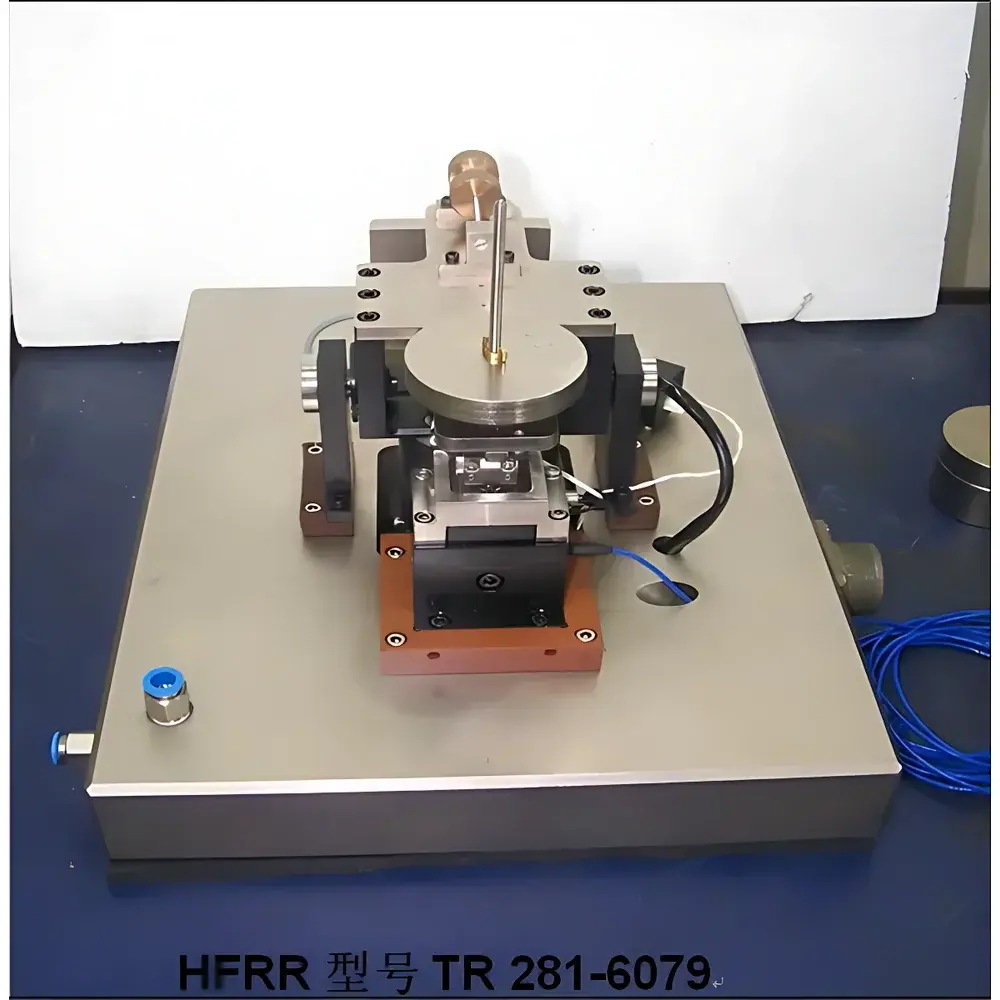
Ducom HFRR Diesel and Additive Lubricity Tester
| Origin | Hong Kong |
|---|---|
| Manufacturer Type | Authorized Distributor |
| Domestic Production | Yes |
| Model | HFRR |
| Price Range | USD 140,000 – 210,000 |
| Instrument Category | High-Precision Tribological Tester |
| Max Friction Force | ±40 N |
| Friction Force Resolution | 0.1 mN |
| Max Test Temperature | 75 °C |
| Oscillation Frequency Range | 10–60 Hz |
| Humidity Control Range | 5–85% RH (adjustable in software) |
| Compliance | ASTM D6079, ISO 12156-1, EN 590 Annex D |
Overview
The Ducom HFRR Diesel and Additive Lubricity Tester is a precision-engineered high-frequency reciprocating rig designed to quantify the boundary lubrication performance of diesel fuels, biodiesel blends, and lubricity-enhancing additives under standardized tribological conditions. Based on the fundamental principle of high-frequency oscillatory motion between a stationary steel ball and a reciprocating flat disc (typically 100Cr6 bearing steel), the instrument replicates the mixed-film contact regime encountered in fuel injection systems—especially in modern common-rail and unit injector components. The test measures wear scar diameter (WSD) on the ball after a defined cycle (e.g., 75 minutes at 60 Hz, 50 N load, 60 °C), while simultaneously capturing real-time friction force via a calibrated piezoelectric sensor. This dual-parameter output—WSD and coefficient of friction (COF)—enables comprehensive evaluation of both anti-wear efficacy and friction-modifying behavior, critical for meeting regulatory mandates such as EN 590, ASTM D975, and ISO 8217.
Key Features
- High-stability reciprocating mechanism with digitally controlled oscillation frequency (10–60 Hz), ensuring precise replication of injection system kinematics
- Integrated piezoelectric force transducer delivering real-time friction force measurement with 0.1 mN resolution and ±40 N dynamic range
- Onboard humidity control system maintaining constant relative humidity (5–85% RH, software-adjustable) throughout testing—essential for reproducible WSD assessment per ASTM D6079 Section 7.3
- Temperature-regulated test chamber supporting operation up to 75 °C, compatible with elevated-temperature lubricity protocols used for low-sulfur and hydrotreated fuels
- Desktop-form-factor design with compact footprint (< 600 × 500 × 450 mm), minimizing laboratory space requirements without compromising mechanical rigidity
- Factory-calibrated load and friction force verification routines (WS 1.4 compliant), enabling traceable in-lab validation prior to each test series
Sample Compatibility & Compliance
The HFRR tester accommodates standard test specimens: 6-mm-diameter 100Cr6 steel balls and 10-mm-thick hardened steel discs (ISO 6506-1 compliant). It supports neat diesel, FAME biodiesel blends (B5–B20), synthetic esters, oxygenated additives (e.g., fatty acid methyl esters, alkyl nitrites), and detergent packages. All operational parameters—including frequency, load, temperature, humidity, and duration—are programmable to align with international standards: ASTM D6079 (standard method for diesel lubricity evaluation), ISO 12156-1 (petroleum products—determination of lubricity by HFRR), and EN 590 Annex D (European diesel specification for maximum allowable WSD ≤ 460 µm). The system architecture supports GLP-compliant data integrity through audit-trail-enabled software logging and user-access-level controls.
Software & Data Management
The proprietary Ducom HFRR Control & Analysis Suite (v4.2+) provides intuitive parameter configuration, real-time force/temperature/humidity monitoring, and automated WSD calculation from high-resolution optical images. Raw time-series friction data are stored in HDF5 format with embedded metadata (operator ID, calibration timestamp, environmental conditions). Export options include CSV, PDF reports (with embedded pass/fail flags per ASTM D6079 Table 1), and XML for LIMS integration. Software complies with FDA 21 CFR Part 11 requirements via electronic signatures, role-based permissions, and immutable audit trails for all test modifications and result approvals.
Applications
- Quality assurance of ultra-low-sulfur diesel (ULSD) and renewable diesel blends prior to distribution
- Formulation screening of lubricity improvers (e.g., amides, esters, sulfur-containing compounds)
- Regulatory compliance testing for EN 590, ASTM D975, and GB 19147 certification
- Research into fuel–additive–metal surface interactions under controlled humidity and thermal stress
- Correlation studies between HFRR WSD and field performance in high-pressure fuel pumps and injectors
- Supporting OEM engine development programs requiring quantifiable boundary lubrication metrics
FAQ
What standards does the Ducom HFRR comply with?
ASTM D6079, ISO 12156-1, EN 590 Annex D, and GB 19147 — fully configurable to match published test protocols.
Is humidity control mandatory for HFRR testing?
Yes. ASTM D6079 specifies humidity control (30–85% RH); the Ducom system enables precise, software-set regulation across 5–85% RH to ensure inter-laboratory reproducibility.
Can the instrument measure friction in real time?
Yes. A factory-calibrated piezoelectric sensor acquires friction force continuously at ≥1 kHz sampling rate, enabling transient COF analysis and wear onset detection.
What is the typical turnaround time for a full ASTM D6079 test?
75 minutes per sample (including 15-min stabilization), plus <2 min for optical imaging and automated WSD analysis.
Does the system support multi-user environments with audit trails?
Yes. Role-based access control, electronic signatures, and tamper-proof audit logs meet GLP and 21 CFR Part 11 requirements for regulated laboratories.



