
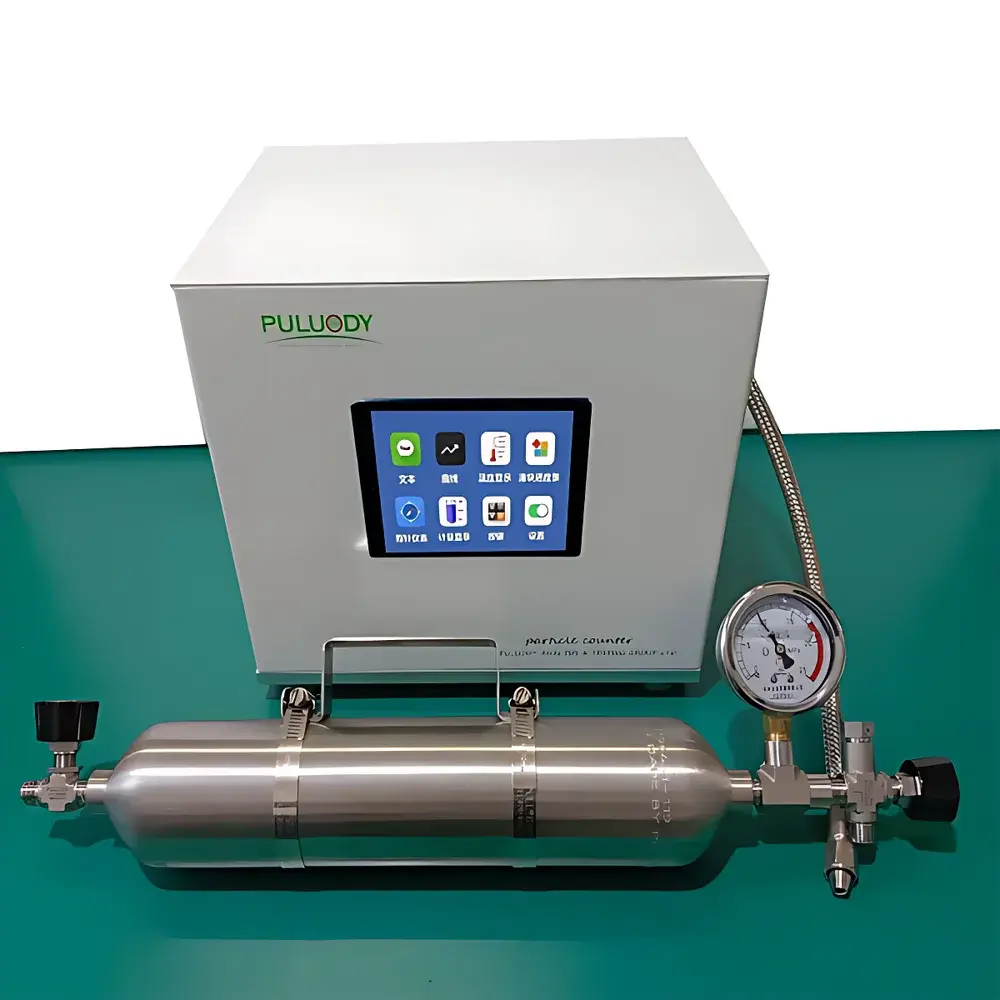
PULUODY PLD-IGS-2025 Automated Inert Gas Sampling System
| Brand | PULUODY |
|---|---|
| Model | PLD-IGS-2025 |
| Origin | Shaanxi, China |
| Housing Material | 316L Stainless Steel |
| Sample Volume | 1 L |
| Maximum Working Pressure | ≥1.3 MPa |
| Vacuum Pump Control Threshold | 1.3 MPa (auto-shutoff with overpressure cutoff and audible/visual alarm) |
| Compliance | Designed for ISO/IEC 17025-aligned laboratory workflows, compatible with ASTM D6164 (gas sampling for radionuclide analysis), USP <661>, and IAEA Safety Standards RS-G-1.7 |
Overview
The PULUODY PLD-IGS-2025 Automated Inert Gas Sampling System is an engineered solution for high-integrity collection and containment of inert and radioinert gases in regulated industrial and nuclear environments. Based on a sealed, pressure-driven vacuum extraction principle, the system operates via controlled negative-pressure aspiration to draw representative gas samples into a certified 1 L stainless steel pressure vessel. Unlike passive grab samplers, the PLD-IGS-2025 integrates real-time pressure monitoring and automated pump termination at a user-defined threshold (1.3 MPa), minimizing cross-contamination risk and ensuring sample integrity from point-of-collection through transport to analytical instrumentation. Its design prioritizes metrological traceability, mechanical robustness under radiological stress, and operational safety—making it suitable for deployment in nuclear fuel cycle facilities, petrochemical process units, and environmental emergency response scenarios where analytical reproducibility and regulatory defensibility are non-negotiable.
Key Features
- Hermetically sealed 1 L 316L stainless steel sample cylinder rated for ≥1.3 MPa working pressure, passivated for resistance to halogenated, acidic, and oxidizing atmospheres
- Integrated intelligent vacuum pump with programmable shutoff at 1.3 MPa, coupled with dual-stage overpressure protection: electrical cutoff + mechanical relief valve activation
- One-touch cyclic sampling mode that evacuates residual gas between cycles, reducing carryover and preserving sample purity across sequential acquisitions
- Ergonomic portable chassis with reinforced lifting handle, IP54-rated electronics enclosure, and shock-absorbing base for field-deployable stability
- Real-time pressure logging via embedded digital transducer (0–2.0 MPa range, ±0.5% FS accuracy), with timestamped data export via USB-C interface
Sample Compatibility & Compliance
The PLD-IGS-2025 is validated for sampling helium (He), argon (Ar), krypton (Kr), xenon (Xe), and their radioactive isotopes (e.g., 85Kr, 133Xe) without adsorption or catalytic interaction. The all-stainless wetted path eliminates polymer gasket leaching and ensures compatibility with gamma spectrometry, gas chromatography-mass spectrometry (GC-MS), and ion mobility spectrometry (IMS). It meets structural requirements outlined in IAEA Safety Guide RS-G-1.7 (Sampling of Radioactive Gases) and supports analytical workflows compliant with ISO/IEC 17025 clause 7.5.2 (handling of reference materials and samples). Optional NIST-traceable pressure calibration certificate available upon request.
Software & Data Management
The system includes embedded firmware supporting local pressure history storage (up to 1,000 acquisition records) and CSV export for integration into LIMS or QA/QC databases. No proprietary software installation is required; exported logs contain acquisition ID, start/end timestamps, final pressure, ambient temperature (via onboard sensor), and operator-assigned batch code. Audit trail functionality complies with ALCOA+ principles (Attributable, Legible, Contemporaneous, Original, Accurate), and data integrity aligns with FDA 21 CFR Part 11 expectations when used in GLP/GMP-regulated laboratories—provided institutional electronic signature and access control policies are implemented externally.
Applications
- Nuclear Facilities: Continuous emission monitoring (CEM) of noble gas stacks at nuclear power plants; off-gas sampling from spent fuel reprocessing lines; verification of containment integrity during decommissioning
- Petrochemical Industry: In-line sampling of purge gases in catalytic reformers; leak detection in closed-loop hydrogenation systems; composition verification prior to flare gas recovery
- Environmental Monitoring: Emergency response sampling following radiological incidents; background Kr-85/Xe-133 surveillance near nuclear sites; atmospheric tracer studies requiring ultra-low blank performance
- Research Laboratories: Calibration gas preparation for gamma spectrometer efficiency validation; inert matrix isolation experiments requiring contamination-free sample transfer
FAQ
Can the PLD-IGS-2025 be used for sampling reactive gases such as chlorine or ammonia?
No. The system is specifically engineered for chemically inert and radioinert gases. Reactive or corrosive species may compromise seal integrity and cylinder passivation—use only with He, Ar, Kr, Xe, and their stable/radioactive isotopes.
Is the 1 L cylinder certified for transport under ADR/RID or IATA-DGR regulations?
The cylinder meets ISO 7866:2012 (refillable seamless aluminum-alloy gas cylinders) dimensional and burst pressure criteria, but formal ADR/RID certification requires end-user registration with national transport authorities and periodic hydrostatic retesting per local jurisdiction.
Does the system support remote operation or integration with SCADA networks?
Not natively. The device operates as a standalone field instrument. For networked deployment, third-party PLC gateways with Modbus RTU support can be interfaced via its analog 4–20 mA pressure output port.
What maintenance intervals are recommended for the vacuum pump and seals?
Pump oil replacement every 500 operating hours; O-ring inspection and replacement every 12 months or after 200 pressurization cycles—whichever occurs first. Full service documentation is included with each unit.
How is sample representativeness ensured during transient flow conditions?
The system employs a laminar-flow inlet restrictor and pre-evacuation stabilization phase (30 s minimum) to minimize turbulence-induced fractionation. For dynamic sources, users should follow ASTM D6164 Annex A2 guidance on residence time correction.






