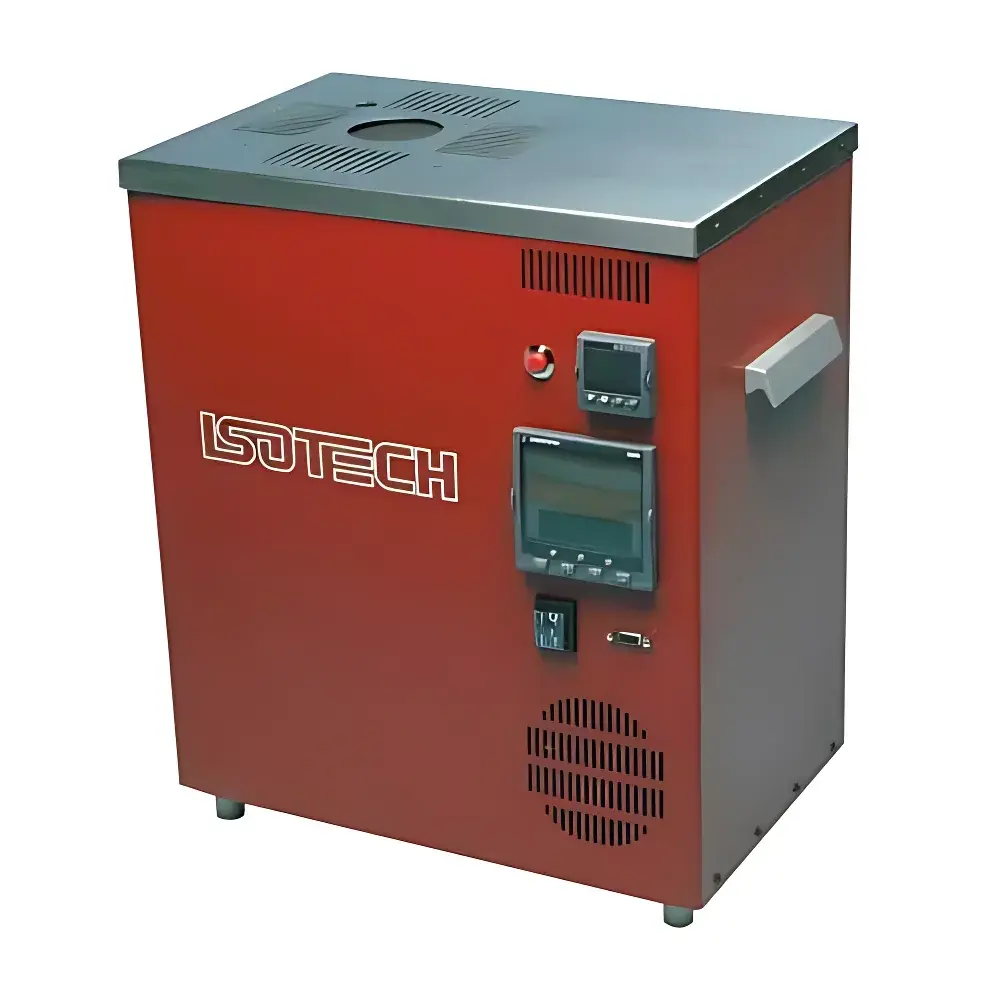
ISOTECH R426 High-Temperature Fixed-Point Blackbody Radiation Source
| Brand | ISOTECH |
|---|---|
| Origin | United Kingdom |
| Model | R426 |
| Type | Fixed-Point Blackbody Furnace |
| Core Technology | Sodium Heat-Pipe Thermal Architecture |
| Compatible Fixed Points | Aluminum (660.323 °C), Silver (961.78 °C), Copper (1084.62 °C) |
| Compliance | Meets ISO/IEC 17025, ASTM E2847, and JJG 856–2015 requirements for radiation thermometry calibration |
| Temperature Uniformity | ≤ ±0.05 K axial gradient across cavity aperture |
| Cavity Emissivity | ≥ 0.9995 (calculated per ISO 8546 and NPL TRA-12) |
| Power Supply Options | 110 V AC / 230 V AC selectable via external transformer |
Overview
The ISOTECH R426 is a high-precision, heat-pipe-based fixed-point blackbody radiation source engineered for primary and secondary calibration of radiation thermometers, infrared thermal imagers, and radiometric sensors in metrology laboratories and national standards institutes. It operates on the principle of thermodynamic equilibrium within a high-emissivity, isothermal cavity—realized through a sodium-filled heat pipe core that delivers exceptional axial temperature uniformity and long-term stability at fixed-point temperatures. Unlike conventional furnace-based blackbodies, the R426 leverages passive heat-pipe conduction to eliminate mechanical stress-induced thermal gradients during ramp-up and soak phases, thereby preserving cavity geometry integrity and minimizing uncertainty contributions from wall-to-core differential expansion. Its design conforms to the physical definition of a blackbody as specified in CIPM Recommendation 2 (2022) and supports traceable realization of the International Temperature Scale of 1990 (ITS-90) at aluminum, silver, and copper fixed points.
Key Features
- Heat-pipe architecture using high-purity sodium working fluid ensures <0.05 K axial temperature gradient across the cavity aperture—critical for low-uncertainty radiance temperature assignment.
- Optimized cavity geometry with conical re-entrant design and gold-plated Inconel walls achieves emissivity ≥ 0.9995, validated via spectral radiance modeling per ISO 8546 and NPL TRA-12 protocols.
- Dual-mode operation: functions both as a fixed-point cell holder (for Al, Ag, Cu) and as a continuously variable high-stability blackbody source (600–1100 °C range).
- Integrated thermal shielding and multi-zone insulation minimize ambient sensitivity and support stable 24-hour soak performance under GLP-compliant laboratory conditions.
- Modular electrical interface supports optional voltage conversion (110 V ↔ 230 V) and integration with programmable temperature controllers compliant with IEC 61508 SIL2 functional safety requirements.
Sample Compatibility & Compliance
The R426 accommodates standard ITS-90 fixed-point cells—specifically aluminum (660.323 °C), silver (961.78 °C), and copper (1084.62 °C)—with mechanical alignment features ensuring repeatable cell insertion depth and radial centering. Its cavity dimensions (Φ25 mm × 120 mm L) comply with ISO/IEC 17025 clause 6.4.4 for calibration equipment suitability, and its radiometric output is certified traceable to NPL and NIST reference standards. The system meets ASTM E2847–22 for infrared thermometer calibration, JJG 856–2015 for blackbody source verification in China, and supports audit readiness for FDA 21 CFR Part 11-compliant environments when paired with validated data acquisition software.
Software & Data Management
While the R426 operates as a hardware-calibrated reference source without embedded firmware, it is fully compatible with third-party metrology software platforms—including Keysight PathWave, Fluke Calibration MET/TEMP II, and custom LabVIEW-based DAQ systems—that implement automated soak monitoring, drift correction algorithms, and uncertainty budgeting per GUM (JCGM 100:2008). All calibration reports generated using the R426 must include cavity temperature uniformity maps, effective emissivity corrections, and spectral radiance uncertainty components—requirements enforced under ISO/IEC 17025:2017 clause 7.8.2 for result reporting.
Applications
- Primary calibration of radiation thermometers used in aerospace engine testing and nuclear fuel rod monitoring.
- Verification of spatial uniformity and temperature accuracy in IR camera systems per ASTM E1933 and IEC 62676-3-2.
- Inter-laboratory comparison studies supporting CIPM MRA signatory obligations.
- Validation of minimum resolvable temperature difference (MRTD) and noise-equivalent temperature difference (NETD) in thermal imaging systems.
- Supporting ISO 13485-certified medical device manufacturers requiring documented traceability for IR fever screening equipment.
FAQ
Does the R426 require active cooling between fixed-point transitions?
No—its sodium heat-pipe design enables natural cooldown with negligible thermal hysteresis; however, forced-air assist is recommended for rapid cycling between Al and Cu points.
Can the R426 be used for non-ITS-90 fixed points such as gold or palladium?
Not without mechanical and thermal recalibration; the cavity geometry and heat-pipe operating envelope are optimized specifically for Al, Ag, and Cu.
Is cavity emissivity user-measurable or factory-characterized only?
Emissivity is factory-characterized via Monte Carlo ray-tracing simulations and verified against NPL reference measurements; users receive full uncertainty budgets with each unit.
What maintenance intervals are recommended for long-term stability?
Annual verification of heat-pipe integrity and cavity surface reflectivity is advised; no consumables or routine recalibration are required under stable environmental conditions.
How does the R426 address thermal expansion effects during fixed-point melting?
The heat-pipe’s axial expansion coefficient is matched to the Inconel cavity liner, and the cell support mechanism decouples radial constraint from axial stress—ensuring cavity geometry remains invariant throughout phase transition.