
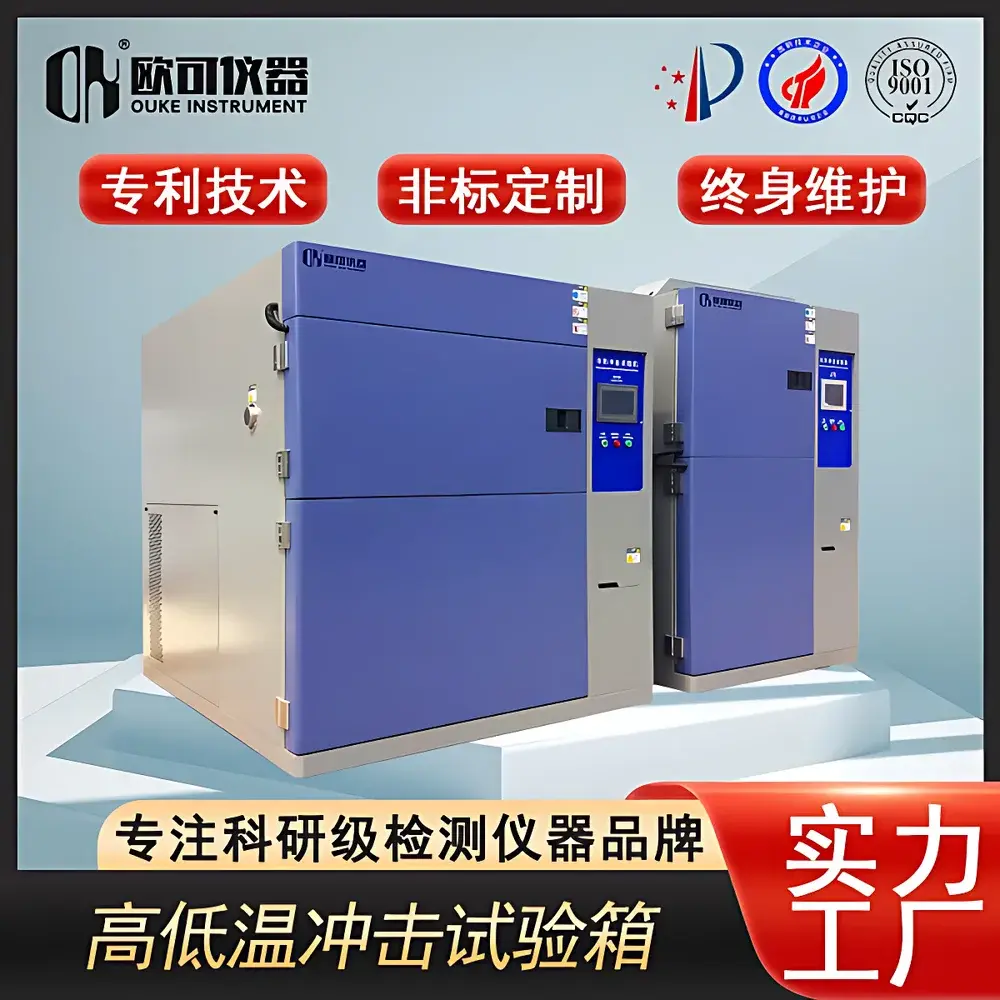
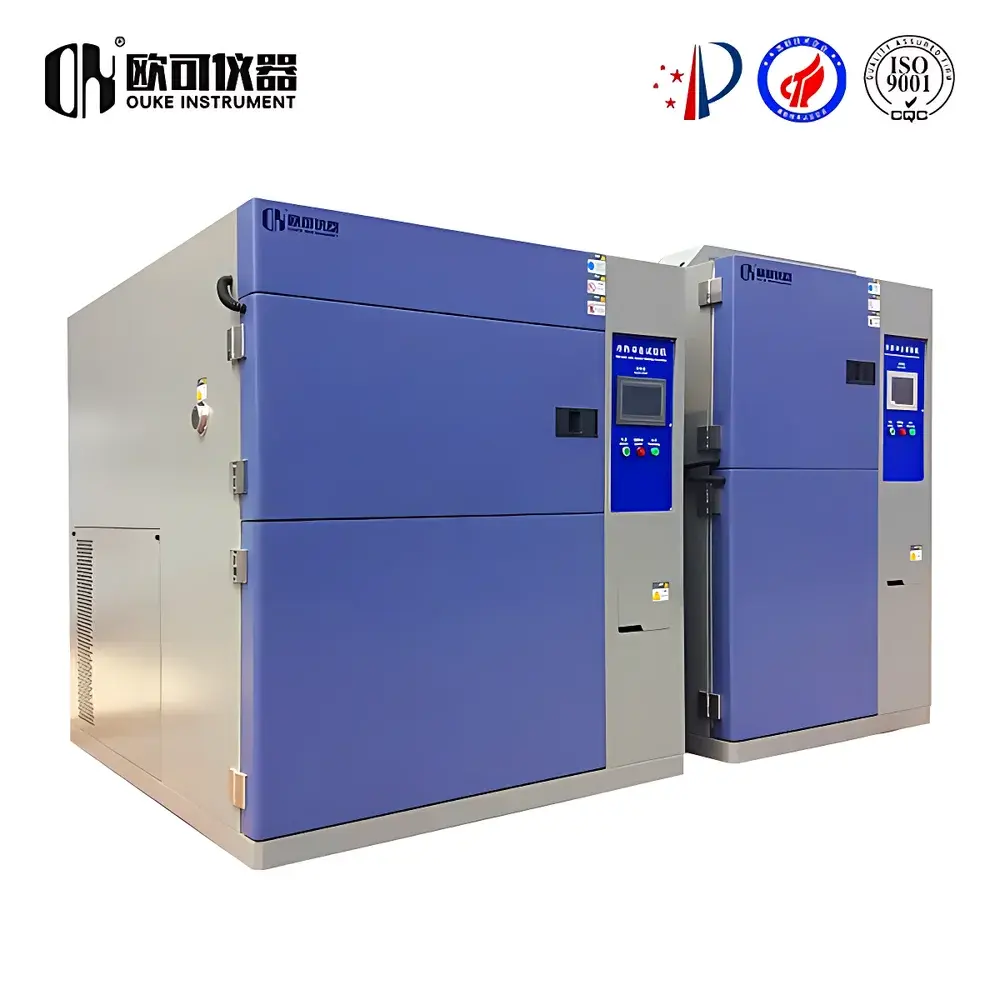
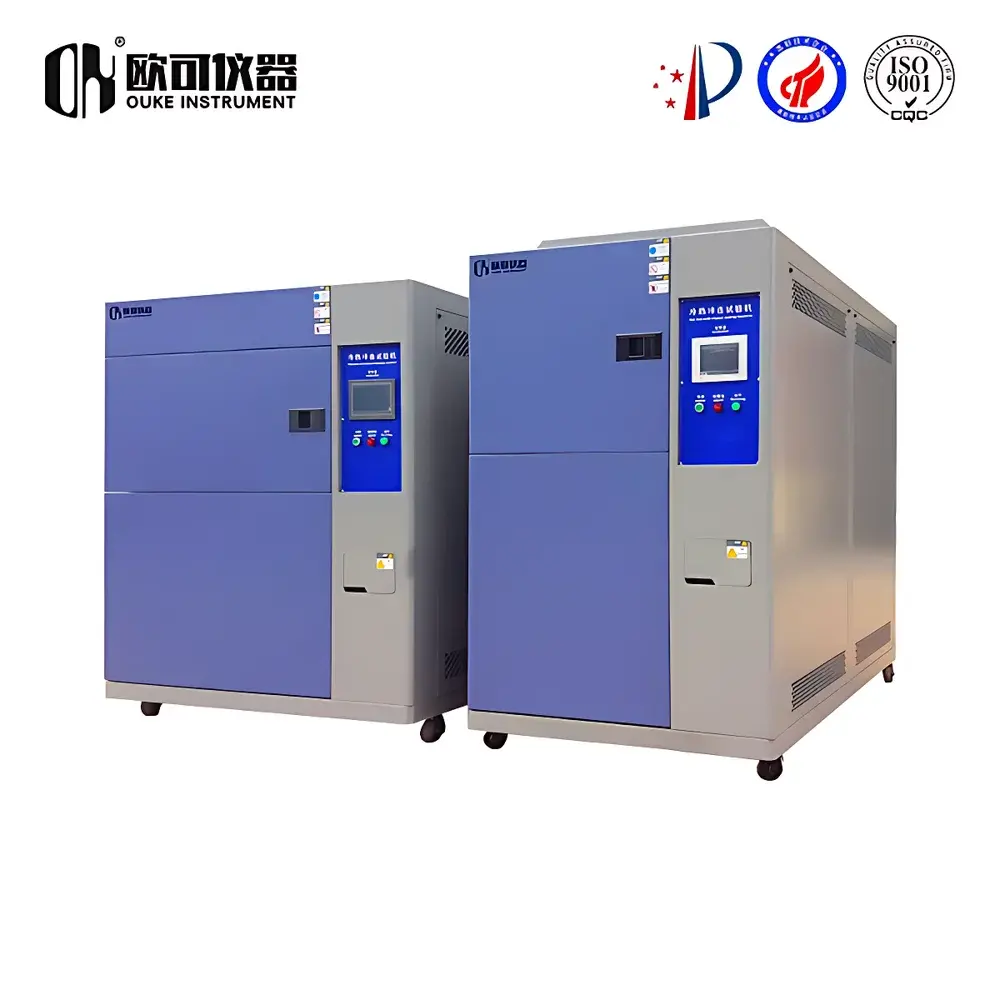
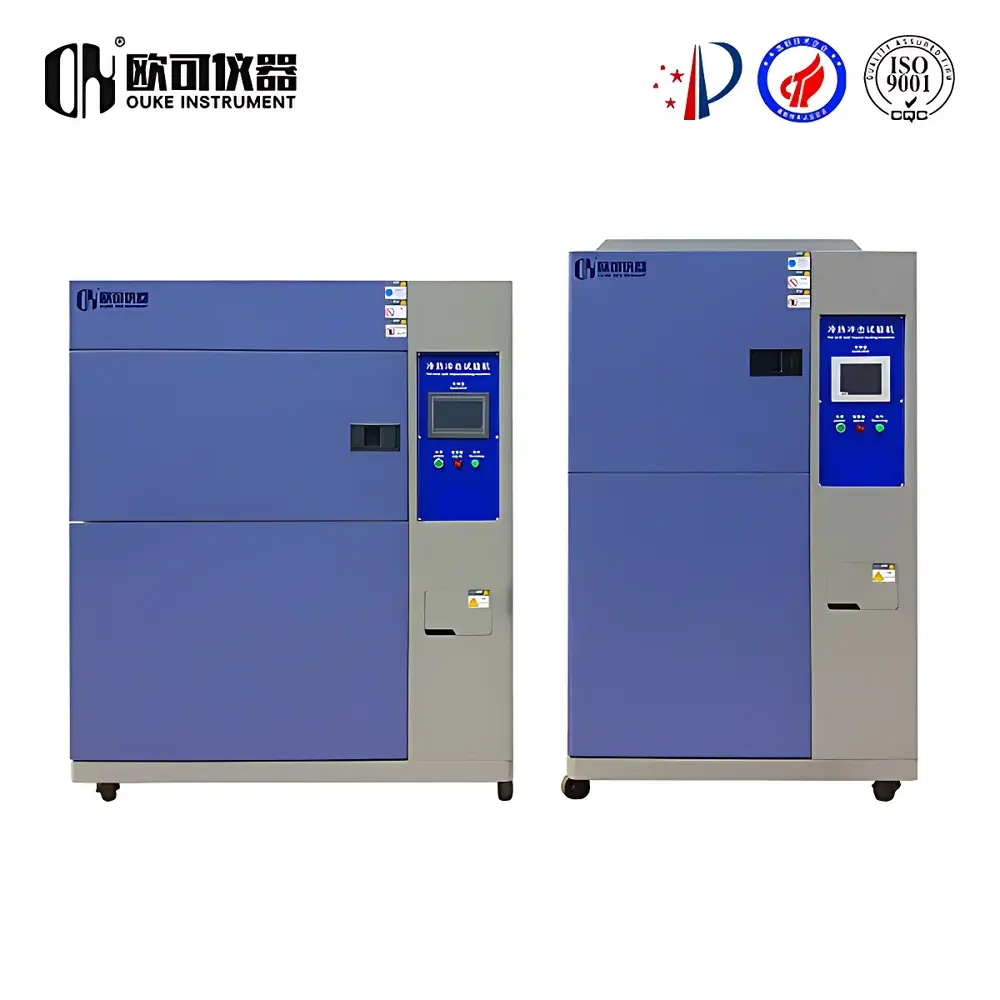
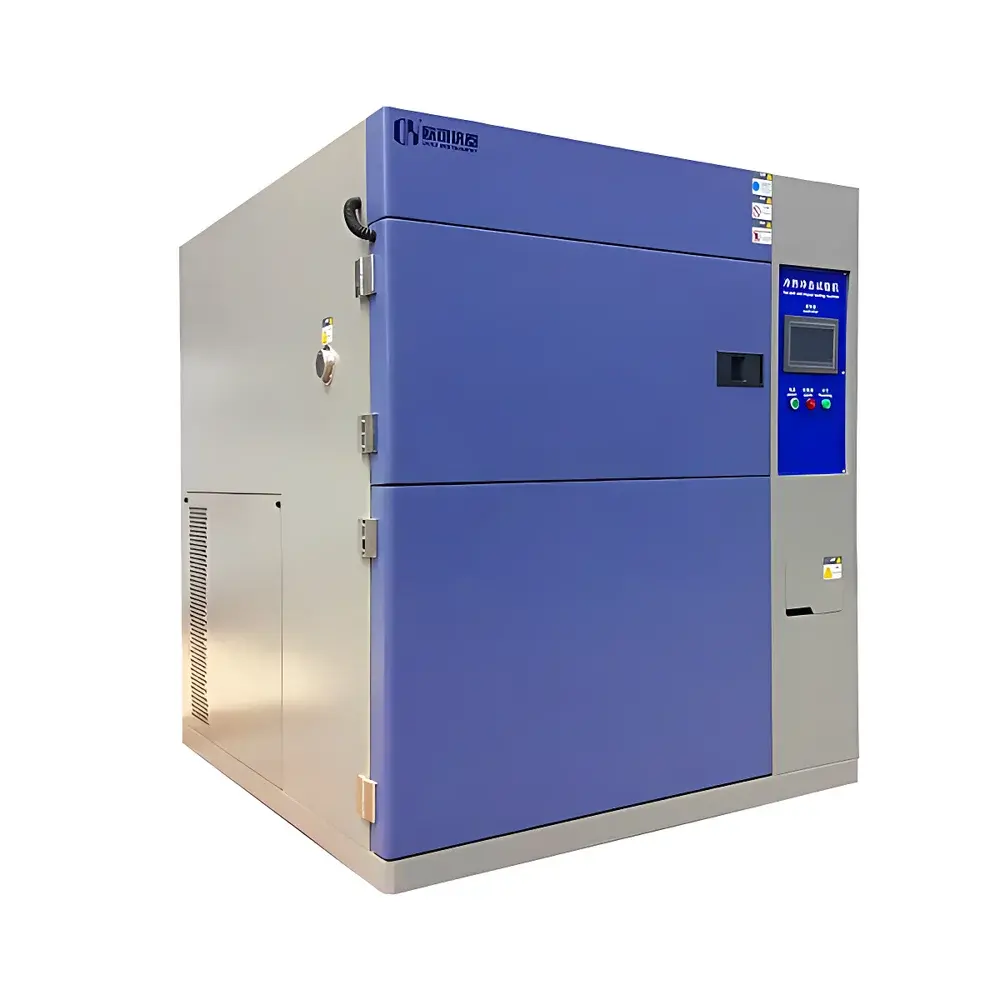
OK-TS-16 Three-Chamber Thermal Shock Test Chamber
| Brand | OK Instruments |
|---|---|
| Origin | Guangdong, China |
| Manufacturer Type | OEM/ODM Manufacturer |
| Country of Origin | China |
| Model | OK-TS-16 |
| High Temperature Range | +150 °C |
| Low Temperature Range | −50 °C |
| Thermal Shock Range | −50 °C to +150 °C |
| Temperature Stability | ±2 °C |
| Heating Rate | 10 °C/min |
| Cooling Rate | 10 °C/min |
Overview
The OK-TS-16 Three-Chamber Thermal Shock Test Chamber is an engineered environmental reliability testing system designed to evaluate material and component integrity under rapid, repetitive transitions between extreme high and low temperature extremes. Unlike two-chamber (basket-transfer) configurations, the OK-TS-16 employs a static-sample architecture: the test specimen remains fixed in the central test chamber at all times, while thermal energy is transferred via high-velocity air exchange through pneumatically actuated isolation dampers connecting to independent hot and cold reservoir chambers. This design eliminates mechanical motion-induced vibration, shock loading, or cable strain—critical for functional testing of powered electronics, PCB assemblies, automotive control units, and sensor modules requiring real-time signal monitoring during thermal transients. The system operates on the principle of convective thermal mass transfer rather than conductive equilibrium, enabling controlled, repeatable shock profiles compliant with international accelerated aging and qualification standards including IEC 60068-2-14, MIL-STD-810H Method 503.5, and GJB 150.5A.
Key Features
- Three-isolated-chamber architecture: dedicated high-temperature chamber (+150 °C), low-temperature chamber (−50 °C), and stationary test chamber—ensuring zero sample displacement during cycling.
- High-speed pneumatic damper system with <5 s chamber-to-chamber switching time, minimizing dwell time outside target temperature bands.
- Cascade refrigeration system utilizing dual-stage compressors and environmentally compliant R404A/R23 refrigerant blends for stable sub-zero operation down to −50 °C.
- Precision PID-controlled electric heating elements with over-temperature cut-off and redundant thermal fuses.
- Stainless steel inner and outer chambers (SUS304) with high-density polyurethane insulation (≥150 mm thickness) for thermal retention and structural rigidity.
- PLC-based control system with 10.4″ color touchscreen HMI, supporting programmable dwell times, cycle counts, ramp rates, and user-defined profile sequencing.
- Comprehensive safety suite: compressor overload protection, phase failure detection, fan motor thermal cutoff, leakage current protection, and door interlock logic.
Sample Compatibility & Compliance
The OK-TS-16 accommodates a broad spectrum of physically constrained and functionally active specimens—including printed circuit boards with attached probes, embedded controllers under power, automotive ECUs with harness interfaces, and aerospace-grade composite coupons. Its static-test configuration meets stringent requirements for tests where mechanical perturbation must be excluded per ISO/IEC 17025-accredited laboratories. The chamber’s thermal performance complies with traceable calibration protocols aligned with ASTM E2293 (Standard Practice for Calibration of Thermal Shock Chambers) and supports documentation for GLP and GMP audit readiness. Temperature uniformity across the working volume is validated per IEC 60068-3-5 (Environmental testing — Part 3-5: Supporting documentation and guidance — Confirmation of the performance of temperature chambers), with stability maintained within ±2 °C during steady-state dwell phases.
Software & Data Management
The embedded control firmware enables full-cycle logging of chamber temperatures (hot/cold/test zones), damper position status, compressor suction/discharge pressures, and heater duty cycles at configurable intervals (1–60 s). Exportable CSV data files include timestamps synchronized to UTC and support post-processing in MATLAB, Python (Pandas), or statistical process control platforms. Optional Ethernet/IP or RS485 Modbus RTU interfaces allow integration into centralized MES or LIMS environments. Audit trail functionality records all parameter modifications, user logins, and alarm events—fully compliant with FDA 21 CFR Part 11 requirements when deployed with electronic signature-enabled access control and password-protected configuration tiers.
Applications
- Electronics reliability validation: solder joint fatigue assessment in IC packages, capacitor dielectric breakdown analysis, and connector contact resistance drift under thermal cycling.
- Automotive component qualification: engine control modules, ADAS sensors, battery management systems, and wiring harnesses subjected to thermal shock per LV-124 or GMW16270.
- Aerospace materials screening: polymer matrix composites, thermal interface materials, and conformal coatings exposed to simulated stratospheric-to-ground thermal gradients.
- Medical device verification: implantable electronics, diagnostic imaging subsystems, and sterilizable enclosures per ISO 13485 environmental stress protocols.
- Research & development: accelerated life modeling of phase-change materials, thin-film adhesion studies, and coefficient-of-thermal-expansion (CTE) mismatch quantification in heterogeneous assemblies.
FAQ
What distinguishes the three-chamber design from two-chamber thermal shock systems?
The OK-TS-16 keeps the test specimen stationary in the central chamber, eliminating mechanical movement-related vibration, misalignment, or connector disengagement—making it suitable for live electrical testing and fragile assemblies.
Does the system support automated test sequencing across multiple temperature profiles?
Yes—the PLC controller allows nested program structures with up to 99 segments per profile, including conditional branching based on elapsed time or temperature thresholds.
How is temperature uniformity verified and maintained over time?
Each unit undergoes factory validation using NIST-traceable PT100 sensors placed at nine standardized locations; routine recalibration follows ISO/IEC 17025 procedures with documented uncertainty budgets.
Can the OK-TS-16 be integrated into an existing laboratory automation infrastructure?
Standard Modbus TCP and optional OPC UA server modules enable bidirectional communication with SCADA, LabVIEW, or custom Python-based orchestration frameworks.
What maintenance intervals are recommended for sustained performance?
Condenser coil cleaning every 3 months, refrigerant pressure verification semiannually, and damper actuator lubrication annually—detailed in the included maintenance logbook and supported by remote diagnostics via OK Instruments’ service portal.



