
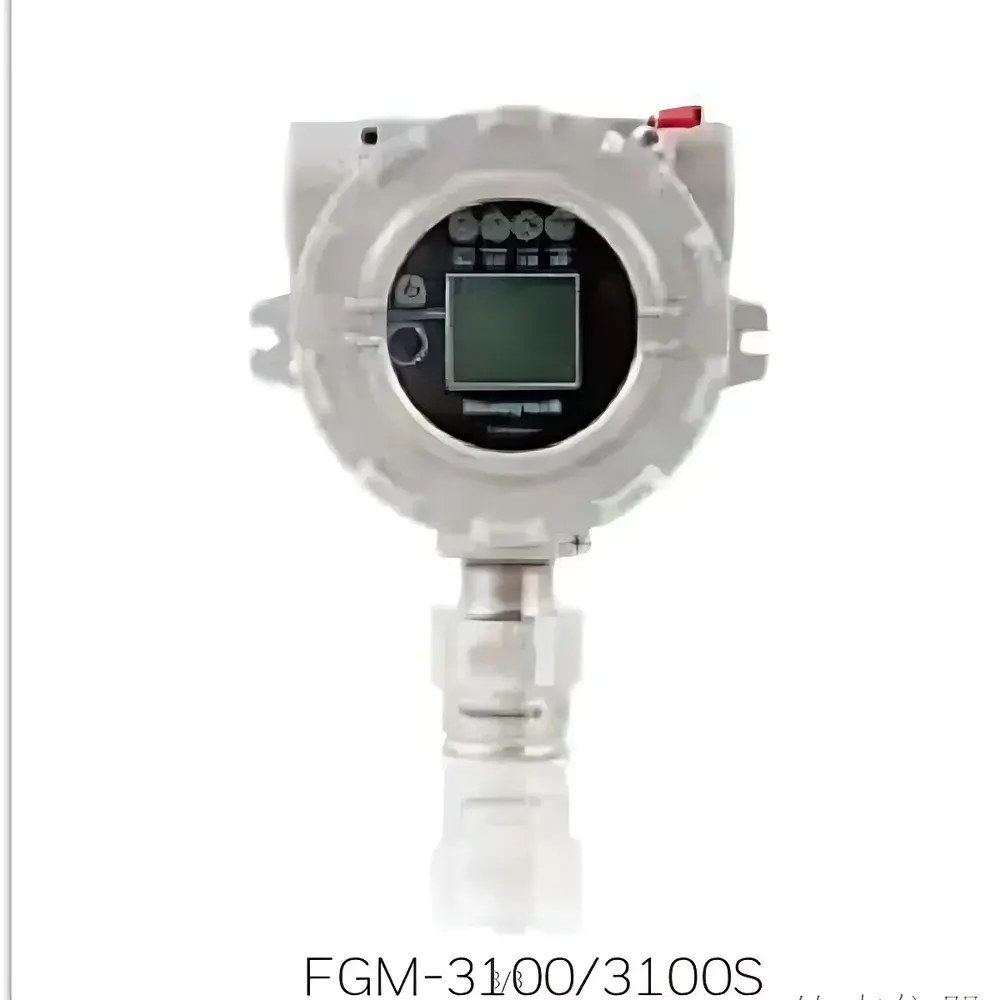
Honeywell RAEAlert Series Point-Type Combustible and Toxic Gas Detector
| Brand | Honeywell |
|---|---|
| Origin | USA |
| Model | RAEAlert Series |
| Detection Principle | Catalytic Bead (Combustible) / Electrochemical (Toxic) |
| Sampling Method | Diffusion |
| Power Supply | 24 VDC (9–28 VDC for combustible |
| Max. Power Consumption | 170 mA @ 24 VDC (combustible), 80 mA @ 24 VDC (toxic) |
| Output Signals | 4–20 mA (field-adjustable), RS485 Modbus RTU (optional), HART 7.2 (optional), 3-channel passive relay (optional) |
| Relay Rating | 30 VDC / 5 A, SPDT, configurable NO/NC |
| Display | 128 × 96 dot-matrix LCD with icon-based UI, 1 status LED + 4 function LEDs |
| Enclosure Material | Aluminum / Stainless Steel |
| IP Rating | IP66 |
| Explosion Protection | Ex d IIC T6 Gb / Ex tD A21 IP66 T80°C (combustible) |
| Fire Certification | CCCF |
| Metrology Approval | CPA |
| Functional Safety | SIL2 per IEC 61508 |
| Operating Temperature | −40°C to +70°C |
| Operating Humidity | 0–95% RH (non-condensing) |
| Pressure Range | 86–106 kPa |
| Dimensions (H×W×D) | 182 × 195 × 107 mm |
| Weight | 1.5 kg (aluminum) / 3.5 kg (stainless steel) |
| Mounting | 2-inch pipe or wall-mount |
| Electrical Entry | 3/4" NPT male |
Overview
The Honeywell RAEAlert Series is a field-proven, fixed-point gas detection platform engineered for continuous, reliable monitoring of combustible and toxic gases in demanding industrial environments. Designed around dual-sensor architecture—catalytic bead (CB) sensors for hydrocarbon-based combustible gases (e.g., methane, propane, hydrogen) and electrochemical (EC) sensors for toxic species (e.g., CO, H₂S, Cl₂, SO₂, NO₂, NH₃)—the detector operates via diffusion sampling without mechanical aspiration, minimizing maintenance and power requirements. Its intrinsic safety and flameproof construction comply with global hazardous area classification standards, enabling deployment in Zone 1/2 (gas) and Zone 21/22 (dust) locations per IEC 60079 and IEC 61241. The device functions as a standalone sensor node or integrates seamlessly into larger safety instrumented systems (SIS), distributed control systems (DCS), or programmable logic controllers (PLC), supporting both analog and digital communication protocols required for modern process safety architectures.
Key Features
- Modular sensor design enables tool-free, hot-swappable replacement—no system shutdown or calibration recalibration required upon sensor change.
- Integrated temperature and zero-point compensation algorithms maintain measurement stability across wide ambient ranges (−40°C to +70°C) and mitigate drift due to thermal gradients or aging.
- Field-configurable 4–20 mA output with micro-adjustment capability allows precise span/zero tuning without opening the enclosure—reducing exposure risk during commissioning or routine verification.
- Infrared remote interface supports full parameter configuration, alarm setpoint adjustment, and diagnostic review without physical access—enhancing personnel safety during maintenance in classified zones.
- Dual-certified explosion protection: Ex d IIC T6 Gb for combustible models and Ex d ia IIC T4 Gb for toxic variants, each paired with Ex tD A21 IP66 dust-ignition-proof housing rated for surface temperatures ≤80°C or ≤130°C respectively.
- Robust mechanical design includes IP66-rated ingress protection, corrosion-resistant aluminum or optional stainless-steel housing, and NPT-threaded conduit entries for secure cable management in outdoor or washdown environments.
- SIL2 certification per IEC 61508 confirms suitability for use in safety-related applications up to Safety Integrity Level 2, including burner management and emergency shutdown loops.
Sample Compatibility & Compliance
The RAEAlert Series supports over 30 target gases across calibrated configurations, with individual sensor modules optimized for selectivity, cross-interference rejection, and long-term baseline stability. Combustible sensors feature poison-resistant catalyst formulations effective against silicones, sulfides, and halogenated compounds. Toxic EC sensors employ proprietary electrolyte formulations and membrane structures to minimize humidity sensitivity and extend service life beyond 24 months under typical operating conditions. All units meet mandatory regulatory requirements including China’s CCCF fire product certification and CPA (China Metrology Accreditation). Additional international conformity includes ATEX, IECEx, UKCA, and UL/cULus Class I Division 1 listings where applicable. Electromagnetic compatibility conforms to EN 61326-1 (industrial environment) and EMC Directive 2014/30/EU.
Software & Data Management
While the RAEAlert operates autonomously without embedded software, its digital interfaces support integration with Honeywell’s Connected Plant ecosystem and third-party asset management platforms via Modbus RTU over RS485. Optional HART 7.2 capability enables bidirectional communication for remote diagnostics—including sensor health status, accumulated exposure time, fault logs, and calibration history—fully traceable for GLP/GMP audit compliance. Relay outputs provide hardwired fail-safe actuation signals compatible with legacy annunciator panels or fire alarm control units. All configuration changes are timestamped and stored locally, satisfying data integrity requirements under FDA 21 CFR Part 11 when deployed in pharmaceutical or food processing facilities.
Applications
Typical deployment scenarios include refinery flare stack monitoring, LNG terminal vapor detection, chemical reactor off-gas analysis, wastewater treatment plant H₂S surveillance, semiconductor fab cleanroom toxics control, and offshore platform bilge gas supervision. The detector is also specified in NFPA 72-compliant fire alarm systems where combustible gas presence triggers pre-alarm notification prior to fire initiation. Its compact footprint and dual mounting options (2-inch pipe or wall bracket) facilitate retrofitting into existing infrastructure without major civil modifications.
FAQ
What gas types can the RAEAlert Series detect?
It supports catalytic bead detection of combustible gases (e.g., CH₄, C₃H₈, H₂) and electrochemical detection of common toxic gases including CO, H₂S, Cl₂, SO₂, NO₂, NH₃, PH₃, and O₂ deficiency/enrichment.
Is field calibration possible without opening the housing?
Yes—using the optional infrared remote controller, users can perform zero calibration, span adjustment, and alarm threshold modification while maintaining explosion-proof integrity.
Does the device support redundant signal transmission?
Yes—simultaneous 4–20 mA analog output and RS485 Modbus RTU digital output allow parallel connection to both DCS and independent safety PLCs for layered protection.
What is the expected service life of the sensors?
Catalytic bead sensors typically last 3–5 years depending on exposure profile; electrochemical sensors are rated for ≥24 months under normal operating conditions and are individually replaceable.
Can this detector be used in outdoor installations?
Yes—the IP66-rated enclosure, wide temperature range (−40°C to +70°C), and UV-stabilized materials make it suitable for unsheltered outdoor mounting, including marine and desert environments.
Related Products







