
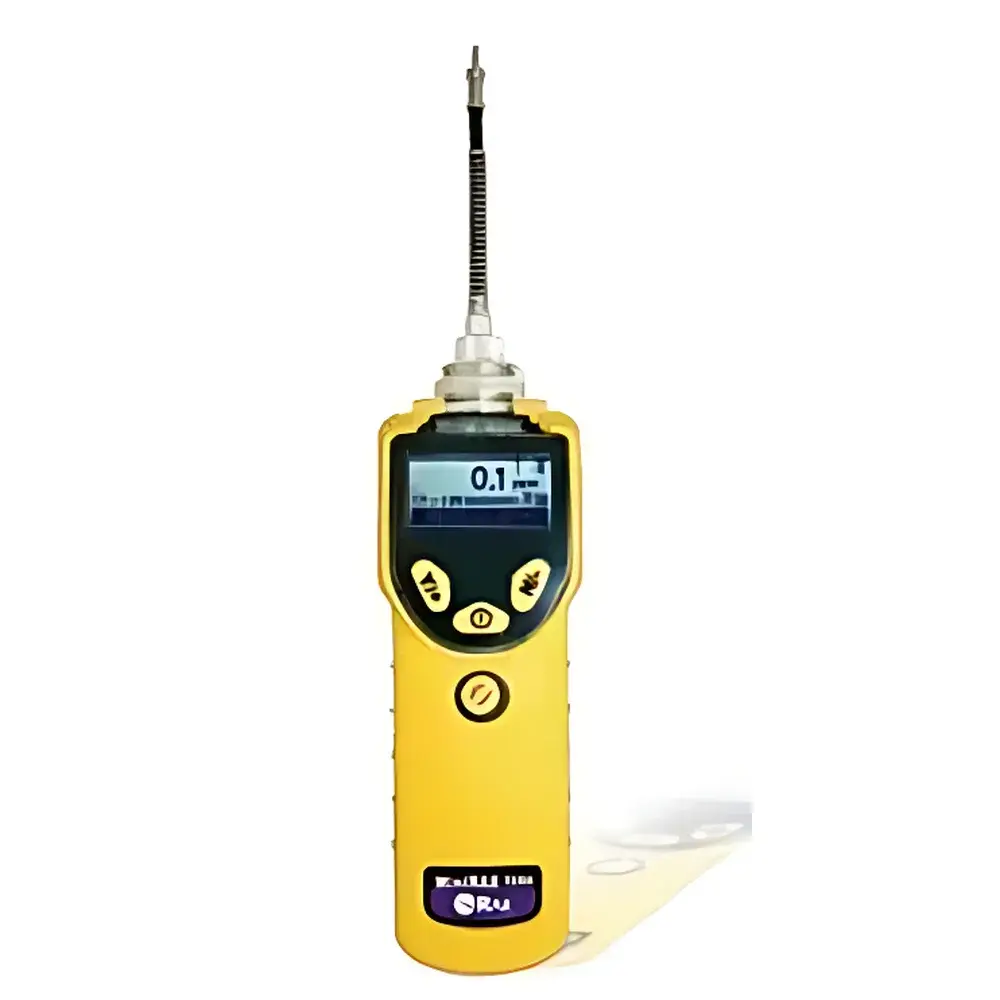
RAE Systems MiniRAE 3000 Portable VOC Detector with Third-Generation PID Sensor
| Brand | RAE Systems Inc. |
|---|---|
| Origin | USA |
| Instrument Type | Portable Gas Detector |
| Detection Principle | Photoionization Detection (PID) |
| Detection Range | 0.1–15,000 ppm (isobutylene-equivalent) |
| Resolution | 0.1 ppm |
| Accuracy | ±3% of reading |
| Response Time (T90) | <2 s |
| Sampling Method | Integrated high-performance pump with optional 30 m sampling hose |
| Environmental Compensation | Integrated temperature, humidity, and barometric pressure sensors with auto-compensation algorithm |
| Communication | Built-in Bluetooth 4.0 or optional 802.11 Wi-Fi module |
| Display | Backlit graphical LCD with multilingual UI (including English, Spanish, French, German, Chinese) |
| Gas Library | Preloaded database covering >2,000 VOCs and selected inorganic compounds |
| Certifications | ATEX II 2G Ex ib IIB T4 Gb, IECEx ib IIB T4 Gb, UL 913 Class I, Division 1, Groups B, C, D, CSA C/US Class I, Div. 1, Groups B, C, D |
Overview
The RAE Systems MiniRAE 3000 (Model PGM-7320) is a high-performance, handheld volatile organic compound (VOC) detector engineered for real-time, field-deployable monitoring across industrial hygiene, emergency response, environmental site assessment, and process safety applications. At its core lies a third-generation photoionization detector (PID) featuring a 10.6 eV krypton lamp—optimized for broad-spectrum ionization of VOCs while minimizing fragmentation and baseline drift. Unlike flame ionization detectors (FIDs), which require hydrogen fuel and elevated operating temperatures, the PID-based MiniRAE 3000 delivers rapid, non-destructive, and intrinsically safe detection at ambient conditions. Its measurement principle relies on UV photon-induced ionization of gas-phase molecules with ionization potentials (IP) below 10.6 eV, generating a proportional current signal that is linearly correlated to concentration across calibrated ranges. This enables quantitative analysis of aliphatic hydrocarbons, aromatics, ketones, esters, amines, and many chlorinated solvents—without requiring compound-specific calibration gases for initial screening.
Key Features
- Third-generation 10.6 eV PID sensor with patented self-cleaning UV lamp technology—maintains stable photon flux and extends lamp service life by reducing window fouling from condensables and particulates.
- Ultra-fast response: T90 ≤ 2 seconds across full dynamic range (0.1–15,000 ppm isobutylene-equivalent), enabling real-time plume mapping and leak localization.
- Integrated dual-mode sampling: High-flow internal pump (≥300 mL/min) with pressure-compensated flow control; supports extended remote sampling via 30 m conductive PTFE-lined tubing without signal attenuation or lag.
- Real-time environmental compensation: Onboard temperature, relative humidity, and barometric pressure sensors feed adaptive algorithms that correct for density, diffusion, and ion recombination effects—ensuring metrological traceability under variable field conditions.
- Wireless telemetry architecture: Standard Bluetooth 4.0 Low Energy (BLE) interface; optional IEEE 802.11 b/g/n Wi-Fi module enables secure TLS-encrypted streaming to RAE’s MultiRAE Pro cloud platform or local incident command systems.
- Intuitive multilingual interface: 128 × 128 pixel backlit graphical LCD with context-sensitive soft keys, configurable alarm thresholds, and data logging (up to 12 months at 1-second intervals).
Sample Compatibility & Compliance
The MiniRAE 3000 detects over 2,000 VOCs listed in its embedded chemical library—including benzene, toluene, xylene (BTX), styrene, acetone, methanol, chloroform, and vinyl chloride—using isobutylene as the primary calibration reference per ASTM D5403 and ISO 16000-18. It complies with international intrinsic safety standards for hazardous locations: ATEX II 2G Ex ib IIB T4 Gb, IECEx ib IIB T4 Gb, UL 913 Class I, Division 1, Groups B, C, D, and CSA C/US Class I, Div. 1, Groups B, C, D. For regulatory reporting, raw sensor output and compensated concentration values are timestamped and stored with audit-trail metadata—supporting GLP-aligned data integrity requirements per FDA 21 CFR Part 11 when used with validated RAE software workflows.
Software & Data Management
Instrument configuration, firmware updates, and historical data retrieval are managed via RAE’s proprietary MultiRAE Pro Desktop Suite (Windows/macOS). The software enables batch export to CSV, PDF report generation with customizable templates, spectral trend overlays, and integration with enterprise EHS platforms via OPC UA or RESTful API. Logged data includes sensor voltage, compensated ppm, environmental parameters, pump status, battery level, and operator ID—each record digitally signed to prevent post-acquisition modification. Optional cloud synchronization provides role-based access control, geotagged event mapping, and automated alert escalation via SMS/email.
Applications
- Industrial hygiene surveys: Personal exposure monitoring (PEL/STEL/TWA) in petrochemical refineries, paint manufacturing, semiconductor cleanrooms, and pharmaceutical production suites.
- Environmental site assessment: Soil vapor intrusion screening, landfill perimeter monitoring, and brownfield remediation verification per EPA Method TO-15 and ASTM D6196.
- Emergency response: Rapid hazard identification during chemical spills, confined space entry pre-testing, and hazmat incident triage under NFPA 472 protocols.
- Process safety: Continuous leak detection around flanges, valves, and pumps in accordance with OSHA PSM and EPA Risk Management Program (RMP) guidelines.
- Indoor air quality (IAQ) auditing: Source identification of off-gassing materials, cleaning agents, and adhesives in commercial buildings and schools.
FAQ
What calibration standards are recommended for routine verification?
Isobutylene (C4H8) at 100 ppm in nitrogen is the primary span gas per manufacturer specifications; zero air must meet ISO 8573-1 Class 1 purity requirements.
Can the MiniRAE 3000 quantify individual compounds in a multi-component vapor mixture?
No—it reports total VOC concentration as isobutylene-equivalent ppm; compound-specific quantification requires GC-PID or GC-MS confirmation.
How often does the UV lamp require replacement under typical field use?
The lamp has a rated lifetime of ≥12,000 hours; the self-cleaning function extends operational stability between maintenance cycles.
Is the instrument compatible with third-party data acquisition systems?
Yes—via Modbus RTU over Bluetooth serial profile or HTTP POST to REST endpoints when configured with Wi-Fi option.
Does the device support bump testing prior to each shift?
Yes—integrated quick-test mode verifies sensor response, pump function, and alarm activation using a 10-ppm isobutylene challenge gas.







