ISOTECH Liquid Nitrogen Comparator Model 461
| Brand | ISOTECH |
|---|---|
| Origin | United Kingdom |
| Model | 461 |
| Power Requirement | None |
| Operating Medium | Liquid Nitrogen (LN₂) |
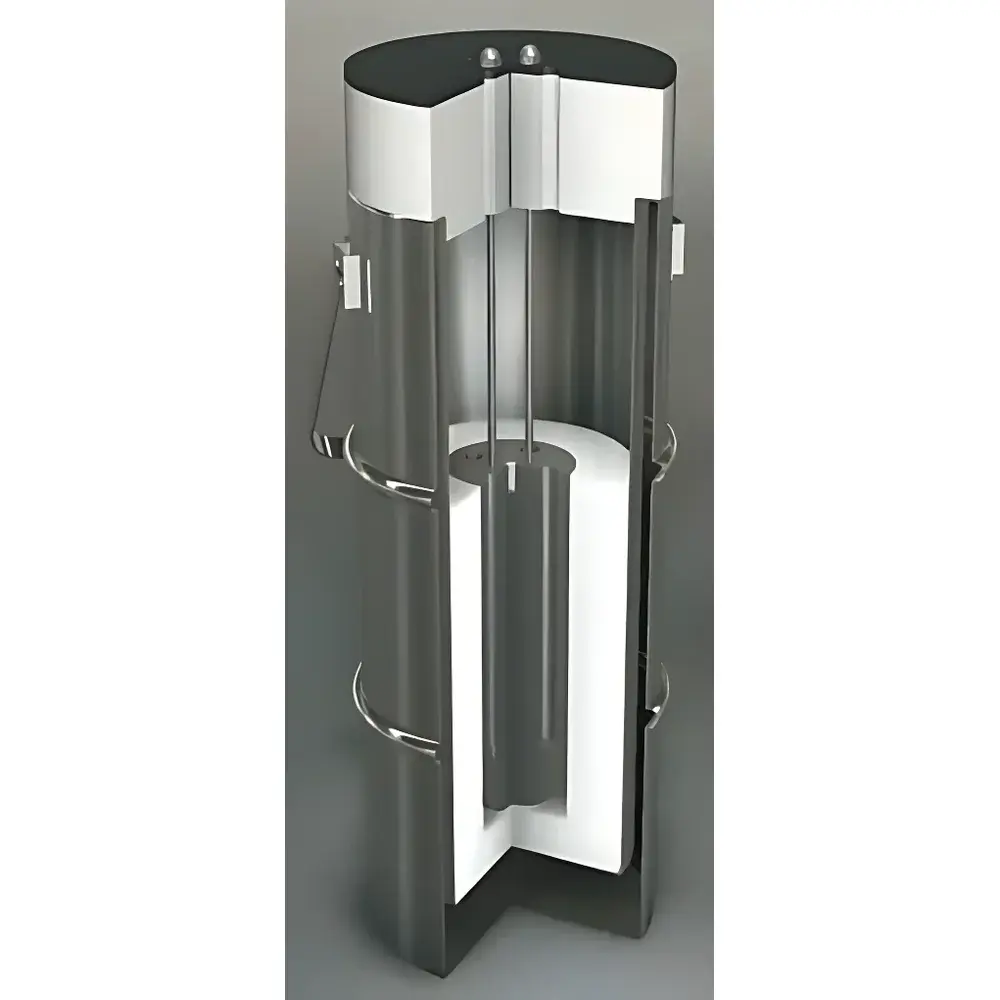
| Construction | Stainless Steel Dewar Vessel with Insulated Lid |
| Calibration Reference Temperature | −196 °C (77 K) |
| Temperature Uniformity | ±0.05 °C (within central 25 mm axial zone, after thermal stabilization) |
| Probe Compatibility | Standard 6–8 mm diameter stem thermometers (glass, platinum resistance, thermocouple, or digital sensors) |
| Compliance | Designed in accordance with ISO/IEC 17025:2017 requirements for reference standards used in thermometer calibration |
Overview
The ISOTECH Liquid Nitrogen Comparator Model 461 is a passive, cryogenic reference standard engineered for high-accuracy interim verification and field calibration of contact temperature sensors at the liquid nitrogen triple point (−195.8 °C, nominally −196 °C). Unlike active dry-well calibrators or bath-based systems, the Model 461 operates on the principle of phase-change temperature stability: when maintained under saturated liquid nitrogen conditions, the comparator provides a highly reproducible and spatially uniform thermal environment governed by the thermodynamic equilibrium between LN₂ liquid and its vapor phase. This physical invariant serves as a primary reference point traceable to the International Temperature Scale of 1990 (ITS-90), enabling direct comparison calibration without external power, refrigeration, or control electronics. Its design prioritizes metrological integrity in environments where portability, intrinsic safety, and operational simplicity are critical—such as cryogenic laboratory audits, pharmaceutical cold-chain validation support, aerospace sensor qualification, and national metrology institute outreach programs.
Key Features
- Passive operation: No electrical supply, heating elements, or moving parts—eliminates electromagnetic interference and reduces failure modes.
- Stainless steel vacuum-insulated Dewar vessel ensures extended hold time (>4 hours typical with full fill) and mechanical robustness for transport and benchtop use.
- Integrated insulated lid with precision-machined thermometer insertion ports (four 6.5 mm bores, depth-adjustable via threaded collar) minimizes evaporative heat ingress and maintains vertical temperature gradient ≤0.03 °C/cm within the central calibration zone.
- Thermal mass optimization allows stabilization to steady-state within 15–20 minutes after LN₂ refill, verified by internal reference sensor monitoring (optional accessory).
- Compliant with ISO 5725 (accuracy, repeatability, reproducibility) and supports uncertainty budgets per GUM (JCGM 100:2008) when used with certified reference thermometers.
Sample Compatibility & Compliance
The Model 461 accommodates a broad range of industrial and laboratory-grade temperature probes, including mercury-in-glass thermometers (ASTM E1, ISO 4885), Pt100 and Pt1000 RTDs (IEC 60751), Type T and Type K thermocouples (IEC 60584), and digital thermistors with rigid stems ≤8 mm OD. Sensor immersion depth is adjustable to meet ISO/IEC 17025 clause 6.4.3 requirements for adequate immersion (minimum 15× probe diameter or 75 mm, whichever is greater). The comparator itself is not a certified reference standard but functions as a transfer standard compliant with EURAMET cg-18 (Guidelines on the Calibration of Thermometers) and supports GLP/GMP audit readiness when documented within a validated calibration procedure (e.g., SOP-TEMP-042). Traceability is established through co-calibration with NIST-traceable reference thermometers or participation in interlaboratory comparisons accredited to ISO/IEC 17043.
Software & Data Management
As a purely passive device, the Model 461 does not incorporate embedded firmware, connectivity interfaces, or onboard data logging. Calibration records—including LN₂ fill date/time, ambient pressure, stabilization duration, reference thermometer readings, unit-under-test (UUT) deviations, and operator identification—are maintained externally using laboratory information management systems (LIMS) or paper-based logbooks compliant with FDA 21 CFR Part 11 (when electronic) or ISO/IEC 17025 clause 7.5. All documentation must retain raw observation sheets, uncertainty calculations, and evidence of environmental monitoring (e.g., barometric pressure, room temperature) to satisfy accreditation body requirements for measurement traceability and audit defensibility.
Applications
- Interim verification of cryogenic temperature sensors prior to and following critical process runs in biopharmaceutical storage facilities (e.g., −150 °C vapor-phase LN₂ freezers).
- On-site calibration support for aerospace test stands requiring rapid validation of thermocouple arrays in propulsion system ground testing.
- Educational demonstration of ITS-90 fixed points and phase-equilibrium thermometry principles in metrology training courses.
- Reference checks for portable dry-block calibrators operating near −100 °C, verifying thermal drift and axial uniformity claims.
- Supporting ISO 13485-compliant temperature mapping studies in cryogenic warehouse validation protocols.
FAQ
What is the recommended minimum immersion depth for a probe during calibration?
Minimum immersion is 75 mm or 15× the probe’s sheath diameter—whichever is greater—to minimize stem conduction error. The Model 461’s calibrated zone extends from 30 mm to 80 mm below the lid surface.
Can the comparator be used with liquid nitrogen containing impurities?
No. Only ≥99.999% purity liquid nitrogen should be used; oxygen or moisture contamination alters the saturation temperature and introduces hysteresis, violating ITS-90 assumptions.
Is periodic recalibration of the comparator itself required?
The comparator has no active components to calibrate; however, its geometric integrity and insulation performance should be verified annually per manufacturer-recommended inspection protocol (e.g., hold-time test, bore concentricity check).
Does ISOTECH provide NIST-traceable calibration certificates for this unit?
ISOTECH supplies a Certificate of Conformance (CoC) with each unit. Optional third-party calibration with NIST-traceable reference thermometers is available through ISO/IEC 17025-accredited laboratories.
How is temperature uniformity verified across the calibration zone?
Uniformity is characterized during type testing using multi-point platinum resistance thermometer (PRT) scans per ASTM E740 and reported in the technical datasheet; end users may verify it periodically using a calibrated multi-sensor probe array.