
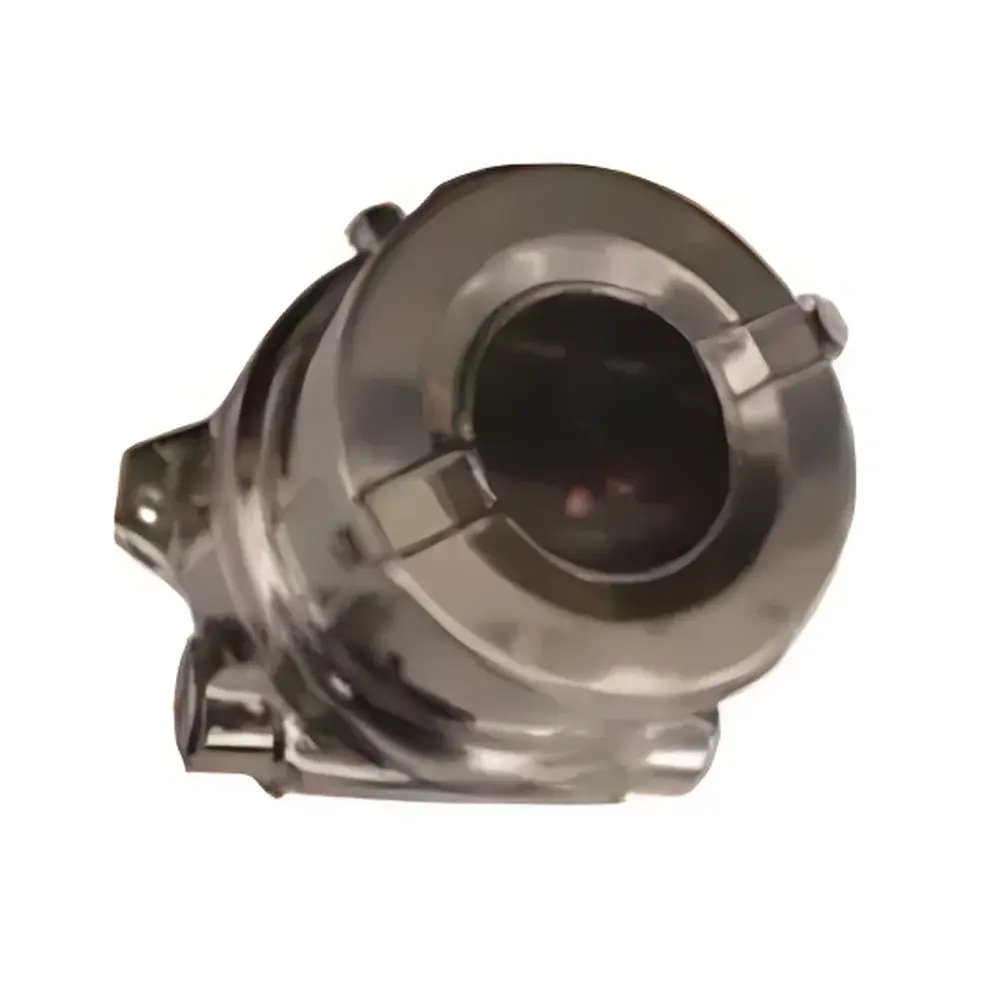
BW FS24X Triple-IR + Visible Light Multi-Spectral Flame Detector
| Brand | BW |
|---|---|
| Origin | Canada |
| Manufacturer Type | Authorized Distributor |
| Origin Category | Imported |
| Model | FS24X |
| Pricing | Upon Request |
Overview
The BW FS24X is a certified multi-spectral flame detector engineered for high-reliability fire detection in demanding industrial environments. It employs a tri-band infrared (IR) and visible light sensing architecture—comprising broadband IR (1–5 µm), narrowband IR centered at 4.3 µm (optimized for CO2 emission signature of hydrocarbon fires), and visible-light (0.4–0.7 µm) detection—to deliver robust, physics-based flame discrimination. Unlike single-band or dual-IR detectors, the FS24X leverages spectral correlation across three independent optical channels to distinguish true flame radiation from transient thermal noise, hot surfaces, welding arcs, sunlight reflections, and modulated artificial lighting. Its detection principle is rooted in radiometric analysis of time-synchronized, wavelength-resolved intensity patterns—enabling reliable identification of flicker frequency (typically 1–25 Hz), spectral ratio signatures, and spatial coherence—all critical parameters defined in UL 268A, EN 54-10, and IEC 61508 SIL2-compliant fire detection systems.
Key Features
- Triple-spectrum sensing: Broadband IR + 4.3 µm CO2-band IR + visible-light channel for multi-parameter flame validation
- Dual microprocessor architecture: Primary processor handles real-time signal sampling (≥1 kHz), FFT-based flicker analysis, and spectral ratio computation; secondary processor manages self-diagnostics, event logging, and communication stack
- FirePic™ event recording: Non-volatile memory stores pre-alarm sensor waveforms (up to 30 seconds prior to alarm activation), timestamped with internal RTC (real-time clock) compliant with ISO/IEC 17025 traceability requirements
- Real-Time Graphing (RTG™): Outputs raw, unprocessed analog waveforms via 4–20 mA (sourcing/sinking selectable) or digital RS-485 Modbus RTU for integration into DCS/SCADA platforms
- 110° conical field-of-view with adjustable sensitivity levels (4 preset thresholds) to accommodate varying ambient IR background conditions
- Automatic optical path and electronic self-test performed every 24 hours per EN 54-10 Clause 6.4.2, including LED intensity verification and photodiode response calibration
- Robust environmental operation: Rated for –40 °C to +70 °C ambient temperature; IP66 ingress protection; EMI immunity per IEC 61000-4-3 (10 V/m, 80 MHz–2 GHz) and IEC 61000-4-4 (±2 kV EFT)
Sample Compatibility & Compliance
The FS24X is validated for detection of hydrocarbon (e.g., propane, heptane, diesel) and non-hydrocarbon (e.g., hydrogen, methanol, sulfur-containing) flames under real-world industrial conditions—including outdoor exposure, high-humidity zones, and areas with mechanical vibration. It meets FM Class I, Division 1, Groups B, C, D; ATEX II 2G Ex db IIB T4 Gb; IECEx Ex db IIB T4 Gb; and CE marking under the EU Machinery Directive 2006/42/EC and EMC Directive 2014/30/EU. All firmware and configuration data are stored with write-protected checksums to satisfy audit requirements under ISO 9001:2015 clause 8.5.2 and FDA 21 CFR Part 11 (when used in pharmaceutical manufacturing facilities with validated control systems).
Software & Data Management
Configuration and diagnostics are performed via Modbus RTU over RS-485 using standard register mapping (0x0001–0x00FF), enabling seamless integration with third-party HMI/PLC systems without proprietary software dependencies. FirePic™ logs include UTC-stamped sensor voltage traces, alarm cause codes (e.g., “4.3 µm dominance”, “visible-light correlation failure”), and system health flags—all exportable as CSV for forensic fire investigation. Firmware updates are digitally signed and require dual-password authentication to prevent unauthorized modification, supporting integrity verification per NIST SP 800-53 RA-5.
Applications
The FS24X is deployed in oil & gas refineries (tank farms, flare stacks, compressor stations), chemical processing plants (reactor zones, distillation units), power generation facilities (turbine halls, fuel storage), offshore platforms, and aviation fuel depots. Its extended 200-ft (61 m) detection range for a 1 ft² (0.093 m²) heptane fire source—validated per UL 268A Annex D—makes it suitable for large-volume, high-ceiling spaces where point-type smoke detectors exhibit delayed response. The modularity supports retrofit into legacy fire alarm panels via 4–20 mA interface, while its low power consumption (<1.2 W standby) enables solar-battery operation in remote monitoring sites.
FAQ
What flame types does the FS24X reliably detect?
It detects hydrocarbon flames (e.g., methane, gasoline, jet fuel) and non-hydrocarbon flames (e.g., hydrogen, ammonia, phosphorus-based combustion) by analyzing CO2 emission bands, broadband thermal radiation, and visible flicker—without requiring ionization or UV components.
Is the FS24X compatible with existing fire alarm control panels (FACPs)?
Yes—via configurable 4–20 mA analog output (with alarm/fault status encoding) or Modbus RTU over RS-485, supporting integration with Siemens Desigo, Honeywell EXCEL, and Schneider Quantum PLC platforms.
How does the dual-processor architecture reduce false alarms?
The primary processor executes real-time spectral ratio algorithms and flicker frequency analysis, while the secondary processor independently verifies sensor health, validates signal coherence across all three bands, and suppresses alarms during confirmed self-test cycles or known interference events.
Does the FS24X support remote firmware updates?
Firmware updates must be performed locally via RS-485 with authenticated access credentials; no over-the-air (OTA) capability is provided to maintain functional safety integrity per IEC 61508-2 Table 5 requirements.
What maintenance intervals are recommended?
Optical window cleaning every 6 months (or per site-specific dust/humidity conditions); full functional verification annually per NFPA 72 Chapter 14 and EN 54-10 Clause 7.3.
Related Products







