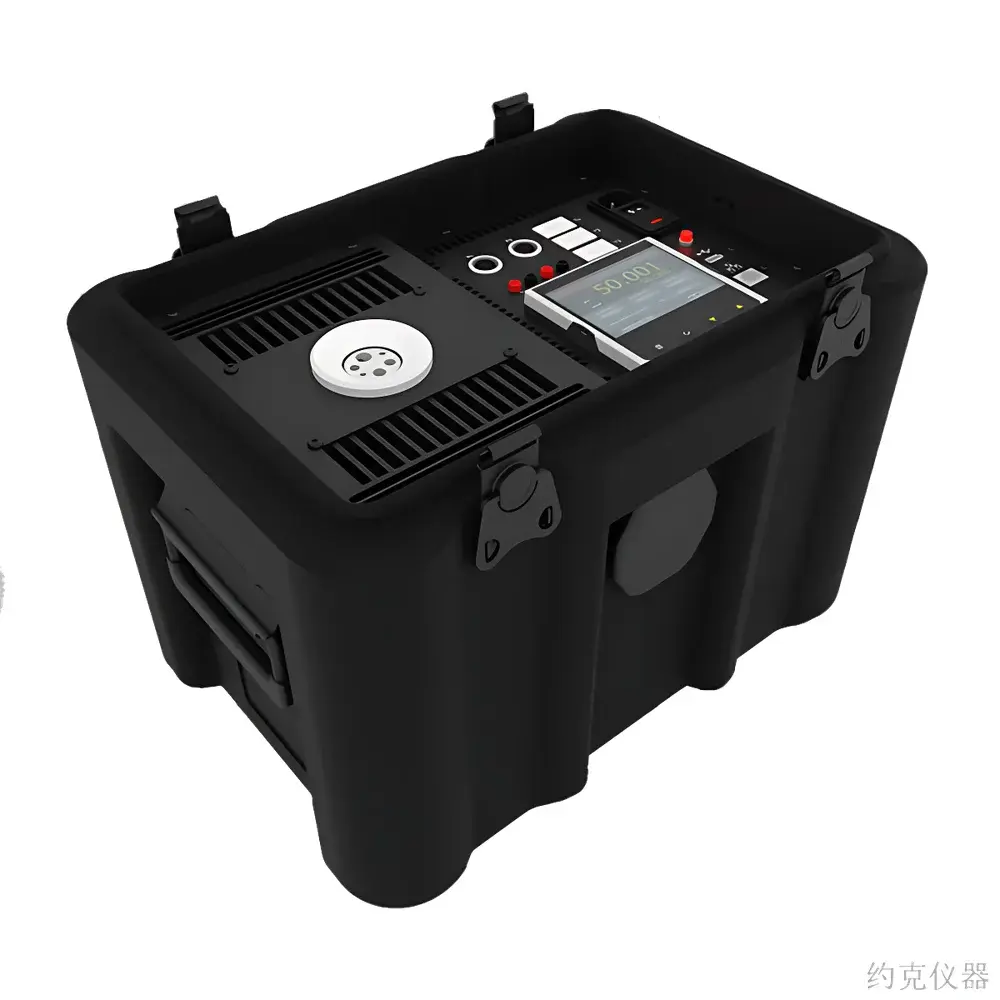
ISOTECH Field-Deployable Dry-Block Calibrator Model 786 / 787
| Brand | ISOTECH |
|---|---|
| Origin | United Kingdom |
| Model | 786 / 787 |
| Instrument Type | Dry-Block Temperature Calibrator |
| Environmental Operating Range | −29 °C to +50 °C |
| IP Rating | IP56 |
| Calibration Well Dimensions (Model 786) | Ø29.4 mm × 203 mm depth |
| Calibration Well Dimensions (Model 787) | Ø25.4 mm × 152 mm depth |
| Stability (Model 786, A-type sensor) | ±0.008 °C |
| Stability (Model 787, B/S-type sensor) | ±0.01 °C to ±0.05 °C |
| Horizontal Uniformity (Model 786) | <0.008 °C |
| Vertical Uniformity (Model 787) | <0.5 °C |
| Heating Time (786 | −40 °C → 140 °C): 30 min |
| Heating Time (787 | −50 °C → 650 °C): 30 min |
| Cooling Time (787 | 650 °C → 100 °C): 90 min |
| Power Supply (786) | 85–264 V AC, 50/60 Hz, 360 W |
| Power Supply (787) | 110/230 V AC, 50/60 Hz, 800 W |
| Weight (786) | 16.8 kg |
| Weight (787) | 18 kg |
| Compliance | MIL-PRF-28800F, BS EN 60068-2-1 & -2-14, ISO 3744:2010 |
Overview
The ISOTECH Field-Deployable Dry-Block Calibrator Models 786 and 787 are purpose-engineered portable temperature calibration systems designed for high-integrity thermometric verification in demanding field environments. Unlike conventional laboratory-grade dry-block calibrators, these units integrate military-spec mechanical robustness with metrological performance traceable to national standards. They operate on the principle of resistive heating within a precisely machined metal block, where thermal energy is uniformly distributed via optimized thermal mass and proprietary heat-sink architecture. The block’s temperature is controlled using high-stability platinum resistance sensors (PRTs) and PID algorithms tuned for minimal overshoot and rapid stabilization. Each model targets a distinct operational envelope: Model 786 covers −40 °C to +140 °C for low-temperature industrial and environmental applications; Model 787 extends to +660 °C, supporting high-temperature process instrumentation calibration in oil & gas, power generation, and aerospace maintenance. Both units maintain full accuracy and stability across ambient temperatures ranging from −29 °C to +50 °C—enabling reliable operation in arctic field camps, desert refineries, or maritime platforms without climate-controlled shelter.
Key Features
- MIL-PRF-28800F certified ruggedization: validated for shock, vibration, dust ingress (IP56), immersion resistance, altitude exposure up to 4,570 m, and extreme ambient storage/operation per BS EN 60068-2-1 and -2-14
- Lab-grade thermal uniformity: horizontal gradient <0.008 °C (Model 786) and vertical gradient <0.5 °C (Model 787) across calibrated well volume—meeting ISO/IEC 17025 requirements for accredited calibration labs
- Dual-mode thermal control: fast ramp rates (−50 °C to +650 °C in ≤30 minutes for Model 787) combined with microprocessor-regulated stability of ±0.008 °C (786, A-type) or ±0.01 °C (787, B/S-type) at setpoint
- Multi-sensor compatibility: integrated support for thermocouples (E, J, K, N, R, S, T) and RTDs (Pt100, Pt1000) with reference-grade accuracy—±0.2 °C for K-type at 660 °C, ±0.35 °C for RTD, or 0.005% of reading
- Field-optimized interface: high-resolution OLED display (0.001 °C resolution across full scale), intuitive menu navigation, and dual-channel input for simultaneous reference/sut comparison
- Modular well inserts: standardized 4-hole configuration (4.5 mm, 6.5 mm, 8.0 mm, 9.5 mm diameters) with depth-optimized geometry (195 mm for 786, 148 mm for 787) to ensure proper immersion depth per ISO 5741 and ASTM E220
Sample Compatibility & Compliance
Models 786 and 787 accommodate a broad range of temperature sensors used in industrial process control, safety-critical instrumentation, and regulatory-compliant monitoring systems. Compatible devices include armored and miniature thermocouples (Type K, T, S), thin-film and wire-wound RTDs, thermistors, and digital temperature transmitters with analog output. The calibrators meet essential regulatory and quality framework requirements: compliance with MIL-PRF-28800F ensures suitability for defense logistics and NATO supply chains; adherence to BS EN 60068-2-1 (cold) and -2-14 (cyclic temperature) validates long-term reliability under climatic stress; and conformance with ISO 3744:2010 acoustic emission limits supports use in noise-sensitive offshore or facility environments. For laboratories operating under ISO/IEC 17025 or FDA 21 CFR Part 11, the units support documented calibration procedures, audit-trail-capable data logging (when paired with optional ISOTECH CalSoft™), and traceable uncertainty budgets per EURAMET cg-18.
Software & Data Management
When connected to ISOTECH CalSoft™ v5.2 (Windows-based), both models enable automated calibration sequences—including ramp-hold-soak protocols, multi-point linearity verification, and hysteresis assessment—with real-time deviation plotting and automatic pass/fail evaluation against user-defined tolerances. All measurement data—including timestamps, ambient conditions, sensor IDs, and environmental logs—are stored in encrypted .csv and .pdf report formats compliant with GLP and GMP documentation standards. The software supports electronic signatures, revision-controlled procedure templates, and direct integration with LIMS via OPC UA or TCP/IP. Internal non-volatile memory retains >1,000 calibration records even during power loss, and firmware updates are performed via USB without external programming hardware. No cloud dependency or subscription licensing is required—ensuring full data sovereignty and long-term validation continuity.
Applications
- On-site verification of temperature transmitters, DCS inputs, and safety shutdown sensors in petrochemical plants and LNG terminals
- Calibration of handheld thermometers and infrared pyrometers used in HVAC commissioning and building diagnostics
- Field validation of cryogenic sensor arrays in pharmaceutical cold-chain logistics and bioreactor monitoring
- Maintenance calibration of turbine inlet thermocouples and boiler tube RTDs in combined-cycle power stations
- Support of ISO 17025-accredited mobile calibration services performing third-party audits under UKAS or ANAB scope
- Environmental monitoring network calibration in remote meteorological stations, polar research outposts, and high-altitude observatories
FAQ
What ambient temperature ranges are supported during active calibration?
Both models operate continuously from −29 °C to +50 °C ambient, with full specification compliance—including stability and uniformity—maintained across this entire range.
Can the 786 and 787 be used for thermocouple calibration above 660 °C?
No. Model 787 has a maximum setpoint of +660 °C, aligned with the upper limit of Type K and N thermocouples. For higher-temperature applications (e.g., Type B or R above 1000 °C), a furnace-based calibrator is required.
Is external cooling required for rapid cooldown below 100 °C?
No. Passive air cooling suffices for most transitions; however, forced-air accessories are available as optional add-ons to reduce 650 °C → 100 °C cooldown time from 90 minutes to approximately 45 minutes.
How is traceability established for field calibrations?
Each unit ships with a UKAS-accredited calibration certificate (ref. NPL or NIST-traceable standards), valid for 12 months. Optional annual recalibration services include on-site execution with full uncertainty budgeting and ISO/IEC 17025 reporting.
Are custom well inserts available for non-standard probe diameters?
Yes. ISOTECH offers bespoke insert manufacturing (aluminum or Inconel) for diameters from 1.5 mm to 12.7 mm, with lead-time of 4–6 weeks and full thermal validation documentation.