NS-V Series Dual-Axis Inclinometer Sensor
| Brand | MEAS |
|---|---|
| Origin | Beijing, China |
| Manufacturer Type | Authorized Distributor |
| Product Origin | Domestic (China) |
| Model | NS-V Series |
| Output Options | Analog Voltage (±2 V) or Current (4–20 mA) |
| Measuring Range | ±5° to ±45° |
| Resolution | 0.001° (typ.) |
| Accuracy | ±0.1° to ±0.5° (0–70°C) |
| Zero & Sensitivity Temp. Stability | ±0.1° and ±0.3° (0–50°C) |
| Enclosure | Aluminum, IP65 |
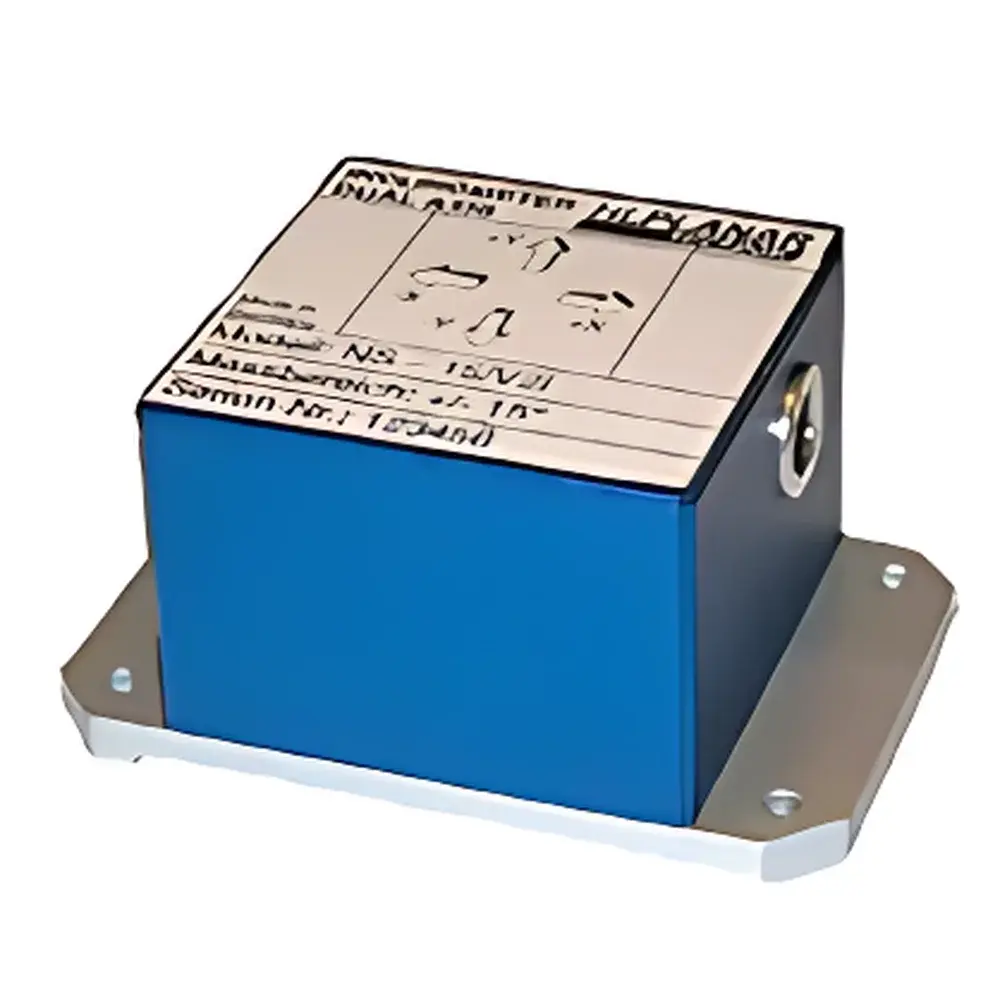
| Electrical Interface | 7-pin M8 connector |
| Supply Voltage | 12–24 VDC |
| Supply Current | ≤30 mA |
| Operating Temp. | −40°C to +85°C (storage), 0°C to +70°C (operation) |
| Dimensions | 90 × 60 × 45.5 mm |
| Weight | 300–320 g |
Overview
The NS-V Series Dual-Axis Inclinometer Sensor is a precision MEMS-based angular displacement transducer engineered for reliable tilt measurement in industrial and mobile equipment applications. Utilizing capacitive sensing technology with integrated signal conditioning, the sensor detects gravitational acceleration components along two orthogonal axes (X and Y), converting angular deviation into calibrated analog output signals. Its core architecture features a monolithic silicon sensing element combined with a dedicated ASIC that performs real-time linearization and temperature compensation—ensuring high repeatability and minimal drift across extended thermal cycles. Designed for integration into structural monitoring, dynamic leveling, and platform stabilization systems, the NS-V Series complies with fundamental requirements for robustness and long-term stability in non-laboratory environments.
Key Features
- True dual-axis measurement with independent X- and Y-axis outputs for simultaneous roll and pitch detection
- Aluminum housing with IP65 ingress protection—resistant to dust, water jets, and mechanical shock
- High-resolution analog output: 0.001° typical resolution with factory-trimmed linearity and temperature compensation
- Two standard output configurations: ratiometric ±2 V voltage output (NS-xx/V2 models) or industry-standard 4–20 mA current loop (NS-xx/V2I models)
- 7-pin M8 circular connector for secure, vibration-resistant electrical interfacing—compatible with DIN 43650 standards
- Wide operating temperature range (0°C to +70°C) and extended storage capability (−40°C to +85°C)
- Compact form factor (90 × 60 × 45.5 mm) optimized for space-constrained mounting on booms, chassis, or control cabinets
Sample Compatibility & Compliance
The NS-V Series is compatible with rigidly mounted metallic, composite, or reinforced polymer substrates where mechanical coupling integrity is maintained. It requires stable mechanical fixation—preferably via threaded inserts or low-resonance elastomeric mounts—to avoid signal artifacts induced by vibration or flexure. While not certified to IEC 61508 or SIL standards out-of-the-box, its design adheres to foundational principles of functional safety for auxiliary sensing roles in machinery control loops. The sensor meets RoHS Directive 2011/65/EU and REACH SVHC compliance. Its analog output interface supports integration into PLCs, DAQ systems, and embedded controllers compliant with IEC 61131-3 and IEEE 11073-10201 standards. For applications subject to GLP or ISO 9001 quality management systems, calibration traceability to NIST or CNAS-accredited laboratories is recommended at installation and annually thereafter.
Software & Data Management
The NS-V Series operates as a self-contained analog transducer without onboard digital communication protocols (e.g., CAN, RS-485, or IO-Link). Signal acquisition relies on external analog-to-digital conversion—typically performed by programmable logic controllers (PLCs), data loggers, or microcontroller units (MCUs) equipped with 12-bit or higher resolution ADCs. To ensure metrological integrity, users should implement software-based linearization correction using the device’s published sensitivity and zero-offset coefficients—available in the manufacturer’s calibration certificate. When integrated into automated test systems or SCADA platforms, the sensor’s analog output supports time-synchronized logging under IEEE 1588 PTP or NTP timestamping. For FDA-regulated applications involving tilt-dependent process control (e.g., pharmaceutical mixing vessels), audit trails must capture raw voltage/current readings, applied scaling factors, and environmental conditions per 21 CFR Part 11 requirements.
Applications
- Real-time leveling feedback for telescopic booms, crawler cranes, and mobile elevating work platforms (MEWPs)
- Inclination monitoring in structural health assessment of bridges, wind turbine towers, and seismic isolation bearings
- Dynamic tilt compensation in road pavers, graders, and asphalt compactors to maintain grade accuracy
- Platform stabilization in marine navigation systems, antenna positioning, and solar tracker alignment
- Integration into load cell-based weighing systems for center-of-gravity correction during lifting operations
- Calibration reference for optical theodolites and laser alignment tools in field metrology
FAQ
What is the difference between NS-xx/V2 and NS-xx/V2I models?
The “V2” suffix denotes voltage output (±2 V ratiometric), while “V2I” indicates 4–20 mA current loop output—selected based on noise immunity requirements and existing control system input specifications.
Can the NS-V Series be used in outdoor environments exposed to rain or snow?
Yes—the IP65-rated aluminum enclosure provides protection against water projected from nozzles and full dust ingress, making it suitable for outdoor deployment when properly mounted with cable glands and orientation minimizing direct water accumulation.
Is temperature compensation applied internally or externally?
Compensation is fully implemented within the integrated ASIC; no external software correction is required for basic operation, though high-accuracy applications may apply secondary polynomial correction using factory-provided thermal drift coefficients.
Does the sensor require recalibration after mechanical shock or vibration exposure?
No routine recalibration is needed unless physical damage occurs; however, periodic verification against a known reference (e.g., precision inclinometer or digital level) is advised following severe mechanical impact or after 12 months of continuous operation.
Are custom measurement ranges available beyond ±45°?
Standard NS-V Series variants are limited to ±5°, ±15°, and ±45°; single-axis configurations or extended-range versions require direct consultation with the original component manufacturer (TE Connectivity / MEAS) through authorized channels.