
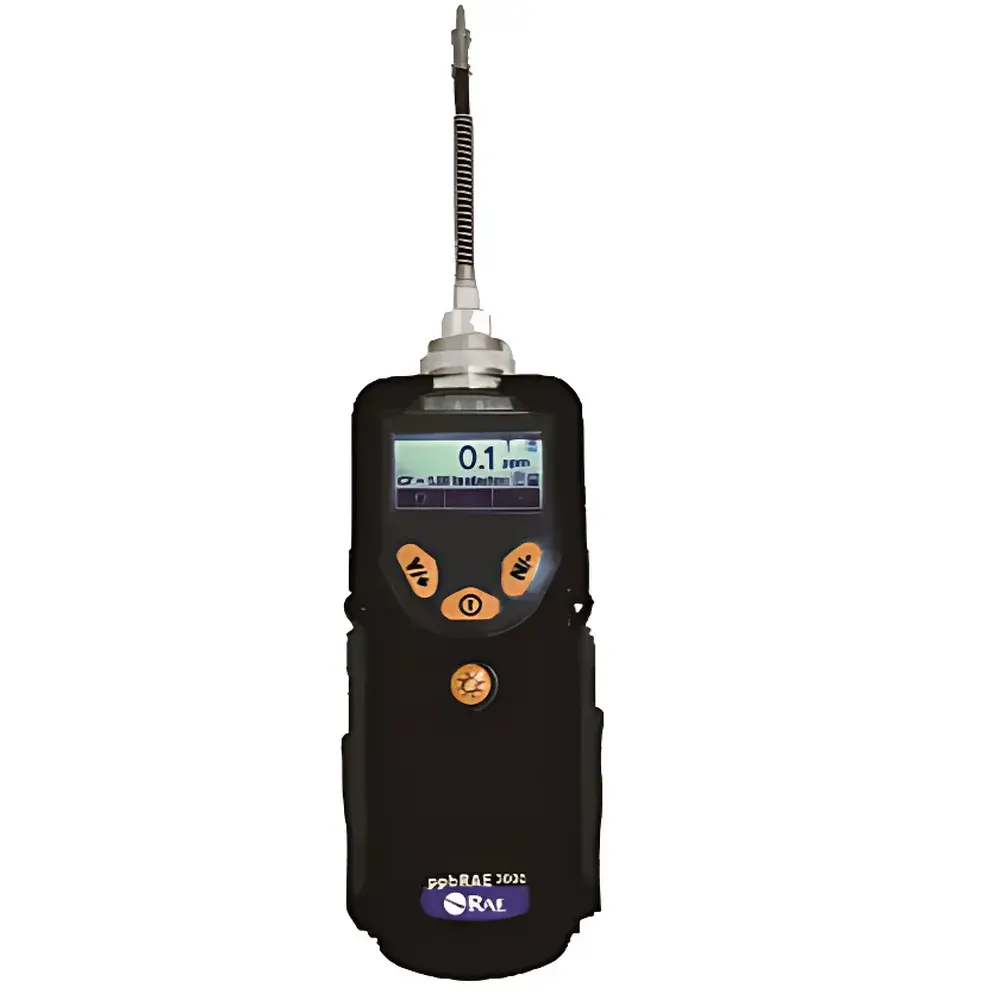
RAE Systems ppbRAE 3000 Portable VOC Detector (PGM-7340)
| Brand | RAE Systems Inc. |
|---|---|
| Origin | USA |
| Instrument Type | Portable VOC Detector |
| Detection Principle | Photoionization Detection (PID) |
| Detection Range | 1 ppb – 10,000 ppm |
| Resolution | 0.01 ppm |
| Accuracy | ±3% of reading |
| Response Time (T90) | 2 s |
| Sampling Method | Integrated high-flow pump with optional 30 m sampling hose |
| Calibration | Auto-zero and temperature/pressure/humidity compensated |
| Connectivity | Integrated Bluetooth and optional wireless module |
| Display | Backlit graphical LCD with multilingual UI (including Chinese) |
| Gas Library | Preloaded database for >1,000 VOCs |
| Compliance | Designed to support OSHA, NIOSH, and ACGIH exposure limit referencing |
Overview
The RAE Systems ppbRAE 3000 Portable VOC Detector (model PGM-7340) is an advanced handheld photoionization detector engineered for ultra-trace detection of volatile organic compounds in field and industrial environments. Utilizing third-generation PID sensor architecture with a 10.6 eV krypton lamp, the instrument delivers laboratory-grade sensitivity—down to 1 part per trillion (ppt) equivalent for select compounds—with a calibrated linear range spanning six orders of magnitude (1 ppb to 10,000 ppm). Its measurement principle relies on ultraviolet photon-induced ionization of VOC molecules in sampled air, followed by quantification of resulting ion current proportional to analyte concentration. This physics-based approach ensures broad-spectrum response across aliphatic, aromatic, chlorinated, and oxygenated VOCs without compound-specific calibration—making it ideal for unknown mixture screening, leak detection, and occupational exposure assessment where rapid, non-destructive analysis is critical.
Key Features
- Ultra-high sensitivity PID sensor with stable 10.6 eV UV lamp and proprietary self-cleaning optical surface technology—maintains consistent lamp output intensity over extended operation, minimizing drift and reducing recalibration frequency.
- Integrated high-capacity diaphragm pump delivering >500 mL/min flow rate, enabling real-time sampling through up to 30 meters of conductive tubing without signal attenuation or lag.
- Multi-parameter environmental compensation: onboard temperature, relative humidity, and barometric pressure sensors feed adaptive algorithms that dynamically correct for density and ionization efficiency variations—ensuring metrological traceability across diverse ambient conditions.
- Dual-mode connectivity: embedded Bluetooth 4.2 for local smartphone/tablet pairing and optional 802.11 Wi-Fi or cellular modem for secure, encrypted telemetry to central monitoring platforms.
- Graphical backlit LCD with intuitive icon-driven navigation, supporting 12 languages including English, Spanish, German, French, Japanese, and Simplified Chinese—designed for glove-compatible operation in hazardous locations.
- On-device VOC library with >1,000 preconfigured response factors (RFs), editable via PC software; supports custom RF entry for site-specific compounds and regulatory compliance reporting (e.g., EPA Method TO-15, ASTM D5504).
Sample Compatibility & Compliance
The ppbRAE 3000 detects VOCs with ionization potentials below 10.6 eV—including benzene, toluene, xylene, styrene, acetone, methanol, formaldehyde (with optional humidification control), and many halogenated solvents. It is not responsive to methane, ethane, CO, CO₂, or H₂O vapor—enabling selective measurement in complex matrices. The device meets IEC 60079-0/-11 for intrinsic safety (Class I, Division 1, Groups A–D; ATEX II 2G Ex ia IIC T4 Ga) and complies with UL 913 8th Edition for hazardous location use. Firmware and data handling protocols are architected to align with FDA 21 CFR Part 11 requirements when used with RAE’s ProRAE Studio II software—supporting electronic signatures, audit trails, and role-based access control for regulated environments.
Software & Data Management
ProRAE Studio II (Windows-based) provides full configuration, firmware update, data download, and report generation capabilities. Raw time-series data—including timestamped concentration values, environmental parameters, pump status, and battery voltage—is stored in ISO-standard CSV and XML formats. Optional cloud integration via RAE Cloud enables real-time dashboard visualization, geotagged event logging, automated alarm escalation (SMS/email), and historical trend analysis with configurable exposure limit overlays (e.g., TLV®, STEL, IDLH). All data exports include cryptographic hash verification for forensic integrity validation during audits.
Applications
- Industrial hygiene monitoring for OEL compliance (OSHA PEL, ACGIH TLV®) in chemical manufacturing, pharmaceutical cleanrooms, and semiconductor fabrication facilities.
- Environmental site assessment: soil vapor intrusion screening, landfill perimeter monitoring, and brownfield redevelopment due diligence.
- Emergency response: rapid hazard identification during chemical spills, confined space entry pre-testing, and fire investigation residue analysis.
- Process safety management: continuous leak detection at flanges, valves, and connectors in petrochemical refineries and LNG terminals.
- Indoor air quality (IAQ) surveys in schools, hospitals, and office buildings—particularly post-renovation or after HVAC system maintenance.
FAQ
What VOCs can the ppbRAE 3000 detect?
It responds to any VOC with an ionization potential less than 10.6 eV—including aromatics, ketones, esters, amines, and many chlorinated hydrocarbons—but does not detect permanent gases (e.g., N₂, O₂, CH₄) or low-IP compounds like hydrogen sulfide.
Is calibration required before each use?
Field zeroing is recommended prior to deployment; full span calibration with certified isobutylene gas is advised every 6 months or after exposure to high-concentration contaminants.
Can the instrument operate in extreme temperatures?
Operating range is –20 °C to +50 °C; extended cold-weather performance is supported via optional heated sampling line and battery thermal management.
Does it support datalogging with GPS tagging?
Yes—integrated GPS (optional external module) enables georeferenced measurements synchronized with concentration readings for mapping contamination plumes.
How is data security ensured during wireless transmission?
Bluetooth pairing uses AES-128 encryption; Wi-Fi/cellular telemetry employs TLS 1.2+ with certificate-based authentication and payload encryption compliant with NIST SP 800-53 controls.
Related Products







