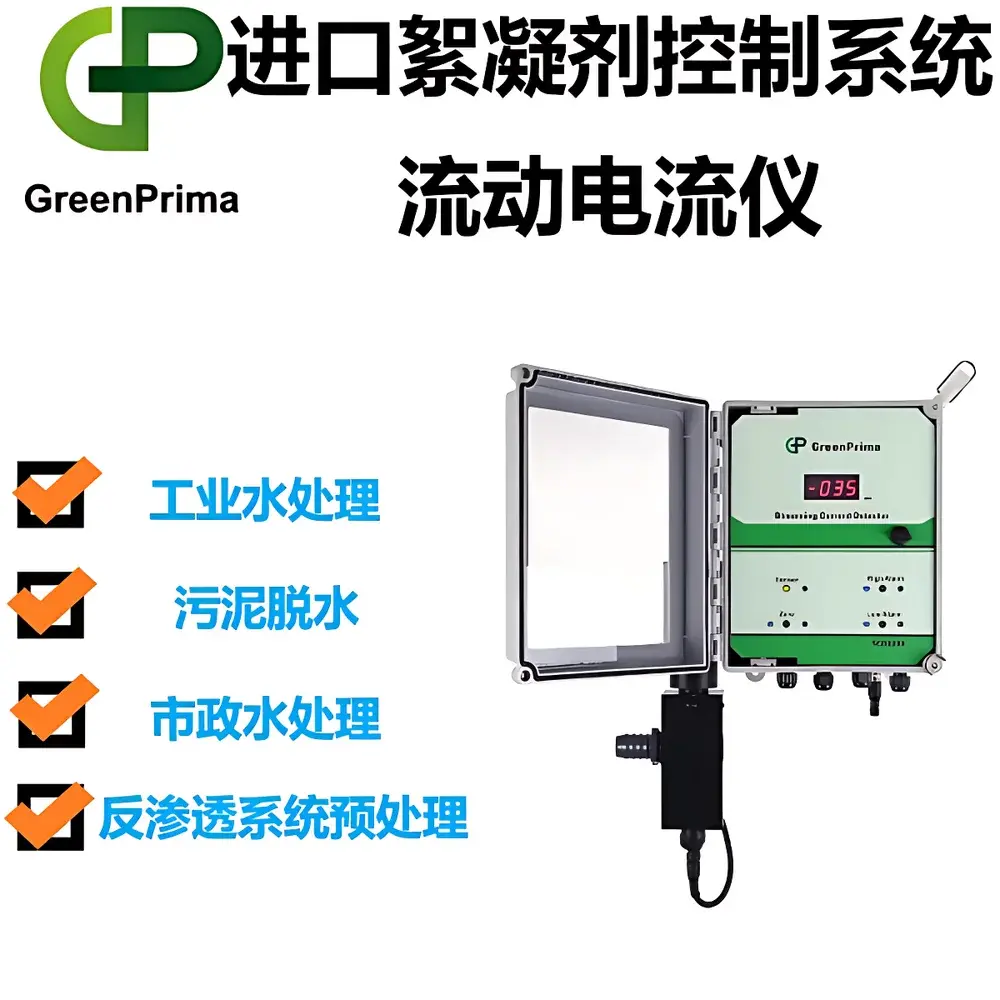
GreenPrima SCD8200 Streaming Current Detector
| Brand | GreenPrima |
|---|---|
| Origin | USA |
| Manufacturer Type | Original Equipment Manufacturer (OEM) |
| Product Origin | Imported |
| Model | SCD8200 |
| Price | Upon Request |
| Power Supply | 100–240 VAC, 50/60 Hz |
| Measurement Range | −1000 to +1000 mV |
| Accuracy | ±0.1% of full scale |
| Resolution | 1 mV |
| Flow Rate | 1 L/min |
| Electrode Chamber Material | Delrin / 316 Stainless Steel / PTFE |
| Inlet Connection | 1/2" NPT |
| Outlet Connection | 3/4" NPT |
| Response Time | ≤1 s |
| Output Signals | 4–20 mA, −10 to +10 V, 0–10 V |
| Communication Protocol | Optional Modbus RTU (RS-485) |
| Alarm Outputs | 2 × SPDT relays (Hi/Lo configurable) |
| Enclosure Rating | IP65 |
| Dimensions | 279 mm × 152 mm (11.0" × 6.0") |
| Weight | 9 kg |
| Display | LED numeric display |
| Auto-zero Calibration | Yes |
Overview
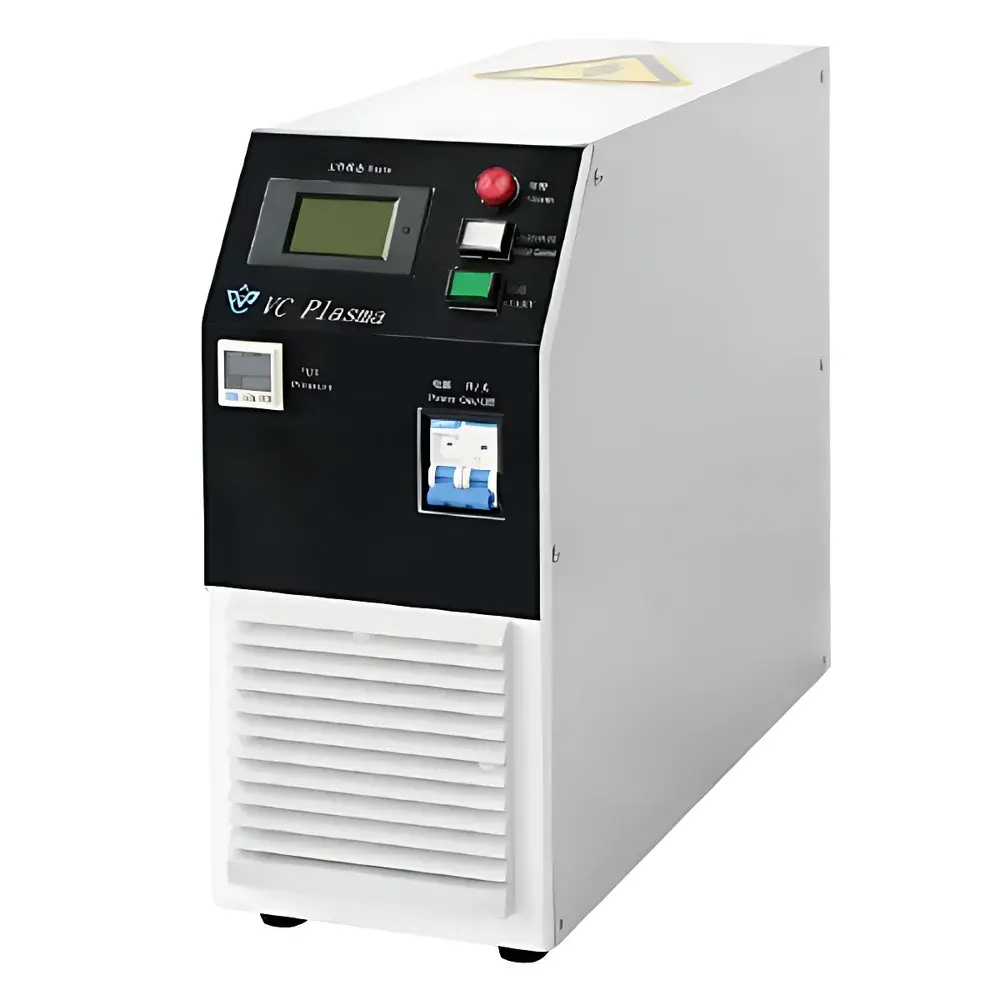
The GreenPrima SCD8200 Streaming Current Detector is an industrial-grade online electrokinetic analyzer engineered for real-time monitoring and control of coagulation efficiency in water and wastewater treatment processes. It operates on the principle of streaming current measurement—a technique grounded in electrokinetics that quantifies the net surface charge of colloidal particles and dissolved ionic species under controlled laminar flow conditions. As process water passes through a precision-machined electrode chamber, the movement of charged species between two parallel electrodes generates a measurable streaming current proportional to the residual zeta potential of the suspension. This signal serves as a robust, dynamic indicator of coagulant dosage adequacy—enabling closed-loop feedback control without reliance on offline jar testing or turbidity proxies. The SCD8200 is specifically designed for integration into continuous-flow systems where rapid, reproducible assessment of charge neutralization is critical to optimizing polymer or metal-salt dosing strategies.
Key Features
- Real-time streaming current measurement with ≤1-second response time, enabling immediate detection of coagulant under- or overdosing events
- Auto-zero calibration routine executed at user-defined intervals or triggered by flow cessation, ensuring long-term baseline stability without manual intervention
- Dual analog outputs (4–20 mA and voltage options) and optional Modbus RTU communication for seamless integration with DCS, PLC, or SCADA platforms
- IP65-rated enclosure with corrosion-resistant wetted materials—Delrin housing, 316 stainless steel electrodes, and PTFE seals—suitable for humid, chemically aggressive environments
- Two programmable SPDT relay outputs for high/low alarm signaling, supporting fail-safe interlocks with chemical feed pumps or bypass valves
- LED-based numeric display with intuitive menu navigation; no external PC required for basic operation or field calibration
Sample Compatibility & Compliance
The SCD8200 is validated for use across a broad range of aqueous matrices, including raw surface water, clarified effluent, activated sludge supernatant, and membrane pre-filtration streams. It accommodates suspended solids concentrations up to 500 mg/L and operates reliably in pH ranges from 4.5 to 10.5. Its design conforms to IEC 61000-6-2 (immunity) and IEC 61000-6-4 (emissions) standards. For regulated facilities operating under GLP or GMP frameworks, the instrument supports audit-ready operation via configurable event logging (e.g., calibration timestamps, alarm triggers, output deviations), though native 21 CFR Part 11 compliance requires integration with validated third-party data acquisition software. It meets ASTM D5893-15 (Standard Test Method for Streaming Current Detection) for comparative charge analysis in coagulation studies.
Software & Data Management
While the SCD8200 functions autonomously with local display and analog outputs, its optional Modbus RTU interface enables bidirectional data exchange with supervisory systems. Process engineers may configure polling intervals, scaling factors, and alarm thresholds remotely via standard Modbus function codes (e.g., FC03 for holding registers). When integrated into a centralized historian, streaming current trends can be correlated with coagulant feed rates, influent turbidity, and final effluent quality parameters—facilitating root-cause analysis during process excursions. Data integrity is preserved through non-volatile memory storage of calibration history and operational events, accessible via serial query or embedded diagnostics menu.
Applications
- Optimization of coagulant dosing in municipal drinking water plants to minimize residual aluminum or iron while meeting turbidity and TOC removal targets
- Control of cationic polymer addition in wastewater tertiary clarification and dissolved air flotation (DAF) units
- Monitoring charge reversal during anaerobic digester supernatant conditioning prior to centrifuge dewatering
- Pre-treatment assurance for reverse osmosis (RO) and nanofiltration (NF) systems to prevent fouling from colloidal carryover
- Process validation support during commissioning or regulatory audits requiring documented evidence of coagulation consistency
FAQ
How does streaming current differ from zeta potential measurement?
Streaming current reflects the net mobile charge density under flow conditions and correlates strongly with coagulant demand; zeta potential is a derived electrophoretic parameter typically measured offline under static or low-shear conditions.
Can the SCD8200 be installed in pressurized pipelines?
Yes—it is rated for continuous operation at line pressures up to 6 bar (87 psi); a pressure-reducing valve is recommended if upstream pressure exceeds this limit.
Is sensor cleaning required during normal operation?
The electrode chamber design minimizes fouling; however, periodic inspection and gentle wiping with deionized water are advised every 2–4 weeks depending on feedwater quality.
Does the instrument require temperature compensation?
No built-in temperature sensor is included, but the streaming current signal exhibits minimal thermal drift (<0.02% per °C) within 10–40°C ambient range; external temperature input can be applied via PLC scaling if needed.
What maintenance intervals are recommended?
Annual verification of calibration accuracy against certified reference solutions (±100 mV and ±500 mV) is advised; electrode replacement is typically required every 24–36 months under continuous operation.
Related Products