
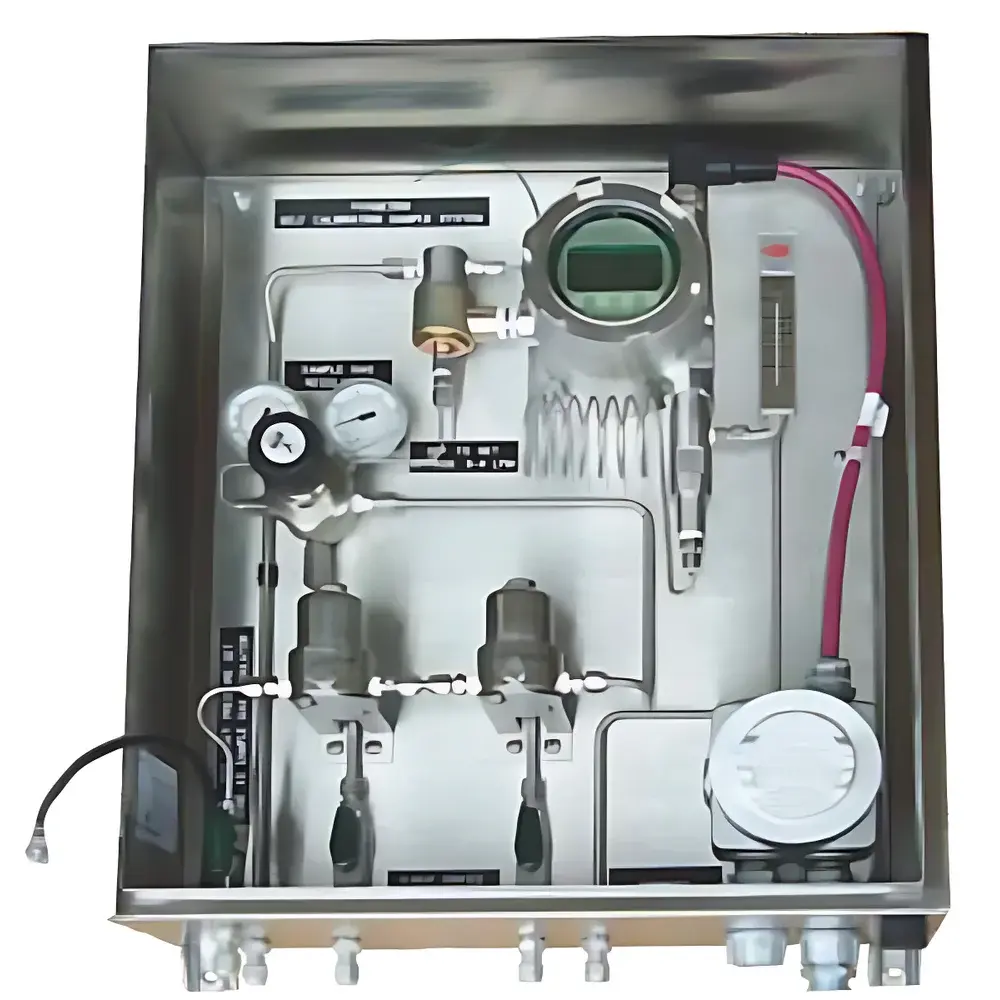
PhyMetrix DPT-910 Online Natural Gas Dew Point Analyzer
| Brand | PhyMetrix |
|---|---|
| Origin | USA |
| Model | DPT-910 |
| Type | Online Dew Point Analyzer |
| Principle | Chilled-Mirror Hygrometry (Nanoporous Metal Oxide Sensor) |
| Measurement Range | −110 °C to +20 °C (dew point) |
| Accuracy | ±2 °C |
| Operating Temperature | −20 °C to +60 °C |
| Enclosure Rating | IP66 & IP68 |
| Hazardous Area Certifications | FM/CSA Class I, Div 1, Groups B, C, D |
| ATEX/IECEx | Ex d IIC T6 Gb / Ex d IIIC T6 Db |
| Gas Inlet/Outlet | 1/4″ Swagelok stainless steel fittings |
| Sample Flow Rate | >1 L/min |
| Power Options | 90–260 VAC, 47–440 Hz |
| Outputs | Isolated RS-422 |
| Housing | Fiberglass-reinforced polymer (FRP) enclosure with large optical-grade viewport |
Overview
The PhyMetrix DPT-910 Online Natural Gas Dew Point Analyzer is a field-deployable, intrinsically robust hygrometer engineered for continuous, real-time water dew point measurement in high-pressure natural gas transmission and processing environments. It employs chilled-mirror hygrometry enhanced by a proprietary nanoporous metal oxide sensing membrane—distinct from conventional capacitive or aluminum oxide sensors—enabling stable, drift-resistant condensation detection across an extended range of −110 °C to +20 °C (dew point). Unlike electrolytic or tunable diode laser (TDL) methods, the DPT-910’s mirror-based principle delivers traceable, first-principle measurement traceable to NIST-traceable humidity standards, satisfying metrological requirements for custody transfer and process compliance. Its design addresses the unique thermodynamic and contamination challenges inherent to natural gas streams—including variable hydrocarbon dew points, presence of triethylene glycol (TEG), H2S, liquid hydrocarbons, and particulate matter—without requiring external sample conditioning beyond integrated filtration and pressure regulation.
Key Features
- Patented nanoporous metal oxide chilled-mirror sensor with rapid thermal response (<60 s for 90% step change) and long-term stability under cyclic wet/dry exposure
- Integrated sample conditioning system: stainless steel particulate filter (1 µm absolute), coalescing pre-filter, pressure regulator (adjustable 1–100 bar), and flow control valve—all housed within the FRP enclosure
- Explosion-proof enclosure certified to FM/CSA Class I, Div 1 (Groups B, C, D) and ATEX/IECEx Zone 1 (Ex d IIC T6 Gb), enabling direct installation in classified areas without remote mounting or purge systems
- Large-diameter optical viewport (≥100 mm clear aperture) with anti-fog coating for unobstructed visual verification of mirror surface condition and frost formation
- Triple power input compatibility: line-powered AC, isolated DC, or loop-powered 4–20 mA—ensuring operational continuity during brownouts or distributed control system (DCS) integration
- Three configurable SPDT alarm relays rated at 3 A / 250 VAC, programmable for high/low dew point, sensor fault, or flow loss conditions
Sample Compatibility & Compliance
The DPT-910 is validated for use with pipeline-grade natural gas (ISO 13686, ASTM D1826, GPA 2145) containing methane (>85%), ethane, propane, nitrogen, CO2, and typical contaminants including TEG carryover (<50 ppmv), H2S (<100 ppmv), and suspended solids (<1 mg/m³). It complies with API RP 14E for offshore instrumentation safety and meets EN 60079-0/-1 for general and flameproof protection. All wetted materials—316L stainless steel inlet/outlet fittings, Hastelloy C-276 mirror substrate, and fluoropolymer gaskets—are selected per NACE MR0175/ISO 15156 for sour service. The analyzer supports audit-ready operation under GLP and GMP frameworks, with optional firmware logging of calibration events, sensor diagnostics, and alarm timestamps aligned to UTC.
Software & Data Management
Local configuration and diagnostics are performed via the front-panel keypad and high-contrast LCD display, supporting multilingual UI (English, Spanish, German, Chinese). Remote monitoring and parameter adjustment are enabled through RS-422 serial interface using Modbus RTU protocol or HART 7.0 command set (universal and common practice commands). Data output includes primary dew point value (°C dp), mirror temperature, sample pressure (bar), flow rate (L/min), and sensor health status. Optional PhyMetrix Insight™ software (Windows-based) provides historical trend visualization, alarm event export (CSV/Excel), and automated report generation compliant with ISO/IEC 17025 documentation requirements. All configuration changes are logged with user ID, timestamp, and pre/post values—satisfying FDA 21 CFR Part 11 electronic record and signature requirements when deployed with audit trail enabled.
Applications
- Real-time dew point monitoring upstream of cryogenic LNG liquefaction trains to prevent hydrate formation in J-T valves and cold boxes
- Custody transfer verification at interconnect points between pipeline operators, ensuring compliance with contractually specified water content limits (e.g., ≤7 lb/MMSCF or ≤−10°C dp)
- Performance validation of molecular sieve dryers and glycol contactors in gas processing plants
- Offshore platform gas export metering skids where space, weight, and hazardous area constraints prohibit rack-mounted analyzers
- Biogas upgrading facilities measuring post-compression dew point prior to grid injection or vehicle fuel compression
FAQ
Does the DPT-910 require periodic mirror cleaning or recalibration?
No routine mirror cleaning is required due to the self-cleaning effect of controlled condensation cycles and the inert surface chemistry of the nanoporous metal oxide layer. Calibration verification is recommended annually using NIST-traceable chilled-mirror reference standards (e.g., Michell Instruments Optidew), with full recalibration only if verification exceeds ±2 °C tolerance.
Can the DPT-910 operate at pipeline pressures up to 100 bar?
Yes—the integrated pressure regulator maintains constant 1–2 bar sample pressure at the sensor chamber regardless of upstream pressure (1–100 bar), eliminating risk of sensor overpressure and ensuring consistent thermal mass transfer characteristics.
Is the RS-422 interface compatible with standard industrial SCADA protocols?
Yes—Modbus RTU over RS-422 is natively supported, and protocol converters (e.g., RS-422 to Modbus TCP or OPC UA) are available for seamless integration into Emerson DeltaV, Honeywell Experion, or Siemens PCS7 systems.
How does the DPT-910 handle condensable hydrocarbons in the sample stream?
The integrated coalescing filter removes liquid hydrocarbons ≥5 µm, while the nanoporous sensor membrane exhibits minimal adsorption hysteresis for C1–C4 species, preventing measurement drift during transient compositional shifts.
What is the minimum required sample flow rate to maintain accuracy?
A sustained flow of ≥1.0 L/min at sensor chamber pressure ensures adequate heat exchange and prevents boundary layer stagnation; lower flows may result in thermal lag and reduced temporal resolution, though the unit will continue reporting valid data down to 0.5 L/min with noted uncertainty increase.
Related Products




