
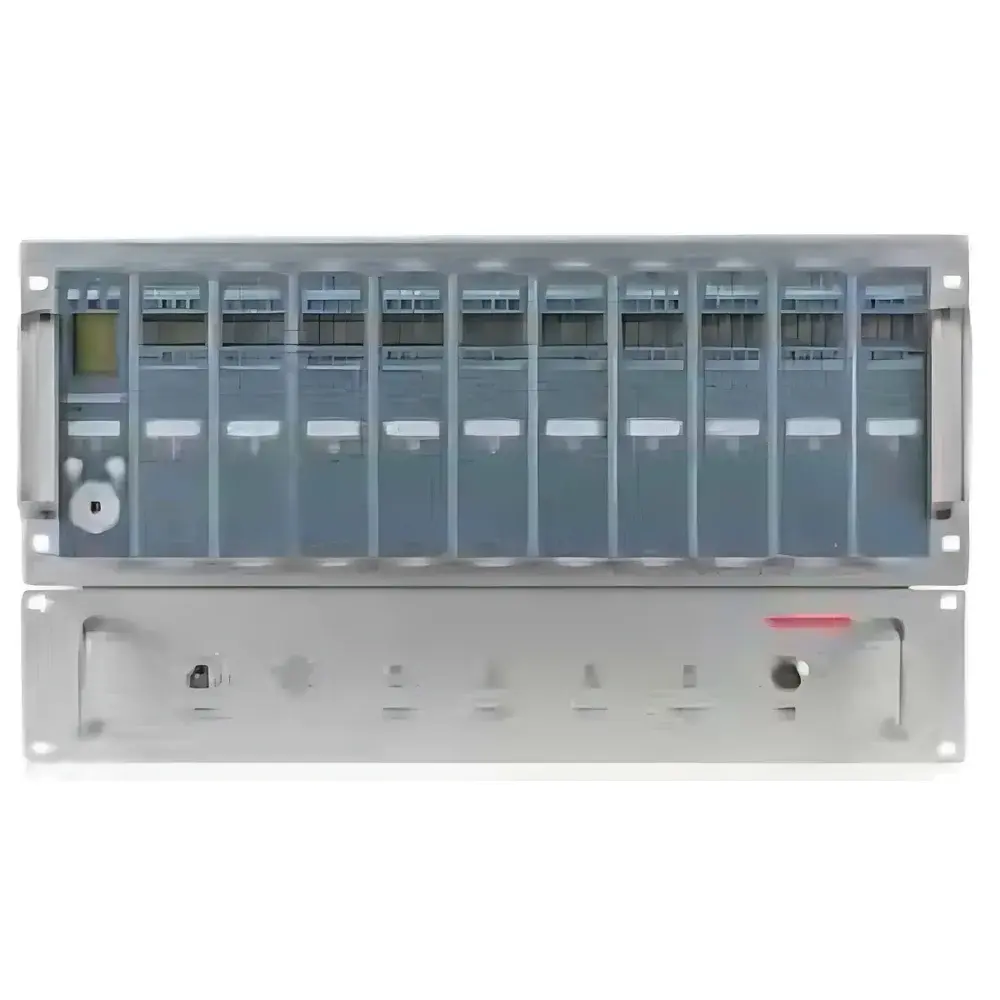
Honeywell FMC-1000Plus Series Intelligent Gas Alarm Controller
| Brand | Honeywell |
|---|---|
| Model | FMC-1000Plus (Panel-Mount) / FMC-1000Plus-W (Wall-Mount) |
| Origin | USA |
| Input Signal | 4–20 mA (2-wire/3-wire gas detectors) |
| Output Signal | 4–20 mA per channel (optional) |
| Power Supply | 24 VDC, 5 A (controller) |
| Operating Temperature | −20 °C to +50 °C |
| Relative Humidity | 0–99% RH (non-condensing) |
| Display | 96×128 dot-matrix LCD with backlight (main controller) |
| Alarm Outputs | 3 relay contacts per channel (High/Low/Fault), 220 VAC, 5 A |
| Communication | RS-485 Modbus RTU |
| Compliance | GB 16808–2008, CCS Certified |
| Dimensions (Panel) | 177 × 482.6 × 82 mm (H×W×D) |
| (Wall) | 246 × 660 × 58.6 mm (H×W×D) |
| Weight | 15 kg (16-channel), 10 kg (4-channel) |
Overview
The Honeywell FMC-1000Plus Series Intelligent Gas Alarm Controller is a modular, industrial-grade safety system engineered for continuous monitoring and real-time response in hazardous environments. It operates on a distributed architecture—each input channel functions autonomously while integrating into a unified supervisory framework via centralized logic and human-machine interface (HMI). Designed for compatibility with 4–20 mA analog output gas detectors—including combustible gas sensors, toxic gas transmitters, and Honeywell-certified flame detectors—the controller delivers deterministic alarm decision-making based on programmable threshold logic (high/low limit, interval-based for O2). Its dual-mode deployment (19″ 4U panel-mount and DIN-rail wall-mount) ensures adaptability across control rooms, skid-mounted process units, offshore platforms, and chemical storage facilities where space, accessibility, and structural integration are critical constraints.
Key Features
- Modular channel architecture: Each 4–20 mA input channel operates independently with dedicated LED status indication, enabling granular fault isolation and maintenance without system-wide interruption.
- Flexible configuration: Users select channel count (4/8/16), optional 24 VDC loop-powered supply modules, and 4–20 mA current-output expansion cards to match site-specific detector topology and power requirements.
- Comprehensive alarm management: Two-level concentration alarms (L1/L2) plus dedicated fault detection per channel; visual distinction via high-brightness LEDs and audible alerts with frequency modulation to differentiate severity levels.
- Remote operational control: Integrated “Remote Reset” and “Remote Mute” functions support safe intervention from distributed control systems (DCS) or safety instrumented systems (SIS) without physical access to the controller enclosure.
- Dual-display interface: Main controller features a 96×128 backlit dot-matrix LCD supporting bilingual (English/Chinese) menu navigation; individual channel cards use 4-digit 7-segment LEDs for immediate local status verification.
- Robust environmental rating: Operates reliably within −20 °C to +50 °C ambient temperature and up to 99% RH (non-condensing), meeting mechanical and thermal stability requirements for Class I, Division 1 hazardous locations when installed with appropriate enclosures.
Sample Compatibility & Compliance
The FMC-1000Plus accepts standardized 4–20 mA signals from third-party and Honeywell gas detection devices compliant with IEC 61000-6-2 (EMC immunity) and IEC 61000-6-4 (EMC emissions). It natively supports Honeywell’s line of infrared (IR) and catalytic bead combustible gas detectors, electrochemical toxic gas sensors, and UV/IR flame detectors—ensuring signal integrity and calibration traceability across the sensing chain. The controller conforms to GB 16808–2008 “General Technical Requirements for Gas Alarm Controllers” and carries China Classification Society (CCS) certification for marine and offshore applications. While not intrinsically safe itself, it is designed for installation in non-hazardous zones (e.g., control rooms, analyzer shelters) and interfaces safely with IS-rated barriers upstream of field devices. All alarm events—including timestamp, measured value, channel ID, and alarm type—are logged with non-volatile memory retention for post-incident forensic review.
Software & Data Management
Data exchange occurs exclusively via isolated RS-485 serial interface using Modbus RTU protocol (slave mode), enabling seamless integration with PLCs, SCADA systems, and enterprise-level safety management platforms. The controller does not embed proprietary software or require PC-based configuration tools; all parameter setup—including alarm setpoints, hysteresis, display units (ppm, %LEL, %vol), and relay behavior—is performed locally via front-panel keypad or remotely via Modbus function codes (03h/06h/10h). Audit trails are limited to internal event logging; no built-in network connectivity, cloud upload, or FDA 21 CFR Part 11-compliant electronic signatures are provided. For regulated industries requiring GLP/GMP documentation, external data historians must capture Modbus-polling records to satisfy traceability and retention mandates.
Applications
- Petrochemical refineries: Monitoring hydrocarbon vapor leaks in compressor stations, loading racks, and tank farm perimeters.
- Natural gas distribution hubs: Continuous surveillance of methane accumulation in metering skids and regulator vaults.
- Pharmaceutical manufacturing: Detection of solvent vapors (e.g., acetone, IPA) in cleanroom utility corridors and solvent recovery areas.
- Marine vessels and offshore platforms: CCS-certified deployment for bilge gas monitoring and engine room combustible gas supervision.
- Wastewater treatment plants: H2S and CH4 detection in headworks, sludge digestion chambers, and enclosed pump stations.
FAQ
Does the FMC-1000Plus support HART communication?
No. It is designed exclusively for 4–20 mA analog input and Modbus RTU serial output. HART-enabled devices require external signal converters.
Can alarm setpoints be modified during operation?
Yes—via front-panel interface or Modbus write commands—without interrupting channel monitoring or relay outputs.
Is battery backup integrated into the main controller unit?
Yes. A sealed 24 VDC, 7.2 Ah rechargeable battery provides ≥30 minutes of runtime during AC mains failure, maintaining alarm functionality and event logging.
What is the maximum cable length between the controller and a 4–20 mA detector?
Up to 1,000 meters using 1.5 mm² twisted-pair shielded cable, assuming loop resistance ≤250 Ω and proper grounding per IEC 61000-6-2.
Are firmware updates available, and how are they deployed?
Firmware revisions are released by Honeywell for critical bug fixes or compliance updates; deployment requires authorized service personnel using a dedicated USB-to-RS232 adapter and Honeywell-provided utility software.
Related Products







