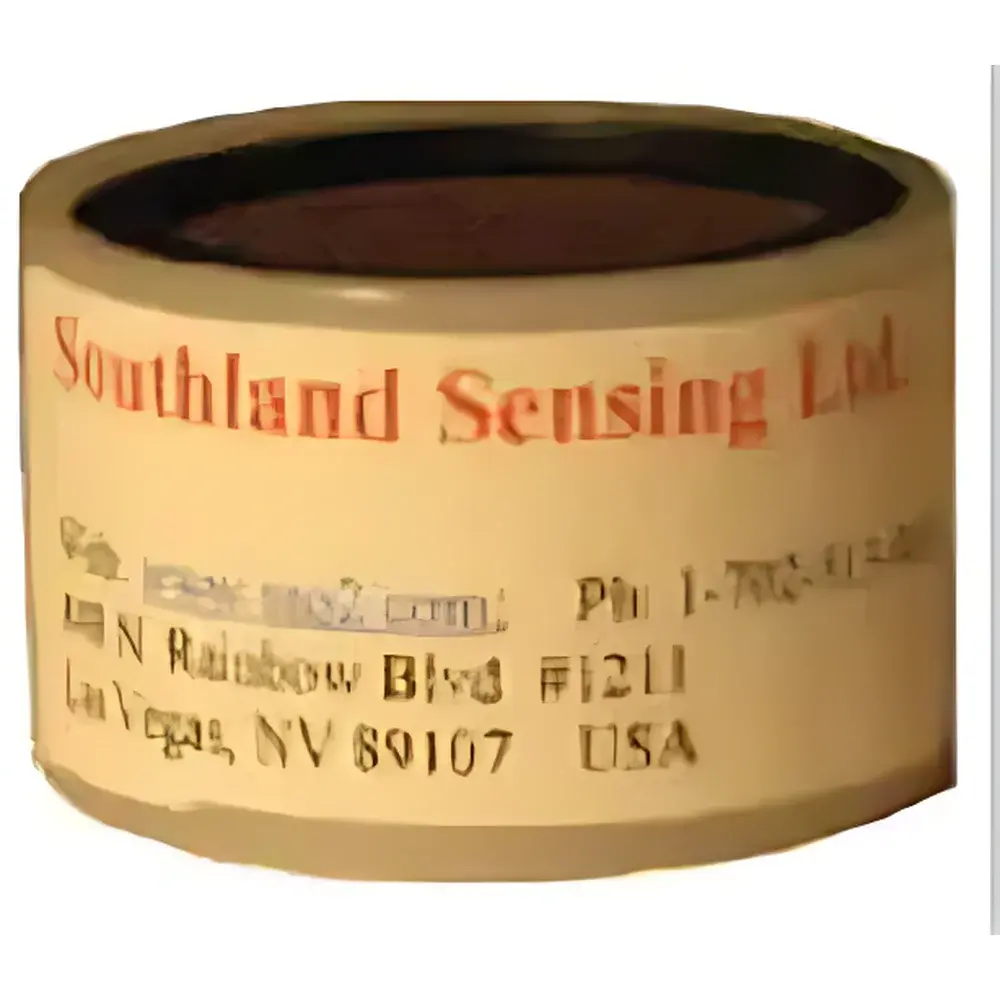
York Instrument TO2-1 Micro-Fuel-Cell Oxygen Sensor
| Brand | York Instrument |
|---|---|
| Origin | USA |
| Manufacturer Type | Manufacturer |
| Origin Category | Imported |
| Model | TO2-1 |
| Measurement Principle | Electrochemical Micro-Fuel-Cell |
| Detection Range (Trace) | 0–10 ppm to 0–10,000 ppm O₂ |
| Detection Range (Percent-Level) | 0–25% O₂ |
| Response Time (T90) | 13 s |
| Accuracy | ±2% of reading |
| Repeatability | ±0.5% |
| Temperature Coefficient | 2.5 %/°C |
| Operating Temperature | 0–50 °C |
| Storage Temperature | 0–45 °C |
| Recommended Flow Rate | 0.5–2 SCFH (0.24–0.94 L/min) |
| Humidity Range | 0–100% RH (non-condensing) |
| Expected Service Life | 15–21 months |
| Shelf Life | 3 months |
| Warranty | 6 months |
| Output Signal | 330–585 µA |
| Electrical Interface | Center Foil (Negative), Outer Foil (Positive) |
| Compliance | Compatible with ASTM D3764, ISO 8573-3, USP <915>, FDA 21 CFR Part 11 (when integrated into validated systems) |
Overview
The York Instrument TO2-1 is a high-stability electrochemical micro-fuel-cell oxygen sensor engineered for continuous, low-drift measurement of trace and percent-level oxygen concentrations in industrial process gas streams, inert gas purification systems, semiconductor purge environments, and laboratory-grade gas analyzers. Unlike paramagnetic or optical sensors, the TO2-1 operates on a galvanic fuel-cell principle: molecular oxygen diffuses through a selective membrane and undergoes reduction at the cathode, generating a linear current proportional to partial pressure—no external power supply is required. This passive, self-powered architecture ensures intrinsic safety in hazardous areas and eliminates zero drift associated with heated-element sensors. Designed for direct integration into OEM gas analyzers and custom monitoring platforms, the TO2-1 delivers reproducible performance across its full dynamic range—from sub-10 ppm detection limits up to 25% O₂—without recalibration between ranges. Its robust ceramic housing and PTFE diffusion barrier provide resistance to condensate, particulates, and moderate hydrocarbon exposure, making it suitable for demanding applications where long-term field stability and maintenance-free operation are critical.
Key Features
- True micro-fuel-cell design: Self-powered, zero-bias operation with no internal heater or excitation voltage
- Wide dual-range capability: Configurable for trace (0–10 ppm to 0–10,000 ppm) or percent-level (0–25%) O₂ measurement
- Fast T90 response time of ≤13 seconds under standard flow conditions (1.0 SCFH)
- High repeatability (±0.5%) and accuracy (±2% of reading) over calibrated temperature range (0–50 °C)
- Low temperature coefficient (2.5 %/°C) — compensated via external signal conditioning or digital correction algorithms
- Hermetically sealed construction with integrated PTFE hydrophobic membrane for humidity resilience (0–100% RH, non-condensing)
- Standard PCB-mount footprint with center-foil negative / outer-foil positive polarity for drop-in replacement
- Designed for compliance-ready integration: Supports audit trails, calibration logging, and data integrity protocols when paired with compatible host instrumentation
Sample Compatibility & Compliance
The TO2-1 is optimized for use in dry or moderately humid non-corrosive gas matrices including nitrogen, argon, helium, CO₂, hydrogen, and synthetic air. It is explicitly validated for O₂ measurement in high-purity CO₂ (e.g., beverage carbonation, food packaging, and laser gas mixes), where cross-sensitivity to CO₂ is negligible due to the electrochemical selectivity of the catalytic electrode system. While not rated for H₂S, Cl₂, SO₂, or halogenated solvents, the sensor exhibits tolerance to short-term exposure to <50 ppm CO and <100 ppm NOₓ when operated within specification. Regulatory alignment includes support for ISO 8573-3 (compressed air purity), ASTM D3764 (oxygen in plastic film permeation testing), and USP (oxygen content in pharmaceutical packaging headspace). When embedded in systems compliant with FDA 21 CFR Part 11, the TO2-1 enables electronic record retention with operator authentication, change control, and time-stamped calibration events.
Software & Data Management
As a transducer-level sensor, the TO2-1 outputs a raw analog current signal (330–585 µA) that requires external signal conditioning—typically a precision I/V converter followed by temperature compensation and linearization. York Instrument provides reference schematics and firmware libraries (C/C++, Python) for common microcontroller platforms (ARM Cortex-M, ESP32) to facilitate integration with data acquisition systems. The output supports 4–20 mA loop conversion or digitization via 16-bit ADCs with ≥0.1% FS resolution. For regulated environments, the sensor’s stable baseline and monotonic response enable implementation of GLP/GMP-compliant calibration workflows—including multi-point span verification, drift trending, and automated alarm thresholds tied to real-time O₂ deviation from setpoints.
Applications
- Ultra-high-purity nitrogen generator monitoring (ppm-level O₂ leak detection)
- Pharmaceutical lyophilizer chamber blanketing control
- Food & beverage modified-atmosphere packaging (MAP) line verification
- CO₂ laser gas mixture verification (O₂ impurity in CO₂/N₂/He blends)
- Electronics manufacturing: Inert glovebox O₂ scrubber efficiency validation
- Research-grade gas chromatography detector auxiliary monitoring
- OEM integration into portable gas analyzers for industrial hygiene and environmental screening
FAQ
What is the recommended flow rate for optimal TO2-1 performance?
A laminar flow of 0.5–2 SCFH (0.24–0.94 L/min) is specified to ensure consistent diffusion-limited response without membrane saturation or boundary-layer distortion.
Can the TO2-1 be used in CO₂-rich environments?
Yes—the TO2-1-2 variant is specifically characterized for stable operation in CO₂ matrices up to 100%, with minimal interference from CO₂ partial pressure fluctuations.
Does the sensor require periodic recalibration?
While inherently stable, annual verification against NIST-traceable zero and span gases is recommended for GxP applications; field recalibration intervals depend on exposure history and regulatory requirements.
How does temperature affect measurement accuracy?
The sensor exhibits a defined temperature coefficient of 2.5 %/°C; accurate compensation requires either hardware-based thermistor integration or software-based lookup table correction using simultaneous temperature readings.
Is the TO2-1 compatible with existing Teledyne, GE Panametrics, or AII sensor housings?
Mechanically and electrically pin-compatible with B-2, L-2, A-2, OX-1, PSR-12-223, and equivalent legacy modules—no adapter board or firmware modification required.