
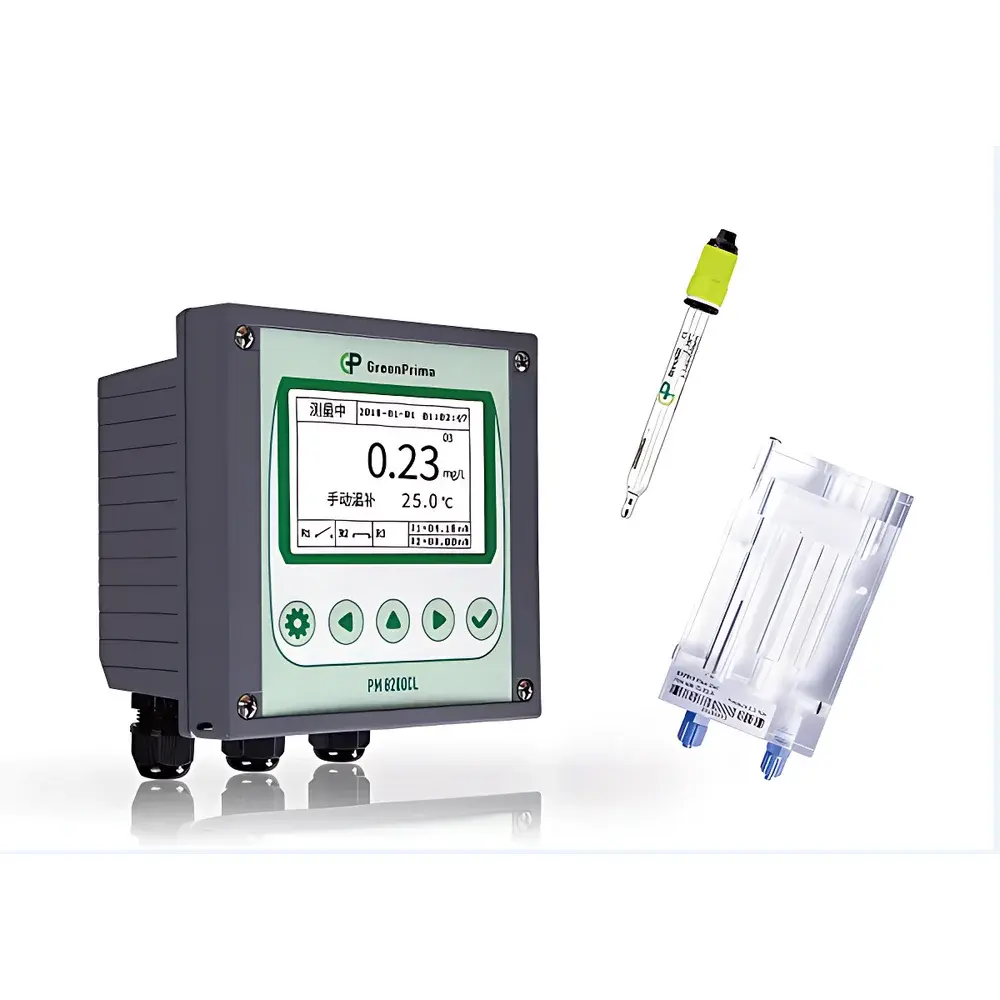
GreenPrima PM8200CL Residual Chlorine Analyzer for Industrial Process Water Disinfection
| Brand | GreenPrima |
|---|---|
| Origin | United Kingdom |
| Manufacturer | GreenPrima Ltd. |
| Type | Online Analyzer |
| Measurement Principle | Amperometric Electrochemical Sensor (Constant Potential) |
| Measured Parameter | Free Residual Chlorine |
| Range Options | 0–2.000 ppm and 0–20.00 ppm |
| Accuracy | ≤2% FS |
| Repeatability | 0.001 ppm |
| Resolution | 0.001 ppm (low range), 0.01 ppm (high range) |
| LOD | 0.001 ppm |
| Operating Temperature | 0–70 °C |
| Storage Temperature | −20–70 °C |
| Temperature Compensation | −10–130 °C (manual/automatic |
| Display | Backlit Graphic LCD |
| Languages | English, Simplified Chinese, Traditional Chinese |
| Data Storage | 600,000 records |
| Power Supply | 90–260 VAC, 50/60 Hz or optional 24 VDC |
| Analog Outputs | Two isolated 4–20 mA outputs (measurand-selectable: Cl₂, ClO₂, or O₃) |
| Digital Communication | RS485 Modbus RTU (HART optional) |
| Relay Outputs | Three programmable relays (2 × alarm, 1 × cleaning control) |
| Cleaning Cycle | Interval 0.1–1000 h, duration 1–1000 s |
| Enclosure Rating | IP65 |
| Dimensions | 144 × 144 × 106 mm |
| Panel Cutout | 138 × 138 mm |
| Weight | 0.86 kg |
Overview
The GreenPrima PM8200CL is a dedicated online residual chlorine analyzer engineered for continuous, reagent-free monitoring of free chlorine concentration in industrial process water systems. It operates on the amperometric electrochemical principle—specifically, constant-potential amperometry—using a three-electrode microcell configuration comprising two platinum working electrodes and one stable reference electrode (Ag/AgCl or similar). At a precisely controlled polarizing potential, hypochlorous acid (HOCl) and hypochlorite ion (OCl⁻) undergo selective electrochemical reduction at the cathode surface, generating a diffusion-limited current linearly proportional to the active chlorine species concentration. This method eliminates dependence on pH-dependent colorimetric reactions or chemical reagents, ensuring long-term stability, minimal maintenance, and high reproducibility under dynamic flow conditions typical of potable water distribution, beverage bottling lines, cooling tower circuits, and membrane pretreatment stages.
Key Features
- Reagent-free, membrane-free operation: No consumables, no electrolyte refills, no periodic membrane replacement—reducing total cost of ownership and operational downtime.
- Triple-analyte capability: Configurable for real-time measurement of free residual chlorine, chlorine dioxide (ClO₂), or dissolved ozone (O₃) via software-selectable calibration curves and electrode conditioning protocols.
- Robust electrochemical architecture: Dual platinum sensing electrodes with integrated interference suppression logic mitigate cross-sensitivity from oxidants such as hydrogen peroxide, nitrate, or transition metals commonly present in municipal or recycled water streams.
- Comprehensive digital and analog I/O: Two fully isolated 4–20 mA outputs for primary measurand (e.g., Cl₂), two for temperature, three relay outputs (two for high/low alarms with adjustable hysteresis, one for automated electrode cleaning control), and RS485 Modbus RTU for integration into SCADA or DCS platforms.
- Intelligent temperature compensation: Supports both manual and automatic compensation across −10–130 °C using either NTC10K or PT1000 sensors—critical for maintaining accuracy across seasonal variations or thermally unstable process points.
- High-integrity data handling: Onboard storage of up to 600,000 timestamped records with configurable logging intervals; compliant with GLP audit-trail requirements for regulated environments.
Sample Compatibility & Compliance
The PM8200CL is validated for use with clarified, low-turbidity aqueous streams typical of post-filtration, post-UV, or post-dechlorination process zones. It accommodates sample temperatures from 0–70 °C and pressures compatible with standard bypass sidestream configurations (up to 6 bar with appropriate flow cell selection). The system meets CE marking requirements per Directive 2014/30/EU (EMC) and 2014/35/EU (LVD). While not certified to ISO 9001 or ISO/IEC 17025 as a standalone device, its measurement methodology aligns with ASTM D1253 (Standard Test Method for Determining Residual Chlorine in Water) and supports compliance with WHO Guidelines for Drinking-water Quality and EPA Method 334.0 (amperometric titration equivalence). For pharmaceutical or food-grade applications, the analyzer’s reagentless design and traceable calibration protocol facilitate alignment with FDA 21 CFR Part 11 data integrity expectations when deployed with appropriate system-level validation documentation.
Software & Data Management
The embedded firmware supports multi-language UI (English, Simplified Chinese, Traditional Chinese) and provides intuitive navigation via membrane keypad. Calibration routines include single-point zero and span adjustment with optional multi-point verification. All calibration events, alarm triggers, relay activations, and cleaning cycles are time-stamped and stored locally. Data export is supported via USB interface (optional) or Modbus polling. The device does not require proprietary PC software for routine operation but offers configuration flexibility through standard Modbus register mapping—enabling seamless integration with third-party historian systems (e.g., Ignition, Siemens Desigo, Rockwell FactoryTalk). Audit logs retain operator actions, parameter changes, and system diagnostics for ≥12 months under default settings.
Applications
- Real-time monitoring of chlorine residual at final disinfection points in municipal drinking water treatment plants.
- Continuous verification of oxidative biocide dosing in HVAC cooling water systems to prevent Legionella proliferation.
- In-line quality assurance during beverage production—ensuring consistent disinfectant levels prior to filler sterilization without introducing analytical artifacts.
- Process control feedback for chlorine dosing pumps in semiconductor ultrapure water (UPW) loop make-up systems.
- Swimming pool and spa water management, where rapid response to bather load-induced chlorine demand fluctuations is essential.
- Validation support for chlorine contact time (CT) calculations required under US EPA Surface Water Treatment Rule (SWTR).
FAQ
Does the PM8200CL require daily maintenance or recalibration?
No. Under stable operating conditions, calibration verification is recommended every 7–30 days depending on water matrix complexity; full recalibration is typically required only after sensor replacement or exposure to fouling agents.
Can the same sensor measure chlorine dioxide and ozone interchangeably?
Yes—the BSENS650 sensor is chemically identical across all three analytes; measurement mode is selected in firmware, and each mode applies a distinct sensitivity factor and temperature correction algorithm optimized per oxidant redox kinetics.
Is the instrument suitable for seawater or brackish water applications?
Not without modification. Standard BSENS650 electrodes are optimized for freshwater matrices (TDS < 1000 mg/L); high chloride concentrations accelerate reference electrode drift and may necessitate custom Ag/AgCl reference designs or flow-cell dilution strategies.
How is sensor fouling mitigated during extended deployment?
The built-in cleaning relay automates mechanical or chemical cleaning cycles—users configure frequency (0.1–1000 h) and duration (1–1000 s) to match biofilm or scale accumulation rates observed at the installation site.
What cybersecurity provisions are included for Modbus communication?
The RS485 interface operates at the serial transport layer only; no network stack, web server, or remote access functionality is implemented—ensuring inherent isolation from IT network threats while preserving deterministic real-time control performance.
Related Products







