
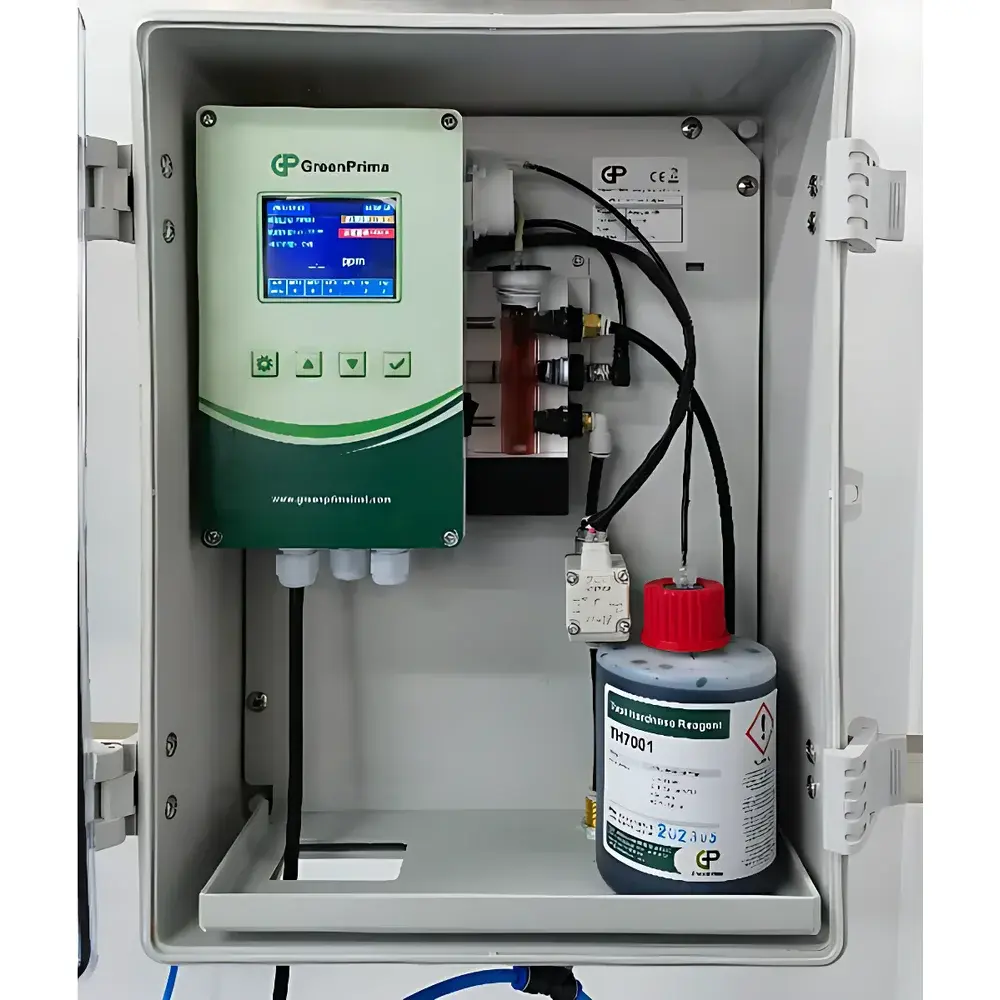
GreenPrima Aqualysis 800 Online Total Hardness Analyzer for Steam-Water Sampling Skids
| Brand | GreenPrima |
|---|---|
| Origin | Shanghai, China |
| Manufacturer Type | Manufacturer |
| Regional Classification | Domestic (China) |
| Model | Aqualysis 800 |
| Instrument Type | Online Water Quality Analyzer |
| Measured Parameter | Calcium & Magnesium Hardness (as CaCO₃) |
| Measurement Principle | Photometric Titration (Colorimetric Endpoint Detection) |
| Measurement Range | 0.447–625.8 ppm CaCO₃ (configurable via reagent kits TH7001–TH7100) |
| Accuracy | ±2% of selected reagent upper limit |
| Repeatability | ±1% of selected reagent upper limit |
| Cycle Time | ~3 minutes (hardness-dependent) |
| Display | Color LCD with bilingual (English/Chinese) UI |
| Dimensions | 400 × 300 × 180 mm (W×H×D) |
| Weight | 4 kg |
| Enclosure Rating | IP65 |
| Power Supply | 85–265 VAC, 47–63 Hz |
| Power Consumption | 25 VA (operational), 3.5 VA (standby) |
| Output Interfaces | 4 programmable relay outputs (250 VAC, 4 A max), 1 isolated 4–20 mA analog output (750 Ω max), 1 RS485 Modbus RTU port |
| Digital Inputs | 2 programmable (IN1: start analysis |
| IN2 | stop analysis) |
| Data Logging | Internal storage for time-stamped measurement records |
| Sample Requirements | pH 4–10 |
| Sample Temp. | 5–40 °C |
| Ambient Temp. | 10–40 °C |
| Operating Pressure | 0.2–6 bar (recommended: 1–2 bar) |
| Mounting | Wall-mounted |
| Calibration & Maintenance | Factory-calibrated |
Overview
The GreenPrima Aqualysis 800 Online Total Hardness Analyzer is an industrial-grade photometric titration system engineered for continuous, real-time monitoring of total hardness—expressed as calcium carbonate (CaCO₃)—in critical water streams. Designed specifically for integration into steam-water sampling skids used in power generation, pharmaceutical manufacturing, and high-purity industrial water systems, the instrument implements a standardized colorimetric endpoint detection method compliant with ASTM D1126 and ISO 6059. It delivers traceable, reproducible results by automating the EDTA-based titration process: sample aspiration, precise reagent dosing (buffer, indicator, and titrant), optical endpoint recognition via dual-wavelength photometry, and digital signal processing. Its architecture eliminates manual intervention while maintaining metrological rigor—making it suitable for environments requiring adherence to USP , EP 2.2.42, and FDA 21 CFR Part 11 data integrity standards when paired with validated software configurations.
Key Features
- Compact wall-mountable enclosure (400 × 300 × 180 mm, 4 kg) with IP65-rated housing for deployment in utility corridors, boiler rooms, and clean utility areas.
- Bilingual (English/Chinese) color LCD interface with intuitive navigation, real-time trend graphs, and configurable alarm thresholds.
- Modular reagent kit compatibility (TH7001 to TH7100) supporting six distinct measurement ranges—from ultra-low hardness (0.447 ppm) to high-hardness industrial feedwater (625.8 ppm CaCO₃).
- Programmable measurement intervals (0–360 minutes) and customizable rinse duration (15–1800 seconds) to optimize response time and reagent economy.
- Four independent relay outputs for direct control of softener regeneration cycles, valve actuation, or SCADA alarm triggers; two digital inputs enable synchronization with external analyzers or PLC-initiated sampling events.
- Integrated data management: timestamped internal logging, Modbus RTU over RS485 for PLC/HMI integration, and isolated 4–20 mA analog output compatible with DCS systems.
Sample Compatibility & Compliance
The Aqualysis 800 operates reliably within defined physicochemical constraints: sample pH must remain between 4.0 and 10.0; transition metal interference is minimized by strict limits on iron (<3 ppm), copper (<0.2 ppm), aluminum (<0.1 ppm), and manganese (<0.2 ppm). These specifications align with ASTM D511 and ISO 9963-1 preconditions for hardness determination. The analyzer meets IEC 61326-1 for electromagnetic compatibility in industrial environments and conforms to CE marking requirements for safety and emissions. For regulated pharmaceutical applications, its firmware supports audit-trail-enabling configurations—when deployed with compliant data acquisition software—to satisfy GLP/GMP documentation requirements under Annex 11 and ALCOA+ principles.
Software & Data Management
While the Aqualysis 800 operates autonomously via embedded firmware, its RS485 interface enables seamless integration with supervisory control systems using standard Modbus RTU protocol. All measurement events—including calibration timestamps, reagent lot tracking, fault logs, and operator actions—are stored locally with millisecond precision. Optional cloud-connected gateways (e.g., GreenPrima MCS Edge Hub) allow encrypted remote access, historical trend visualization, and predictive maintenance alerts based on reagent consumption rates and cycle consistency. Data export supports CSV and XML formats for LIMS ingestion, and optional 21 CFR Part 11-compliant electronic signature modules are available for validation-critical installations.
Applications
- Continuous hardness monitoring of boiler feedwater and condensate return lines to prevent scale formation and ensure ASME PTC 19.11 compliance.
- Real-time verification of softener effluent quality in pharmaceutical purified water (PW) and water-for-injection (WFI) distribution loops per USP and EU GMP Annex 1.
- Performance evaluation of ion exchange and reverse osmosis pretreatment stages in power plant makeup water systems.
- Automated hardness surveillance in closed-loop cooling towers to support corrosion and deposition risk modeling per CTI Guidelines.
- Integration into multi-analyte steam-water sampling skids (e.g., for simultaneous conductivity, silica, sodium, and dissolved oxygen monitoring) via GreenPrima’s MCS series multi-channel selector.
FAQ
What measurement principle does the Aqualysis 800 employ?
It uses automated photometric titration with EDTA, detecting the colorimetric endpoint via dual-wavelength absorbance measurement—fully aligned with ISO 6059 and ASTM D1126.
Can the instrument be calibrated without certified reference standards?
No. Initial calibration and periodic verification require NIST-traceable hardness standards (e.g., CaCO₃ solutions at 50, 100, and 250 ppm); factory calibration certificates are provided with each unit.
Is the analyzer suitable for high-pressure sampling lines?
Yes—when installed with appropriate pressure-reducing regulators and sample coolers, it accepts inlet pressures up to 6 bar; optimal operation occurs at 1–2 bar with temperature-controlled sample conditioning.
How often must reagents be replaced?
Depending on measurement frequency and selected range, standard reagent kits (e.g., TH7030) support 30–90 days of continuous operation; low-consumption design minimizes waste and disposal burden.
Does the device support remote diagnostics and firmware updates?
Yes—via RS485-connected gateways or optional Ethernet/WiFi modules; secure OTA updates follow IEC 62443-3-3 guidelines for industrial cyber security.







