
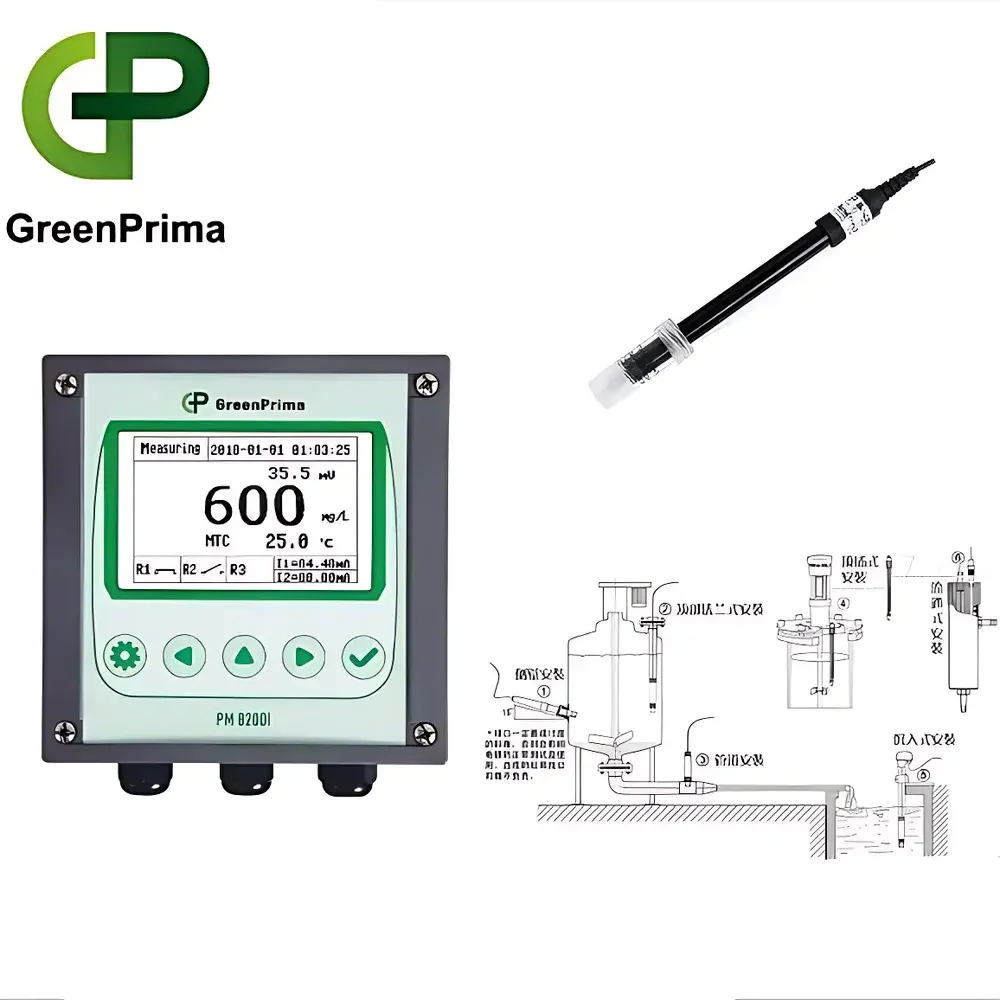
GreenPrima PM8200I Online Calcium Hardness Analyzer – Ion-Selective Electrode (ISE) Method
| Brand | GreenPrima |
|---|---|
| Origin | United Kingdom |
| Manufacturer | GreenPrima Ltd. |
| Type | Online Multi-Ion Analyzer |
| Model | PM8200I |
| Measurement Range | 0.01–40,400 mg/L CaCO₃-equivalent |
| Detection Limit | 0.01 mg/L |
| Response Time | 5 s |
| Accuracy | ±0.01 mg/L (low range), ±3% FS (sensor) |
| Temperature Range | 0–80 °C |
| Output | Dual isolated 4–20 mA, RS485 Modbus RTU, optional HART |
| Enclosure Rating | IP65 |
| Power | 90–260 VAC / 24 VDC |
| Dimensions | 144 × 144 × 106 mm |
| Weight | 0.86 kg |
| Sensor | Bsens740 calcium-selective composite electrode (PPS body, PG13.5 thread, 5 m cable, max. pressure 3.5 bar) |
Overview
The GreenPrima PM8200I Online Calcium Hardness Analyzer is a dedicated, industrial-grade instrument engineered for continuous, real-time measurement of calcium hardness in aqueous streams using potentiometric ion-selective electrode (ISE) technology. Unlike colorimetric or titrimetric methods, the PM8200I employs a solid-state calcium-selective composite electrode (Bsens740) that generates a stable Nernstian potential proportional to the logarithm of free Ca²⁺ activity—converted and reported as total calcium hardness expressed in mg/L as CaCO₃. This principle ensures direct, reagent-free quantification without sample digestion, chemical dosing, or optical path interference. Designed for permanent installation in process water loops, boiler feedwater systems, cooling towers, pharmaceutical purified water (PW) distribution networks, and semiconductor ultrapure water (UPW) recirculation lines, the analyzer delivers high reproducibility under variable flow, temperature, and background ionic strength conditions. Its robust architecture supports long-term unattended operation with minimal drift—critical for compliance with pharmacopeial water quality requirements (e.g., USP , EP 2.2.43) and industrial pretreatment control.
Key Features
- True online ISE-based calcium hardness measurement—no reagents, no consumables, no moving parts, zero risk of tubing clogging or liquid leakage
- Integrated Bsens740 calcium-selective electrode with chemically resistant PPS housing, rated to 3.5 bar and -5 to 70 °C, suitable for pressurized piping and submerged mounting
- Dual-range controller with selectable resolution (0.01 / 0.1 / 1 mg/L) and configurable accuracy modes aligned to application-critical thresholds
- Automatic temperature compensation using NTC10K or PT1000 sensor input; compensated range spans -10 to 130 °C for full thermal stability across steam-condensate and chilled-water applications
- Backlit high-contrast dot-matrix LCD display showing real-time Ca²⁺ concentration, measured temperature, system status, relay states, and timestamped events
- Two fully programmable 4–20 mA analog outputs—assignable to hardness value, temperature, or diagnostic status—with 0.1% FS linearity and galvanic isolation up to 500 Ω loop resistance
- RS485 interface supporting standard Modbus RTU protocol for seamless integration into SCADA, DCS, or MES platforms; optional HART 7.5 output available for legacy asset management systems
- Configurable cleaning cycle (0.1–1000 h interval; 1–1000 s duration) via dedicated relay output—enabling automated electrode surface maintenance in high-fouling environments
Sample Compatibility & Compliance
The PM8200I is validated for use in low-to-moderate conductivity waters (typical range: 10–2000 µS/cm) including municipal surface water, groundwater, reverse osmosis permeate, deionized water, and steam condensate. It maintains measurement integrity in the presence of common interferents such as Mg²⁺, Na⁺, K⁺, and Cl⁻ at typical environmental and industrial concentrations—though elevated Mg²⁺ (>100 mg/L) may require empirical correction per ASTM D1126-22 Annex A4. The system complies with IEC 61326-1 (EMC for industrial environments), IEC 61000-4 series immunity standards, and meets CE marking requirements for electrical safety (IEC 61010-1). Its firmware architecture supports audit-trail-enabled calibration logging and user-access control (via password-protected setup mode), facilitating alignment with GLP and GMP documentation practices under FDA 21 CFR Part 11 where electronic records are retained.
Software & Data Management
The PM8200I embeds non-volatile memory capable of storing up to 10,000 timestamped measurement records—including hardness values, temperature readings, calibration timestamps, alarm events, and relay activation logs. Local data retrieval is supported via on-device menu navigation with scrollable history and export-ready CSV formatting upon USB memory stick insertion (optional accessory). Remote configuration and diagnostics are achievable through Modbus register mapping: all critical parameters—including calibration coefficients, alarm setpoints, output scaling, and cleaning schedules—are modifiable via host PLC or engineering workstation. Firmware updates are performed via secure UART bootloader protocol, ensuring version traceability and rollback capability. No cloud dependency or proprietary software is required—integration relies solely on open industrial protocols.
Applications
- Boiler feedwater monitoring to prevent scale formation in high-pressure steam generation systems
- Pharmaceutical water-for-injection (WFI) and purified water (PW) loop surveillance per EU GMP Annex 1 and WHO TRS 992
- Cooling tower blowdown control to optimize water reuse and minimize antiscalant dosing
- Electroplating bath chemistry management where Ca²⁺ accumulation affects coating adhesion and bath stability
- Food & beverage process water verification prior to CIP/SIP cycles and final product contact
- Municipal drinking water treatment plant effluent compliance reporting against local hardness limits (e.g., WHO Guideline Value: ≤200 mg/L as CaCO₃)
FAQ
How does the PM8200I differentiate calcium hardness from total hardness?
The PM8200I measures free Ca²⁺ activity specifically via its calcium-selective membrane. Total hardness (Ca²⁺ + Mg²⁺) requires either parallel magnesium measurement or laboratory titration (e.g., EDTA method per ISO 6059); this instrument reports only calcium contribution.
Is field calibration required, and how often?
Initial two-point calibration (e.g., 50 mg/L and 500 mg/L CaCO₃ standards) is mandatory after installation or electrode replacement. Subsequent verification is recommended every 30–90 days depending on fouling risk; drift exceeding ±5% of span triggers recalibration.
Can the Bsens740 electrode be used in seawater or brine?
No. High chloride and sodium concentrations cause severe ISE membrane interference and accelerated aging. The electrode is specified for freshwater and low-salinity process streams only (TDS < 1000 mg/L).
Does the analyzer support automatic pH compensation?
No. Calcium ISE response is pH-dependent below pH 5 and above pH 11. For accurate results, sample pH must be maintained between 5.5 and 10.5—typically achieved via inline pH stabilization or bypass stream conditioning.
What maintenance tasks are required beyond electrode cleaning?
Annual verification of temperature sensor accuracy and biannual inspection of O-ring integrity at the electrode thread interface are recommended. Electrode lifetime averages 18–24 months in clean, non-abrasive water; replacement is indicated by >15 mV drift in zero-solution potential or failure to stabilize within 60 s.







