
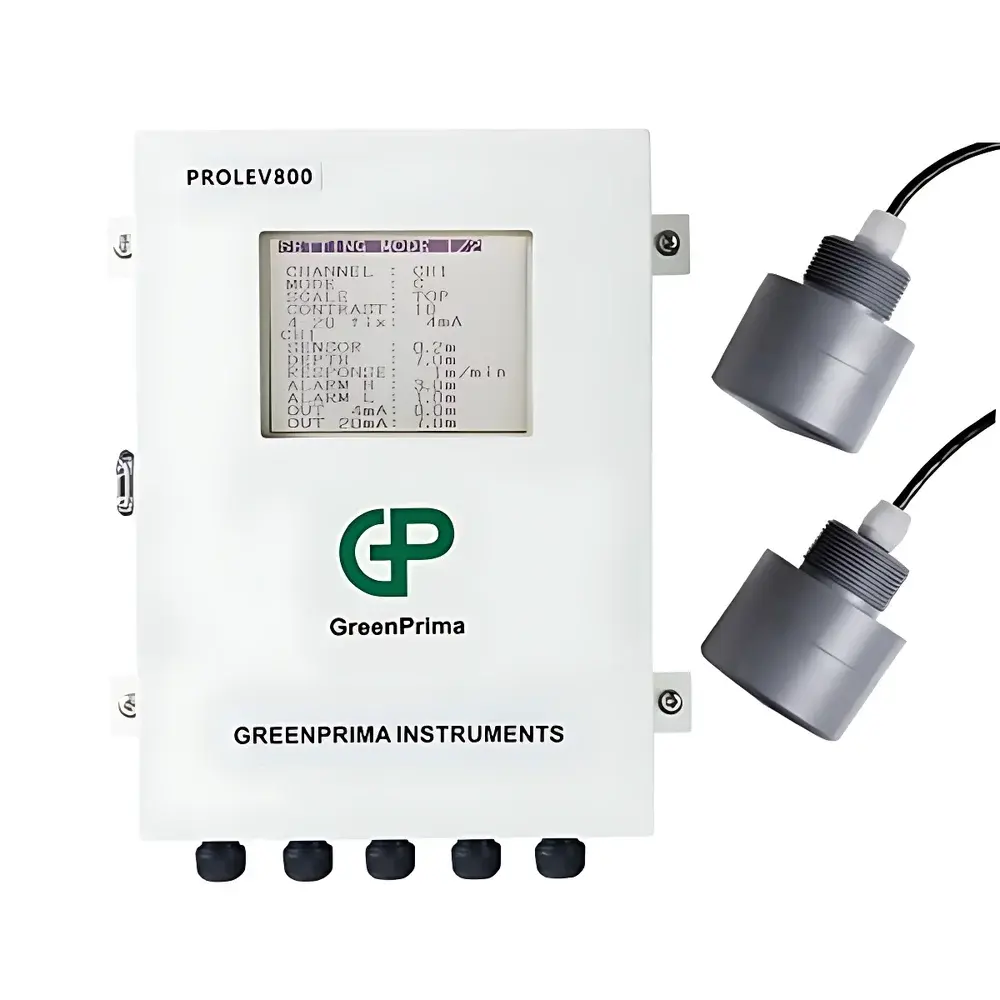
GreenPrima PROLEV800 Ultrasonic Sludge Blanket Level Monitor
| Brand | GreenPrima |
|---|---|
| Origin | UK |
| Manufacturer Type | Manufacturer |
| Origin Category | Imported |
| Model | PROLEV 800 |
| Price | Upon Request |
| Measurement Range | 0.4–10 m |
| Sensor Capacity | 2 independent probes |
| Accuracy | ±1 cm |
| Response Time | 1 s |
| Operating Temperature | −20 to +60 °C |
| Display | Large LCD with graphical interface (numerical, trend plot, echo waveform) |
| Enclosure Rating | IP68 |
| Weight | 3.6 kg (transmitter), 3 kg (probe) |
| Output | 4–20 mA analog output |
| Alarms | 2 programmable high/low level relays |
| Communication | RS-232C (≤10 m cable length) |
| Power Supply | 85–264 VAC, 10 VA |
| Cable Length | 20 m |
| Backlight Adjustment | Yes |
| Trend Storage | 5 min to 48 h history on display |
Overview
The GreenPrima PROLEV 800 Ultrasonic Sludge Blanket Level Monitor is an industrial-grade, non-contact level measurement system engineered for continuous, real-time monitoring of sludge blanket depth in clarifiers, thickeners, and settling basins. It operates on the principle of time-of-flight ultrasonic pulse-echo measurement: a transducer emits a high-frequency acoustic pulse (typically 1–5 MHz) downward into the liquid column; the elapsed time between transmission and reception of the reflected signal from the sludge–liquid interface is precisely measured and converted into distance using the speed of sound in water (adjusted for temperature). This method enables robust discrimination between the clear supernatant layer and the denser, acoustically attenuating sludge blanket—without requiring immersion, moving parts, or direct contact with suspended solids. The instrument is designed for integration into municipal wastewater treatment plants, coal washing facilities, power station ash ponds, and potable water pre-sedimentation units where reliable, long-term interface tracking is critical for process control and regulatory compliance.
Key Features
- Large-format backlit LCD display supporting simultaneous numeric readout, real-time echo waveform visualization, and dynamic trend plotting (selectable time windows: 5 minutes to 48 hours)
- Dual-probe capability: single transmitter unit supports two independently mounted ultrasonic sensors—enabling differential profiling (e.g., center vs. edge) or redundancy configuration
- Embedded microprocessor with adaptive signal processing algorithms that filter noise from turbulent flow, floating scum, or gas entrainment while maintaining stable interface detection
- No mechanical actuators or wear-prone components—ensuring minimal maintenance and extended service life in harsh, high-solids environments
- Configurable 4–20 mA analog output with linear or square-root scaling, plus two user-defined relay outputs for high/low blanket-level alarms
- RS-232C serial interface for local diagnostics, firmware updates, and raw data logging (cable run ≤10 m)
- IP68-rated housing for both transmitter and probe—suitable for outdoor mounting and submersion up to 10 m depth
- Adjustable display brightness and configurable auto-off settings to optimize visibility under varying ambient light conditions
Sample Compatibility & Compliance
The PROLEV 800 is validated for use in heterogeneous aqueous suspensions containing organic and inorganic particulates typical of activated sludge, primary settleables, anaerobic digester feed, coal fines, fly ash slurries, and lime softening precipitates. Its acoustic design accommodates variable sludge density gradients (from 1.005 to >1.08 g/cm³) and moderate surface turbulence without loss of interface lock. While not certified to a specific ISO or ASTM standard as a standalone device, its measurement methodology aligns with principles referenced in ISO 10703 (water quality — determination of suspended solids), EPA Method 160.1 (total suspended solids), and EN 14855 (sludge characterization). When integrated into SCADA or DCS systems, the 4–20 mA output and alarm relays support compliance with IEC 61511 (functional safety for SIS) and can be configured to meet GLP/GMP audit requirements via external data logging and timestamped event records.
Software & Data Management
The PROLEV 800 operates autonomously without external software dependency. All configuration—including zero calibration, range setting, damping factor, alarm thresholds, and trend duration—is performed locally via intuitive menu navigation on the LCD. Raw echo amplitude and transit-time data are continuously processed onboard; no proprietary drivers or PC-based utilities are required for routine operation. For archival and trending beyond the built-in 48-hour window, the RS-232C port permits connection to third-party HMI platforms or PLCs supporting Modbus ASCII or custom ASCII protocols. Output data includes current interface height (m), status flags (e.g., “signal weak”, “no echo”, “out of range”), and diagnostic counters—enabling predictive maintenance scheduling based on signal-to-noise ratio decay trends over time.
Applications
- Optimization of return activated sludge (RAS) and waste activated sludge (WAS) pumping rates in secondary clarifiers
- Monitoring separation efficiency in gravity thickeners and dissolved air flotation (DAF) units
- Control of underflow concentration in lamella settlers and inclined plate clarifiers
- Real-time assessment of sludge blanket rise during shock loading events or nitrification/denitrification upsets
- Performance verification of chemical coagulation/flocculation dosing in potable water treatment
- Level surveillance in coal preparation plant tailings thickeners and power plant ash settling ponds
FAQ
Can the PROLEV 800 distinguish between multiple layers (e.g., scum, sludge, and clear water)?
The instrument is optimized to detect the dominant acoustic impedance discontinuity—typically the sludge–supernatant interface. While advanced echo analysis may reveal secondary reflections, it does not provide multi-layer decomposition like dedicated ultrasonic stratification analyzers.
Is temperature compensation automatic?
Yes—the transmitter incorporates an internal temperature sensor and applies real-time speed-of-sound correction using the empirical equation for water between 0–40 °C; manual offset adjustment is available for extreme ambient deviations.
What is the maximum recommended installation height above the liquid surface?
Mounting height must ensure full beam coverage across the target interface zone; GreenPrima recommends ≤1.5 m clearance for optimal near-field resolution and avoidance of side-wall interference.
Does the system support HART or Modbus RTU communication?
No—only RS-232C ASCII protocol is provided. Integration with HART or Modbus networks requires an external protocol converter.
How often is calibration required?
Factory calibration is stable over time; field verification using a known reference distance (e.g., calibrated tape measure or laser distance meter) is recommended annually or after physical repositioning of the sensor.
Related Products







