
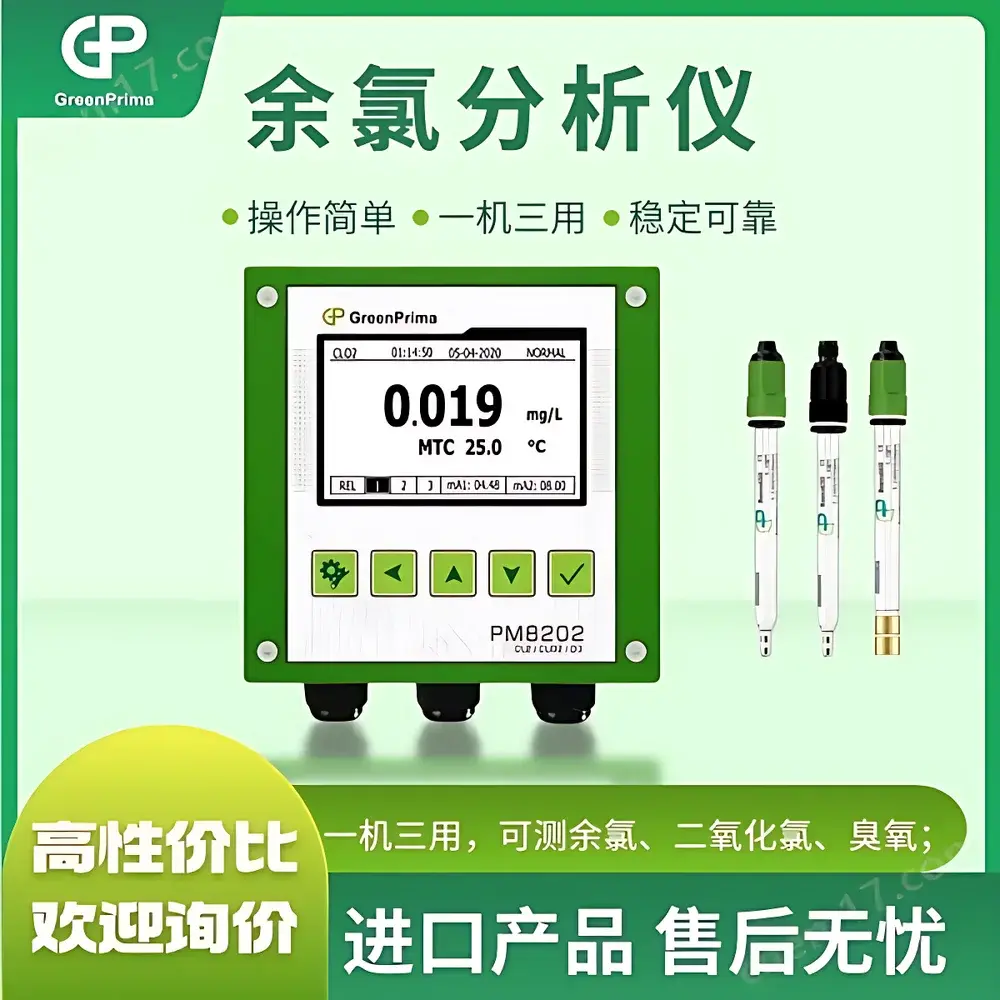
GreenPrima PM8202CL Residual Chlorine and Chlorine Dioxide Analyzer
| Brand | GreenPrima |
|---|---|
| Origin | United Kingdom |
| Manufacturer Type | Original Equipment Manufacturer (OEM) |
| Product Category | Imported Instrument |
| Model | PM8202CL |
| Instrument Type | Online Analyzer |
| Measurement Principle | Amperometric Constant-Voltage Detection |
| Measured Parameters | Free Chlorine, Total Chlorine, Chlorine Dioxide, Ozone |
| Range | 0.00–20.00 ppm / 0.00–200.00 ppb |
| Accuracy | ±2% of Full Scale (F.S.) |
| Resolution | 0.001 ppm / 0.01 ppm |
| Temperature Compensation | –10 to +130 °C (NTC10K or PT1000 sensor compatible) |
| Operating Temperature | –10 to +70.0 °C |
| Storage Temperature | –20 to +70.0 °C |
| Display | Backlit Graphic LCD (Chinese/English Switchable) |
| Data Storage | 600,000 records |
| Power Supply | 90–260 VAC, 50/60 Hz or Optional 24 VDC |
| Output | Dual Isolated 4–20 mA (0.1% F.S., max. loop resistance 500 Ω), RS485 Modbus RTU |
| Relay Outputs | 2 programmable Hi/Lo alarms (5 A / 250 VAC / 30 VDC) |
| Cleaning Control | Adjustable interval (0.1–1000 h) and duration (1–1000 s) |
| Enclosure Rating | IP65 |
| Dimensions (W×H×D) | 144 × 144 × 108 mm |
| Panel Cutout | 138 × 138 mm |
| Weight | 0.87 kg |
Overview
The GreenPrima PM8202CL is a high-stability online residual chlorine and chlorine dioxide analyzer engineered for continuous, real-time monitoring in municipal drinking water distribution systems, hospital wastewater treatment streams, secondary water supply networks, and industrial process water circuits. It operates on the amperometric constant-voltage detection principle—applying a fixed polarization potential across a dual-platinum (Bsens650) or gold (Bsens660) working electrode pair immersed in a precisely regulated flow cell (BAF615 constant-flow chamber). This electrochemical architecture enables selective, membrane-free oxidation current measurement proportional to free chlorine, total chlorine, chlorine dioxide, and ozone concentrations. Unlike colorimetric or DPD-based methods, the PM8202CL requires no reagents, zero sample pre-treatment, and eliminates consumables such as replacement membranes or electrolyte solutions—reducing operational overhead while maintaining trace-level sensitivity and long-term baseline stability.
Key Features
- Triple-analyte capability: Simultaneous or configurable measurement of free chlorine, chlorine dioxide, and ozone without hardware modification
- Reagent-free, membrane-free amperometric sensing with dual-platinum or gold electrodes for enhanced interference rejection and extended service life
- Integrated BAF615 constant-flow chamber ensuring laminar, pressure-independent sample delivery at stable hydraulic residence time
- Full-featured controller with backlit graphic LCD supporting both English and Chinese UI, password-protected configuration access, and intuitive menu navigation
- Dual isolated 4–20 mA analog outputs assignable to measured parameter and temperature; RS485 Modbus RTU interface for SCADA and DCS integration
- Two independent relay outputs with user-defined alarm thresholds, hysteresis control, and fail-safe status reporting
- Programmable automatic cleaning sequence with adjustable frequency (0.1–1000 hours) and duration (1–1000 seconds)
- Robust IP65-rated enclosure suitable for wall-mount, panel-mount, or inline pipe installation in humid or chemically aggressive environments
- Comprehensive data logging: 600,000 timestamped records with parameter value, temperature, and system status flags
Sample Compatibility & Compliance
The PM8202CL is validated for use in potable water matrices meeting WHO Guidelines for Drinking-water Quality and EU Directive 98/83/EC. Its amperometric sensor design inherently tolerates moderate turbidity (<50 NTU), pH range 4.0–8.5, and common background ions (e.g., Cl⁻, SO₄²⁻, NO₃⁻) without cross-sensitivity. Calibration verification follows ASTM D6503–22 (Standard Practice for Determination of Residual Chlorine in Water by Amperometric Titration) and ISO 7393-2:2017 (Water quality — Determination of free chlorine and total chlorine — Part 2: Method using N,N-diethyl-p-phenylenediamine (DPD)). While not a Class I medical device, its output integrity supports GLP-compliant documentation when paired with audit-trail-enabled SCADA systems adhering to FDA 21 CFR Part 11 requirements for electronic records.
Software & Data Management
Data acquisition and configuration are managed via the embedded firmware with non-volatile flash memory. All logged entries include UTC timestamps, measured concentration, compensated temperature, sensor status (e.g., electrode offset, flow fault), and calibration history. Export is supported through Modbus register polling or manual USB dump (via optional adapter). The system maintains full traceability: each calibration event records date/time, standard concentration used, operator ID (if entered), and post-calibration verification deviation. Firmware updates are performed via secure serial upload with checksum validation, preserving configuration integrity across revisions.
Applications
- Municipal drinking water treatment plants: Real-time monitoring at chlorination contact tanks, clearwells, and distribution system entry points
- Hospital central sterile supply departments (CSSD) and wastewater disinfection units requiring ozone or chlorine dioxide verification
- High-rise building secondary water supply systems where residual biocide decay must be tracked across vertical distribution
- Pharmaceutical facility purified water (PW) and water-for-injection (WFI) loop sanitization validation
- Food & beverage production lines using chlorine-based sanitizers for CIP rinse verification
- Swimming pool and spa water management systems requiring multi-oxidant control
FAQ
Does the PM8202CL require daily maintenance or reagent replenishment?
No. It operates without chemical reagents, membranes, or liquid electrolytes. Routine maintenance is limited to periodic sensor cleaning (automated or manual) and annual verification against NIST-traceable standards.
Can the same sensor measure free chlorine, total chlorine, and chlorine dioxide interchangeably?
Yes—electrode selection (Bsens650 for chlorine species, Bsens660 for ozone and ClO₂) and software configuration determine analyte specificity. No hardware swap is needed between chlorine and chlorine dioxide modes.
Is temperature compensation automatic and configurable?
Yes. The system accepts either NTC10K or PT1000 temperature probes and applies polynomial-based compensation across –10 to +130 °C. Manual offset adjustment is available for fine-tuning in non-standard thermal environments.
What cybersecurity protocols does the RS485 Modbus interface support?
Modbus RTU operates at the serial transport layer and does not include native encryption. Secure deployment requires network-level segmentation, firewall rules, and physical access control per IEC 62443-3-3 guidelines for industrial automation systems.
How is calibration traceability documented for regulatory audits?
Each calibration event is stored with timestamp, standard concentration, operator ID, and residual error. When integrated into validated LIMS or MES platforms, this data satisfies ALCOA+ principles (Attributable, Legible, Contemporaneous, Original, Accurate, Complete, Consistent, Enduring, Available) for GMP/GLP compliance.
Related Products







