
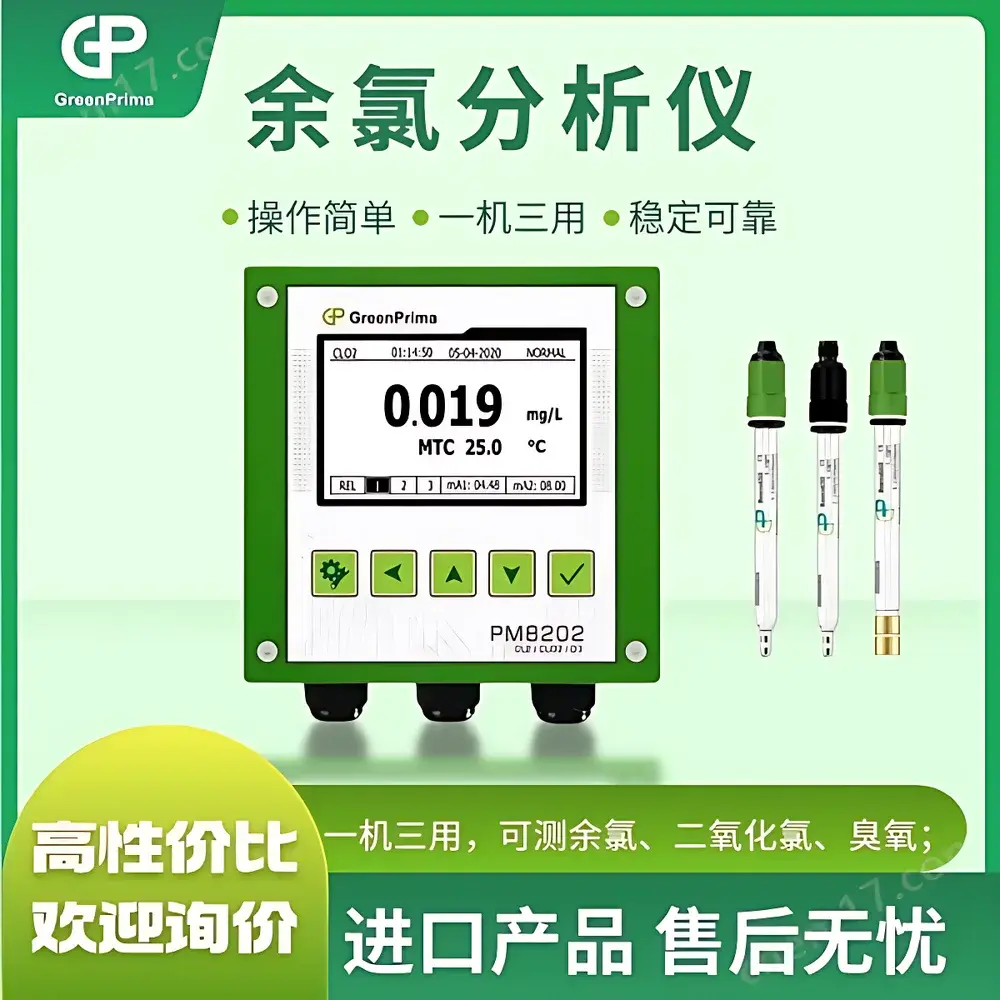
GreenPrima PM8202CL Electrochemical Residual Chlorine, Chlorine Dioxide and Ozone Analyzer
| Brand | GreenPrima |
|---|---|
| Origin | United Kingdom |
| Manufacturer Type | Original Equipment Manufacturer (OEM) |
| Product Category | Imported Instrument |
| Model | PM8202CL |
| Instrument Type | Online Analyzer |
| Measurement Principle | Amperometric Constant-Voltage Electrochemistry |
| Measured Parameters | Free Chlorine, Total Chlorine, Chlorine Dioxide, Ozone |
| Range | 0.00–20.00 ppm / 0.00–200.00 ppb |
| Accuracy | ±2% of Full Scale (F.S.) |
| Resolution | 0.001 ppm / 0.01 ppm |
| Temperature Compensation | –10 to +130 °C (NTC10K or PT1000 sensor support) |
| Operating Temperature | –10 to +70.0 °C |
| Storage Temperature | –20 to +70.0 °C |
| Display | Backlit Graphic LCD (Chinese/English Switchable) |
| Data Storage | 600,000 records |
| Power Supply | 90–260 VAC, 50/60 Hz or 24 VDC optional |
| Output | Dual isolated 4–20 mA (≤500 Ω, 0.1% F.S.), RS485 Modbus RTU |
| Relay Outputs | Two programmable Hi/Lo alarms (5 A / 250 VAC / 30 VDC) |
| Cleaning Control | Adjustable interval (0.1–1000 h) and duration (1–1000 s) |
| Enclosure Rating | IP65 |
| Dimensions | 144 × 144 × 108 mm |
| Panel Cutout | 138 × 138 mm |
| Weight | 0.87 kg |
Overview
The GreenPrima PM8202CL is an online electrochemical analyzer engineered for continuous, real-time monitoring of free chlorine, total chlorine, chlorine dioxide, and ozone in aqueous systems. It operates on the principle of amperometric constant-voltage electrochemistry—applying a fixed polarization potential across a dual-electrode sensing cell to drive selective redox reactions at the working electrode surface. The resulting current is linearly proportional to the concentration of oxidizing species present, enabling stable, drift-free measurement without chemical reagents or optical components. Unlike colorimetric or DPD-based methods, this technique eliminates interferences from turbidity, color, or organic matter, making it ideal for challenging matrices such as hospital wastewater, secondary distribution networks, and industrial process water where sample pretreatment is impractical or undesirable.
Key Features
- True multi-analyte capability: Simultaneous or sequential measurement of residual chlorine (free and total), chlorine dioxide, and ozone using interchangeable or configurable sensor modules (Bsens650 Pt/Pt or Bsens660 Au/Pt electrode pairs)
- Reagent-free, membrane-free operation: No consumables—including no electrolyte refills, no replaceable membranes, and no DPD tablets—reducing long-term cost of ownership and maintenance burden
- Integrated BAF615 flow-controlled cell: Maintains consistent laminar flow across the electrode surface, minimizing boundary layer effects and ensuring reproducible mass transport conditions
- Dual isolated 4–20 mA analog outputs with user-selectable scaling for primary measurement and temperature; fully compliant with industrial signal standards
- RS485 Modbus RTU interface for integration into SCADA, DCS, or PLC-based supervisory systems; supports standard register mapping for seamless data acquisition
- Configurable cleaning cycle with adjustable frequency (0.1–1000 hours) and duration (1–1000 seconds) to mitigate biofouling and deposit accumulation on electrode surfaces
- Robust IP65-rated enclosure suitable for wall-mount, panel-mount, or inline pipe installation in humid or splash-prone environments
- Full-featured data logging: Stores up to 600,000 timestamped records including measured values, temperature, alarm status, and system diagnostics
Sample Compatibility & Compliance
The PM8202CL is validated for use in potable water distribution systems, healthcare facility effluent streams, cooling tower circuits, food & beverage process lines, and municipal secondary supply networks. Its electrochemical architecture meets functional requirements aligned with ISO 7888 (water quality — determination of residual chlorine), ASTM D1253 (standard test method for residual chlorine in water), and US EPA Method 334.0 (amperometric titration for chlorine species). While not a certified reference method per se, its performance characteristics—including ±2% F.S. accuracy, sub-ppb resolution, and automatic temperature compensation—support routine compliance verification under GLP and GMP frameworks. The instrument’s audit-trail-capable logging and password-protected configuration align with FDA 21 CFR Part 11 expectations for electronic records in regulated water operations.
Software & Data Management
Data retrieval and configuration are supported via local keypad navigation or remote access through Modbus-enabled HMIs or custom middleware. All logged entries include UTC timestamps, sensor ID, measurement mode, temperature reading, and operational flags (e.g., cleaning active, calibration due, alarm triggered). The internal memory retains data during power interruption and supports export via serial dump or periodic polling. Firmware updates are performed via secure USB or Modbus register upload, preserving configuration integrity across revisions. Optional cloud connectivity kits enable MQTT-based telemetry to centralized dashboards for predictive maintenance analytics and regulatory reporting.
Applications
- Drinking water treatment plants: Continuous monitoring at chlorination contact tanks, clearwells, and distribution pump stations
- Hospital and pharmaceutical wastewater: Real-time tracking of disinfectant residuals prior to discharge or reuse
- Food processing facilities: Verification of sanitizing rinse concentrations on CIP lines and equipment surfaces
- Cooling water systems: Detection of chlorine dioxide dosing efficacy and early warning of microbiological risk
- Swimming pool and spa management: Automated control of oxidation-reduction potential (ORP)-correlated dosing systems
- Industrial boiler feedwater: Monitoring for residual oxidants that may accelerate corrosion in stainless steel circuits
FAQ
What electrochemical principle does the PM8202CL employ?
It uses amperometric constant-voltage detection, where a fixed bias potential is applied between working and counter electrodes to selectively reduce chlorine species, generating a diffusion-limited current proportional to concentration.
Can the same sensor measure chlorine, chlorine dioxide, and ozone simultaneously?
No—measurement modes are selected sequentially via software configuration; each analyte requires optimized polarization voltage and calibration, but hardware remains identical across modes.
Is temperature compensation automatic?
Yes—integrated NTC10K or PT1000 probe support enables real-time compensation across –10 °C to +130 °C, with user-selectable algorithm coefficients.
Does the analyzer meet regulatory requirements for drinking water compliance reporting?
It satisfies technical performance criteria referenced in ISO 7888 and ASTM D1253; however, formal certification for regulatory submission depends on site-specific validation per local authority protocols.
How often does the sensor require recalibration?
Typical field recalibration intervals range from 30 to 90 days depending on matrix fouling potential; the unit logs calibration history and alerts users when deviation exceeds user-defined thresholds.







