
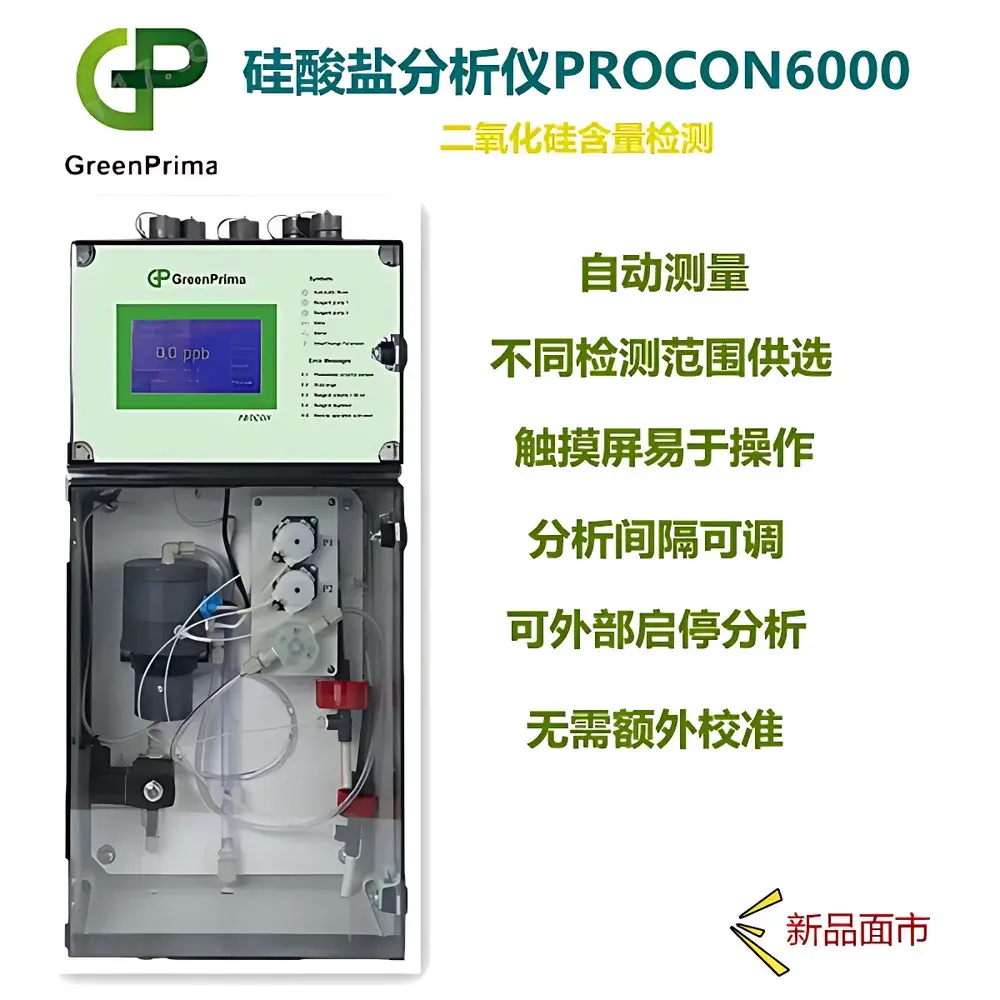
GreenPrima PROCON 6000 Online Silicate Analyzer
| Brand | GreenPrima |
|---|---|
| Origin | United Kingdom |
| Manufacturer Type | Original Equipment Manufacturer (OEM) |
| Product Category | Imported Instrument |
| Model | PROCON 6000 |
| Instrument Type | Online Analyzer |
| Measurement Principle | Photometric Analysis of Reduced β-Molybdo-Silicic Acid Complex |
| Measuring Range | 1–100 ppb / 4–999 ppb / 0.02–3 ppm SiO₂ |
| Resolution | 0.1 ppb / 1 ppb / 0.01 ppm |
| Accuracy | ±2% of full scale |
| Repeatability | ±0.5 ppb / ±4 ppb / ±0.02 ppm |
| Zero Stability | Automatic Drift Compensation |
| Sample Temperature Range | 5–45 °C |
| Power Supply | 110–230 V AC, 50/60 Hz |
| Power Consumption | ~16 VA |
| Enclosure Rating | IP65 |
| Dimensions (H×W×D) | 640 × 315 × 190 mm |
| Display | 240 × 128 pixel monochrome touchscreen |
| Analysis Cycle Time | 13 min (standard), adjustable from 1–99 min or externally triggered |
| Analog Output | 0/4–20 mA, max. load 500 Ω |
| Relay Outputs | 3 × SPDT, zero-potential, 230 V AC / 3 A (Alarm, Limit, Analysis) |
| Remote Control Input | Dry contact, 18 V DC, ~4 mA |
| External Interface | USB (optional data logging) |
| Housing Material | Industrial-grade polymer with stainless steel fasteners |
| Compliance | CE, RoHS, IEC 61000-6-2/-6-3, EN 61326-1 |
Overview
The GreenPrima PROCON 6000 is a fully automated, online photometric silicate analyzer engineered for continuous, high-stability measurement of dissolved silica (SiO₂) in ultra-pure water streams. It operates on the established colorimetric principle of molybdate reduction: soluble silicate ions react with ammonium molybdate under acidic conditions to form heteropoly acids, which are subsequently reduced—typically using ascorbic acid—to yield a blue-colored β-molybdo-silicic acid complex. The intensity of this chromophore, measured at 815 nm via a stable LED-light source and precision photodiode detector, is directly proportional to the concentration of reactive silica species. Designed specifically for critical water chemistry control in high-pressure steam cycles, the PROCON 6000 delivers trace-level detection down to 1 ppb with sub-part-per-trillion baseline stability—essential for preventing silica deposition in turbine blades and heat exchangers. Its architecture integrates real-time drift correction, automatic reagent blanking, and self-diagnostic routines to maintain metrological integrity across extended unattended operation.
Key Features
- Fully autonomous operation: integrated microprocessor controls sampling, reagent dosing, reaction timing, optical measurement, and system flushing without manual intervention
- Three selectable measurement ranges (1–100 ppb, 4–999 ppb, 0.02–3 ppm SiO₂) optimized for distinct process zones—e.g., condensate polishers vs. boiler feedwater
- High-resolution touchscreen interface (240 × 128 pixels) with intuitive navigation, multilingual support (English, German, French, Spanish), and real-time trend visualization
- Configurable analysis cycle (13 min standard; programmable 1–99 min) with external trigger capability via dry-contact input for synchronization with plant DCS or PLC events
- Zero-potential relay outputs (3 × SPDT) compliant with IEC 60947-5-1 for alarm, limit, and analysis status signaling—rated for 230 V AC / 3 A switching
- Isolated 0/4–20 mA analog output with configurable scaling, linearization, and fault reporting (e.g., sensor failure, low reagent, timeout)
- IP65-rated enclosure with corrosion-resistant housing and ring-terminal electrical connections—suitable for installation in turbine halls, chemical metering rooms, or outdoor analyser shelters
- No routine calibration required: factory-calibrated optical path and temperature-compensated reagent delivery ensure long-term reproducibility per ASTM D859 and ISO 10523
Sample Compatibility & Compliance
The PROCON 6000 is validated for use with deionized, demineralized, and condensate water matrices meeting ASTM D1193 Type I or II specifications. It tolerates total organic carbon (TOC) ≤ 50 ppb and suspended solids < 1 mg/L. Interference from phosphate is minimized through controlled pH adjustment and selective molybdate stoichiometry; chloride concentrations up to 100 ppm do not affect accuracy. The analyzer conforms to EU directives 2014/30/EU (EMC) and 2011/65/EU (RoHS), carries CE marking, and meets IEC 61326-1 for industrial electromagnetic immunity. Its firmware architecture supports audit trails and user-access levels aligned with FDA 21 CFR Part 11 requirements when paired with optional USB data export and timestamped event logging.
Software & Data Management
Embedded firmware provides non-volatile storage of >10,000 measurement records with timestamps, reagent usage logs, and diagnostic flags (e.g., pump stroke count, valve actuation history, lamp intensity decay). Optional USB data export enables CSV-formatted retrieval for integration into LIMS or SCADA systems. All configuration parameters—including alarm thresholds, output scaling, and maintenance reminders—are password-protected and modifiable via the touchscreen or remote Modbus RTU (RS-485, optional). Firmware updates are performed via USB stick with cryptographic signature verification to ensure integrity.
Applications
- Power generation: monitoring silica in turbine condensate, boiler feedwater, and steam drum blowdown to prevent quartz scaling per EPRI TR-102555 guidelines
- Pharmaceutical manufacturing: ensuring USP compliance for Water for Injection (WFI) and Pure Steam systems
- Semiconductor fabrication: controlling silica in ultrapure water (UPW) distribution loops where ≥1 ppb excursions risk wafer defectivity
- Chemical and petrochemical plants: safeguarding ion exchange resin beds and reverse osmosis membranes against colloidal silica fouling
- Research laboratories: reference-grade validation of silica removal efficiency in novel membrane or adsorbent technologies
FAQ
What sample flow rate and pressure are required for continuous operation?
The analyzer requires a minimum sample flow of 150 mL/min at 0.5–3 bar inlet pressure. Integrated flow monitoring triggers an alarm if deviation exceeds ±15% for >30 seconds.
How often must reagents be replaced?
With standard daily operation (13-min cycle), the reagent pack (molybdate + reducing agent + acid) lasts approximately 90 days. An onboard level sensor alerts users 72 hours prior to depletion.
Does the instrument support remote diagnostics?
Yes—via optional RS-485 Modbus RTU interface, enabling readout of all internal sensors (lamp intensity, temperature, valve status) and error codes by third-party SCADA systems.
Can it measure both orthosilicic acid and polymeric silica?
The PROCON 6000 quantifies only reactive (monomeric) silica species that participate in the molybdate reaction. Polymeric or colloidal silica requires pre-acid hydrolysis (not included) for full recovery.
Is validation documentation provided for GMP environments?
Yes—each unit ships with Factory Acceptance Test (FAT) report, calibration certificate traceable to NIST SRM 2022, and IQ/OQ protocol templates compliant with Annex 15 and EU GMP Chapter 4.







