
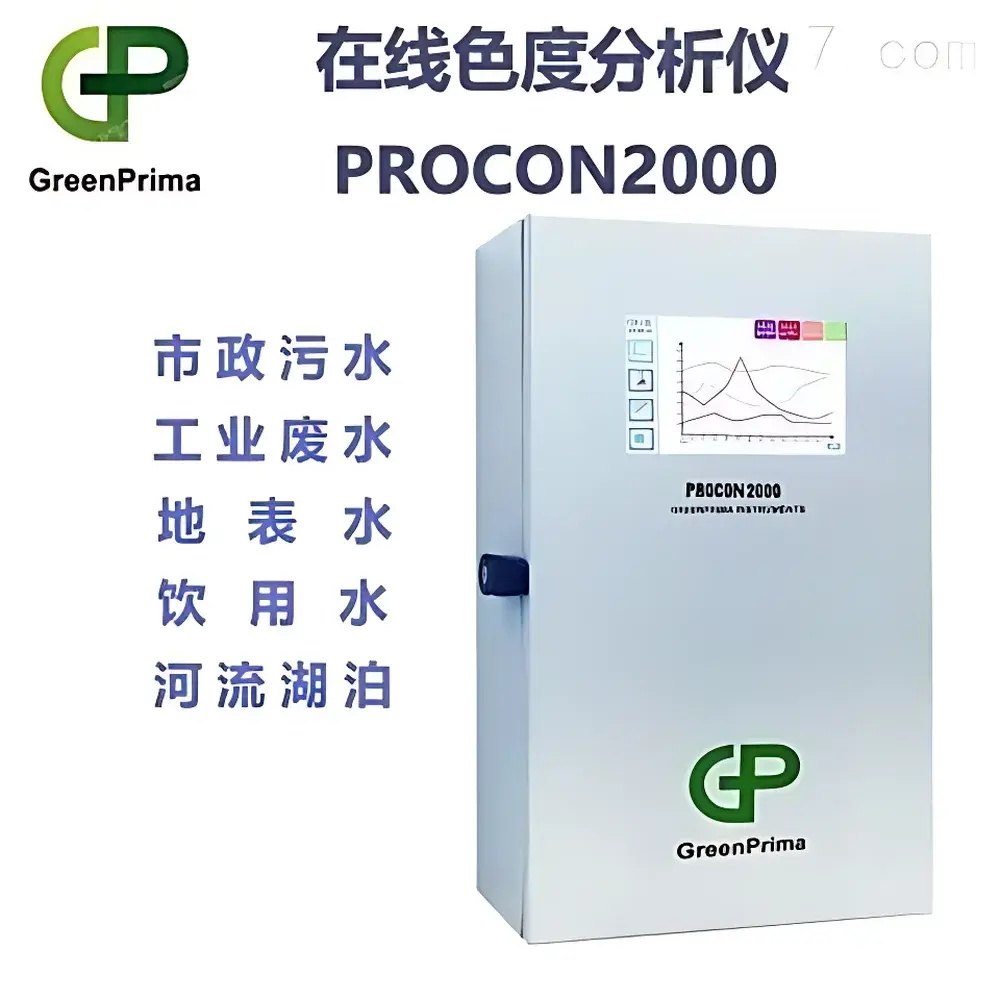
GreenPrima PRO CON2000 Online Seawater Colorimeter
| Brand | GreenPrima |
|---|---|
| Origin | United Kingdom |
| Manufacturer Type | Manufacturer |
| Origin Category | Imported |
| Model | PRO CON2000 |
| Price | Upon Request |
| Measurement Principle | UV-VIS Absorption Spectrophotometry |
| Sensor Range | 0–100 Pt-Co and 0–2000 Pt-Co (customizable) |
| Accuracy | < ±5% F.S. |
| Repeatability | < ±5% F.S. |
| Response Time | < 5 s |
| Sample Flow Rate | 0–2 L/min |
| Max Operating Pressure | < 2 bar |
| Operating Temperature | 0–50 °C |
| Sample Volume per Measurement | < 100 mL |
| Wetted Materials | Quartz, Polypropylene, FPM Fluoroelastomer, Stainless Steel (316L), Borosilicate Glass |
| Display | 8.5" TFT Color Touchscreen (800 × 480 px, LED backlight) |
| Data Storage | 8 GB SD card |
| Analog Output | 4–20 mA (isolated, ≤500 Ω load, accuracy < 0.5%) |
| Relay Outputs | Programmable (5 A NO / 3 A NC @ 277 VAC) |
| Communication | RS485 Modbus RTU (Slave/Master) |
| Power Supply | 100–240 VAC or 24 VDC, 50–60 Hz |
| Power Consumption | < 20 W |
| Enclosure | Wall-mounted stainless steel (EN 1.4435 / AISI 316L) |
| Dimensions (H×W×D) | 430 × 340 × 200 mm |
| Weight | < 14 kg |
| Ingress Protection | IP65 |
| Hazardous Area Certification | ATEX Zone 1/2 optional |
Overview
The GreenPrima PRO CON2000 Online Seawater Colorimeter is a dedicated photometric analyzer engineered for continuous, reagent-free color assessment of marine and estuarine waters using standardized UV-VIS absorption spectrophotometry. It operates on the principle of measuring absorbance at defined wavelengths—typically within the 400–700 nm visible range—and correlates spectral response to the Platinum-Cobalt (Pt-Co) color scale, an internationally recognized metric for quantifying yellowish hue intensity in aqueous matrices. Unlike endpoint laboratory methods, the PRO CON2000 integrates flow-through optical cell design with dual-beam referencing, enabling real-time compensation for lamp drift, window fouling, and baseline shifts. Its application extends beyond seawater to include brackish water, desalination intake streams, coastal effluent discharges, and high-salinity industrial process waters where conventional colorimeters may suffer from chloride interference or refractive index variability. The system complies with ASTM D1209 and ISO 7887 for color measurement methodology and is validated for use in environments requiring long-term unattended operation under fluctuating salinity (0–45 ppt) and temperature conditions.
Key Features
- Reagent-free operation: Eliminates chemical consumption, waste generation, and associated regulatory reporting burdens.
- Multi-mode measurement scheduling: Supports manual-triggered analysis, programmable time-based cycles (e.g., every 15 min), and event-driven sampling synchronized with flow or level signals.
- Optical stability architecture: Xenon flash lamp with >10-year service life; quartz flow cell with anti-fouling hydrophobic coating; self-compensating dual-beam photodetector array.
- Robust wetted path: All fluid-contact components—quartz optical windows, polypropylene manifolds, FPM seals, and 316L stainless-steel fittings—are selected for corrosion resistance in chloride-rich media.
- Sub-5-second measurement cycle: Full spectral acquisition, signal processing, Pt-Co conversion, and data logging completed within 4.8 seconds—enabling near real-time trend monitoring.
- Fully autonomous maintenance sequence: Integrated ultrasonic cleaning pulse, air purge, zero-reference flush, and optical path verification without operator intervention.
- Zero-consumables design: No filters, membranes, or calibration cartridges required; only periodic visual inspection of optical surfaces recommended.
Sample Compatibility & Compliance
The PRO CON2000 accommodates heterogeneous aqueous samples with suspended solids up to 100 mg/L TSS and turbidity ≤ 400 NTU without signal distortion, thanks to its patented laminar-flow cuvette geometry and wavelength-specific scatter correction algorithm. It maintains metrological integrity across salinity gradients (0–45 g/kg), pH 4–10, and dissolved organic carbon (DOC) concentrations up to 25 mg/L. Regulatory alignment includes conformance with EU Water Framework Directive (WFD) Annex V parameter definitions for “color” as a supporting quality element, US EPA Method 8025B for spectrophotometric color evaluation, and GLP-compliant audit trails when paired with GreenPrima’s optional secure firmware package (21 CFR Part 11 ready). The enclosure meets IP65 ingress protection for outdoor coastal installations and supports ATEX-certified variants for offshore platform deployment in Zone 1 hazardous locations.
Software & Data Management
Embedded firmware provides local data handling via an 8 GB industrial-grade microSD card, retaining ≥12 months of second-resolution measurements at default logging intervals. The 8.5-inch capacitive touchscreen interface supports multilingual configuration (English, Spanish, German, Chinese), intuitive alarm threshold setup, and on-device trend visualization with zoom/pan functionality. Raw absorbance spectra (340–900 nm, 1 nm resolution) and processed Pt-Co values are exportable via USB mass storage or Modbus TCP/IP gateway integration. Remote diagnostics, firmware updates, and configuration backup are enabled through encrypted HTTPS web interface (TLS 1.2), with role-based user access control (admin/operator/viewer). Historical datasets integrate natively with SCADA platforms (e.g., Ignition, Siemens Desigo, Schneider EcoStruxure) and LIMS systems via OPC UA or CSV batch ingestion.
Applications
- Real-time monitoring of colored dissolved organic matter (CDOM) in coastal zone management programs.
- Early detection of algal bloom precursors or terrestrial runoff events in marine protected areas.
- Process control in seawater-cooled power plants, where humic acid ingress affects heat exchanger fouling rates.
- Effluent compliance tracking for desalination facilities discharging concentrate streams into sensitive benthic habitats.
- Quality assurance in marine aquaculture operations, where color shifts correlate with feed degradation or microbial metabolite accumulation.
- Research-grade validation of satellite-derived ocean color algorithms (e.g., NASA OCx, ESA C2RCC) using in situ ground-truth reference data.
FAQ
Does the PRO CON2000 require daily calibration?
No. It performs automatic zero-reference correction before each measurement cycle using deionized water or process blank, and factory calibration remains stable for ≥12 months under typical operating conditions.
Can it operate submerged or in tidal zones?
No. The analyzer is rated IP65—not submersible—and must be installed in a dry, ventilated shelter or cabinet with ambient temperature control; optional NEMA 4X enclosures are available for splash-prone coastal sites.
Is spectral data accessible for custom algorithm development?
Yes. Full-resolution absorbance spectra (ASCII format) are stored alongside Pt-Co values and can be retrieved via USB or Modbus register mapping for third-party modeling.
How is biofouling mitigated in long-term seawater deployments?
The system employs pulsed ultrasonic transducers mounted adjacent to the quartz flow cell, activated hourly in low-power mode, combined with periodic reverse-flow flushes using clean seawater or filtered intake source.
What validation documentation is supplied?
Each unit ships with a UKAS-accredited factory calibration certificate traceable to NPL standards, ISO/IEC 17025 test report, CE Declaration of Conformity, and ATEX Certificate of Conformity (if specified).





