
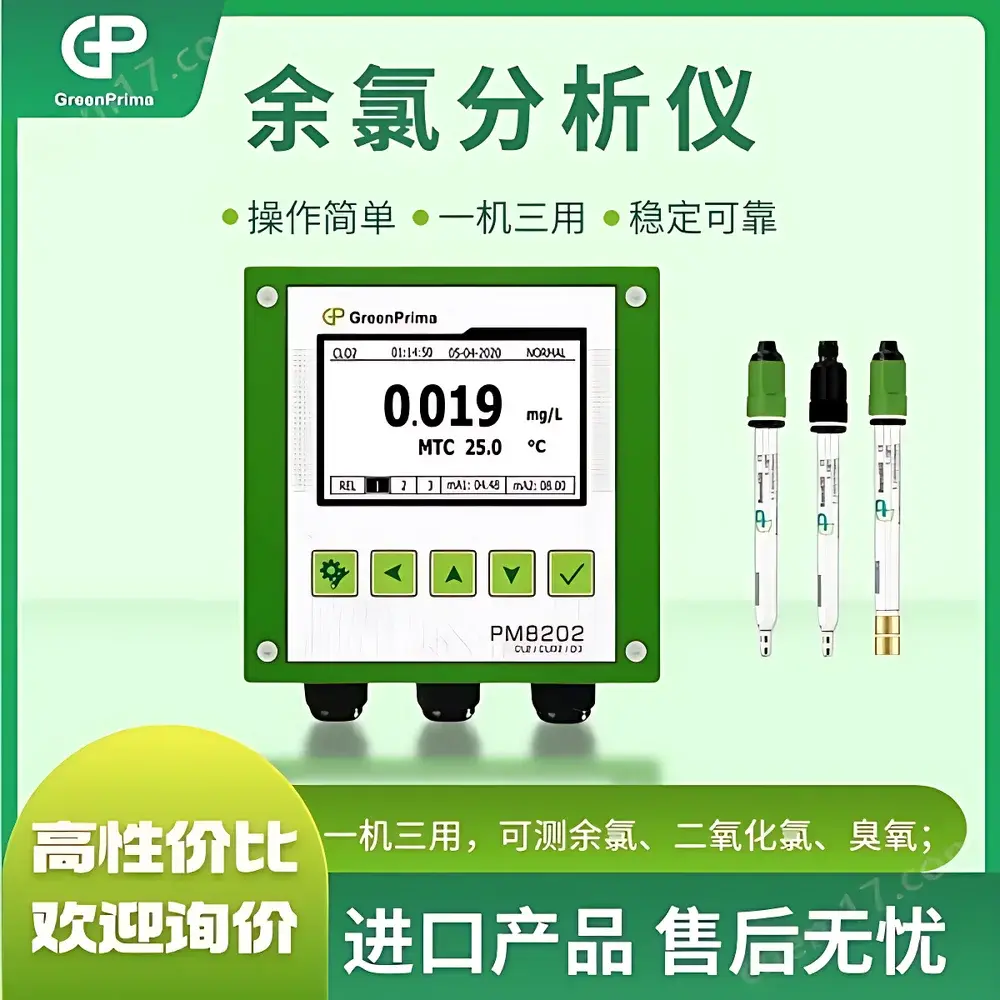
GreenPrima PM8202CL Residual Chlorine and Chlorine Dioxide Analyzer
| Brand | GreenPrima |
|---|---|
| Origin | United Kingdom |
| Manufacturer Type | OEM Manufacturer |
| Origin Category | Imported |
| Model | PM8202CL |
| Instrument Type | Online Analyzer |
| Measurement Principle | Amperometric (Constant Voltage) |
| Measured Parameters | Free Chlorine, Total Chlorine, Chlorine Dioxide, Ozone |
| Range | 0.00–20.00 ppm / 0.00–200.00 ppb |
| Resolution | 0.001 ppm / 0.01 ppm |
| Accuracy | ±2% FS |
| Temperature Compensation | –10 to 130 °C (NTC10K or PT1000) |
| Operating Temperature | –10 to 70.0 °C |
| Storage Temperature | –20 to 70.0 °C |
| Display | Backlit Graphic LCD (Chinese/English) |
| Data Storage | 600,000 records |
| Power Supply | 90–260 VAC, 50/60 Hz or 24 VDC optional |
| Output | Dual isolated 4–20 mA (max. 500 Ω, 0.1% FS), RS485 Modbus RTU |
| Relay Output | 1 multifunction relay (5 A / 250 VAC / 30 VDC) |
| Alarm Output | 2 independent Hi/Lo setpoints with hysteresis |
| Cleaning Cycle | 0.1–1000 h (adjustable), cleaning duration: 1–1000 s (adjustable) |
| Enclosure Rating | IP65 |
| Dimensions | 144 × 144 × 108 mm |
| Panel Cutout | 138 × 138 mm |
| Weight | 0.87 kg |
Overview
The GreenPrima PM8202CL is a high-stability, online amperometric analyzer engineered for continuous, real-time monitoring of residual chlorine (free and total), chlorine dioxide, and ozone in aqueous systems. Unlike colorimetric or photometric methods requiring reagents and sample conditioning, the PM8202CL employs a constant-voltage amperometric detection principle—applying a fixed bias potential across a dual-platinum (Bsens650) or gold (Bsens660) working electrode assembly housed within the BAF615 flow-through cell. This electrochemical architecture enables direct, membrane-free measurement of oxidizing species without chemical consumption, delivering long-term baseline stability and minimal maintenance. The integrated constant-flow chamber ensures laminar, reproducible hydrodynamic conditions—critical for achieving consistent mass transport to the electrode surface and eliminating flow-rate dependency. Designed for unattended operation in municipal, healthcare, and industrial water infrastructure, the analyzer meets functional requirements aligned with ISO 7888, ASTM D1253, and US EPA Method 334.0 for residual disinfectant monitoring.
Key Features
- True reagent-free operation: No colorimetric reagents, membranes, or electrolyte refills required—reducing consumables and operational overhead.
- Dual-electrode sensor options: Bsens650 (platinum) for broad-spectrum oxidant detection; Bsens660 (gold) optimized for chlorine dioxide selectivity in complex matrices.
- BAF615 precision flow cell: Maintains stable, low-shear sample flow (0.1–2.0 L/min) with pressure-independent hydraulic design—ensuring repeatable response across variable system pressures.
- Multi-parameter capability: Single instrument platform supports configurable measurement modes for free chlorine, total chlorine, ClO₂, and O₃—eliminating need for parallel analyzers.
- Robust environmental resilience: IP65-rated enclosure, wide operating temperature range (–10 to 70 °C), and NTC10K/PT1000 temperature compensation support deployment in pump stations, rooftop tanks, and wastewater treatment corridors.
- Comprehensive I/O architecture: Dual 4–20 mA analog outputs (isolated, field-configurable), RS485 Modbus RTU for SCADA integration, one multifunction relay, and two programmable alarm relays with hysteresis.
- Secure human-machine interface: Backlit graphic LCD with bilingual (English/Chinese) navigation, password-protected configuration access, and audit-ready parameter logging.
Sample Compatibility & Compliance
The PM8202CL is validated for use in potable water distribution networks, hospital effluent streams, secondary water supply systems, and industrial process cooling loops where residual disinfectant control is mandated under local health codes or ISO 22000/ISO 9001 quality management frameworks. It operates effectively across pH 4.0–8.5 and turbidity ≤ 5 NTU without pretreatment. Sensor performance remains unaffected by common interferents including nitrite (< 5 mg/L), bromide (< 10 mg/L), and moderate levels of organic matter (COD < 50 mg/L). The analyzer complies with electromagnetic compatibility standards EN 61326-1 and safety standard EN 61010-1. Its data integrity features—including timestamped storage of 600,000 measurement records and non-volatile memory retention—support GLP-aligned recordkeeping and facilitate FDA 21 CFR Part 11 readiness when deployed with compliant SCADA software.
Software & Data Management
Local configuration and diagnostics are performed via the onboard menu-driven interface. For centralized supervision, the RS485 Modbus RTU port enables seamless integration into existing PLCs, DCS, or cloud-based water intelligence platforms (e.g., Siemens Desigo, Honeywell Experion, or custom MQTT gateways). All analog outputs support linear scaling to user-defined ranges (e.g., 0–5 ppm mapped to 4–20 mA), with independent calibration offsets per parameter. The built-in cleaning scheduler allows automated periodic electrode surface refresh using compressed air or low-pressure water—configurable from 6 minutes to 41.7 days between cycles. All configuration changes, alarm events, and calibration logs are time-stamped and stored locally, enabling traceability during internal audits or regulatory inspections.
Applications
- Municipal drinking water: Continuous verification of chlorine residuals at entry points, storage reservoirs, and zone boundary valves to ensure compliance with WHO Guidelines and national drinking water standards (e.g., UK DWI, US EPA Stage 2 DBPR).
- Hospital water systems: Monitoring of hot/cold water loops for Legionella control, where precise ClO₂ or free chlorine dosing prevents biofilm formation in premise plumbing.
- Food & beverage processing: Real-time verification of sanitizing rinse concentrations on CIP lines and fillers to meet SQF, BRCGS, and FDA Food Safety Modernization Act (FSMA) requirements.
- Pharmaceutical purified water (PW) and WFI distribution: Support for USP and EU GMP Annex 1 water system validation through stable, low-drift oxidant trending.
- Industrial cooling towers: Optimization of biocide dosing to minimize corrosion risk while maintaining microbial control per CTI guidelines.
FAQ
Does the PM8202CL require daily calibration or frequent maintenance?
No. The amperometric sensor exhibits excellent zero and span stability. Field calibration is recommended every 30–90 days depending on application severity, using standardized chlorine standard solutions traceable to NIST. Electrode replacement intervals typically exceed 18 months under normal operating conditions.
Can the same sensor measure both free chlorine and chlorine dioxide simultaneously?
No—measurement mode must be selected per installation. However, the instrument firmware supports rapid reconfiguration between parameters without hardware change, allowing flexible redeployment across different disinfection regimes.
Is temperature compensation automatic and configurable?
Yes. The unit accepts either NTC10K or PT1000 sensors and applies polynomial-based compensation algorithms per ISO 5667-3. Manual offset adjustment is available for fine-tuning in thermally stratified systems.
What is the minimum detectable concentration for ozone in ppb?
The lower limit of quantitation (LLOQ) for ozone is 0.5 ppb (signal-to-noise ≥ 10:1) under controlled flow and temperature conditions.
How is data integrity ensured during power interruption?
All critical parameters—including calibration coefficients, alarm thresholds, and real-time measurements—are written to non-volatile flash memory before power-down. Upon restart, the system resumes operation with no data loss and preserves the last valid timestamped record.







