
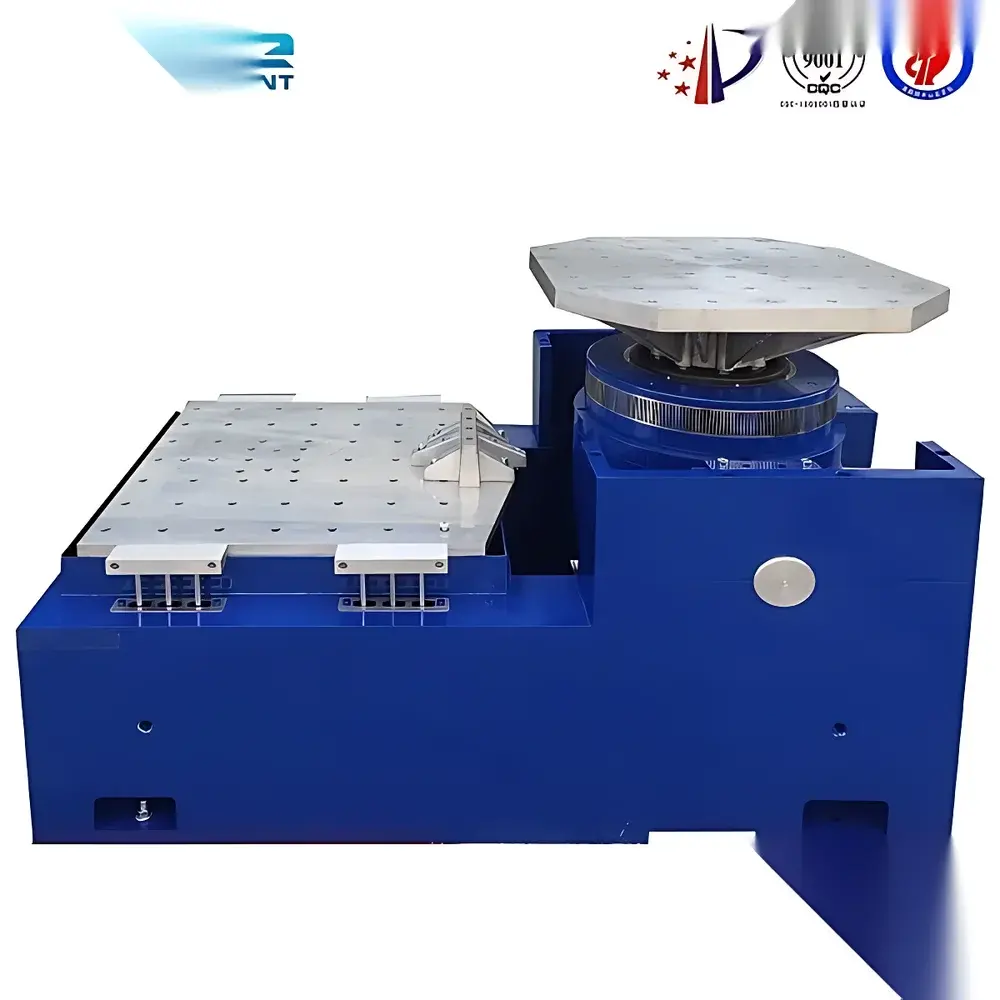
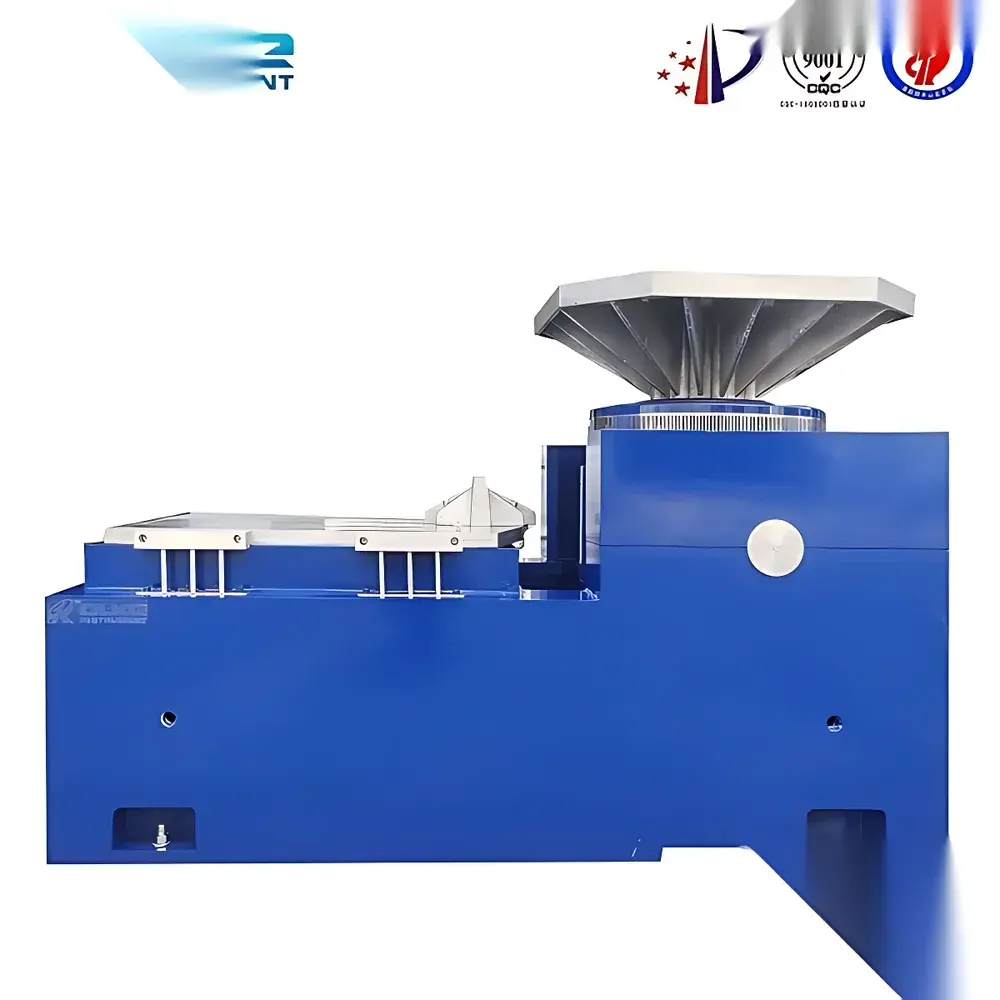
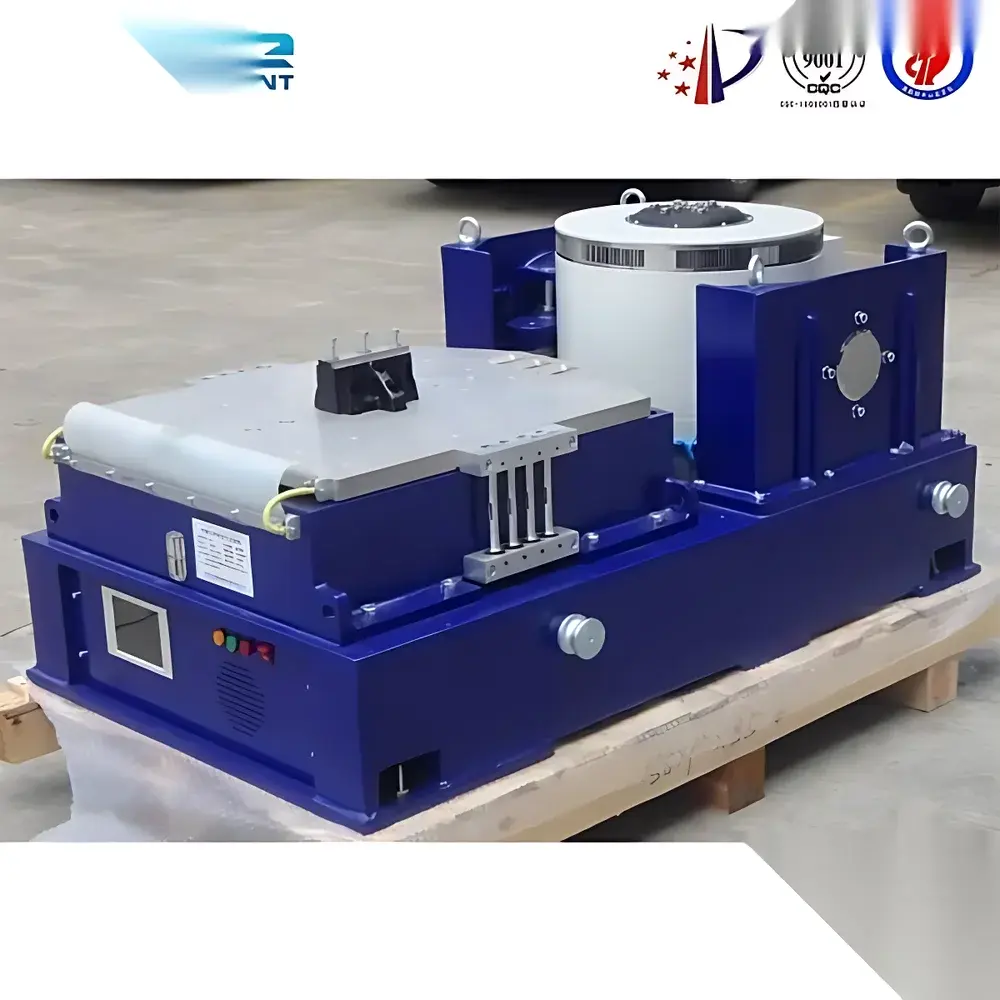
Electromagnetic Vertical Vibration Shaker System – OK-ES Series Technical Manual
| Key | Brand: Other Brands |
|---|---|
| Origin | Imported |
| Manufacturer Type | Authorized Distributor |
| Price | USD 13,800 (FOB) |
| Frequency Range | 10–400 Hz |
| Max. Load Capacity | 100 kg |
| Displacement Amplitude | 0.5–5 mm (peak-to-peak) |
| Driving Principle | Electromagnetic Force Actuation |
| Control Interface | RS-485 Optional |
| Compliance | GB/T 13310-1991, GB/T 2423.10-1995, JJG 190-1997, IEC 60068-2-6 |
| Cooling Method | Natural Convection |
| Power Supply | 220 VAC ±10%, 50 Hz |
| Table Size | 50 × 50 cm |
| Moving Mass | 50–100 kg |
| Input Power | 2.2–3.0 kVA |
| Waveform Options | Sine, Half-Sine |
| Optional Accessories | Amplitude & Acceleration Display Unit, PC-Based Vibration Controller, Thermal-Stable Voltage Regulator, Serial Printer Interface |
Overview
The OK-ES Series Electromagnetic Vertical Vibration Shaker System is a precision-engineered electrodynamic vibration exciter designed for laboratory-grade and industrial qualification testing of mechanical components, electronic assemblies, packaging systems, and structural subassemblies. Operating on the principle of Lorentz force actuation—where controlled current through voice-coil windings interacts with a permanent magnetic field to generate linear oscillatory motion—the system delivers repeatable, traceable sinusoidal and half-sinusoidal waveforms across a broad frequency spectrum (10 Hz to 400 Hz). Its vertical-only or combined vertical/horizontal configurations (OK-ES-6/10/20 models) support standardized environmental stress screening per IEC 60068-2-6 and national equivalents including GB/T 2423.10-1995 (equivalent to ISO 8568) and GB/T 13310-1991. The shaker’s rigid aluminum alloy table, low-mass moving element (50–100 kg), and optimized electromagnetic gap design ensure high force-to-weight ratio, minimal phase distortion, and stable amplitude control within ±2% linearity over rated displacement range (0.5–5 mm p-p).
Key Features
- Electromagnetically driven linear motion with zero mechanical backlash, eliminating hydraulic fluid dependency and associated maintenance.
- Integrated anti-electromagnetic-interference (EMI) circuitry compliant with IEC 61000-4-3, ensuring signal integrity in high-noise test environments such as EMC labs or near RF transmitters.
- Digital timer-based test duration control enabling programmable dwell time, cycle count, and automatic shutdown—critical for accelerated life testing protocols.
- Lightweight yet structurally robust architecture: table mass optimized for high acceleration fidelity; base frame engineered for floor-mount stability without anchoring under ≤100 kg payload.
- Modular auxiliary interface options—including RS-485 serial communication for SCADA integration, real-time amplitude/acceleration monitoring display units, and optional voltage regulation to mitigate grid fluctuation impact on waveform fidelity.
- Natural convection cooling eliminates fan-induced vibration artifacts and acoustic noise, preserving measurement integrity during low-amplitude, high-resolution modal analysis.
Sample Compatibility & Compliance
The OK-ES platform accommodates test specimens up to 100 kg with uniform center-of-gravity alignment on its 50 × 50 cm non-perforated aluminum table. Fixture adaptability supports standard ISO 10816-3 mounting interfaces and custom jig integration via threaded T-slots. All models meet metrological verification requirements per JJG 190-1997 (Calibration Specification for Electrodynamic Vibrators) and are validated for use in GLP-compliant quality assurance workflows. Test reports generated using optional PC-based controllers may include timestamped audit trails, operator ID logging, and parameter change history—supporting FDA 21 CFR Part 11 readiness when paired with qualified software.
Software & Data Management
While the base unit operates standalone via front-panel controls, optional vibration control software enables closed-loop amplitude regulation, sweep profile definition (logarithmic/linear), and harmonic distortion monitoring. Data export formats include CSV and MATLAB-compatible .mat files. Communication via RS-485 allows integration into centralized test management platforms (e.g., NI TestStand, Keysight PathWave) for automated test sequencing and cross-instrument synchronization. Firmware updates are delivered via secure USB interface with cryptographic signature verification.
Applications
- Environmental stress screening (ESS) of PCBs, connectors, and solder joints per IPC-J-STD-002 and MIL-STD-810H Method 514.8.
- Vibration fatigue assessment of automotive ECUs, battery modules, and ADAS sensor housings.
- Package integrity validation for pharmaceutical primary containers under ASTM D999 and ISTA 3A.
- Modal parameter identification (natural frequency, damping ratio) for lightweight aerospace components using sine dwell and resonance dwell techniques.
- Calibration reference shaker for accelerometers and velocity transducers per ISO 16063-21.
FAQ
What standards does the OK-ES series comply with for vibration testing?
It conforms to IEC 60068-2-6, GB/T 2423.10-1995, GB/T 13310-1991, and JJG 190-1997 for performance verification and calibration traceability.
Can the system perform horizontal vibration testing?
Models OK-ES-6, OK-ES-10, and OK-ES-20 support simultaneous vertical and horizontal excitation via dual-axis actuator configuration; OK-ES-2 and OK-ES-3 are vertical-only.
Is external power conditioning required?
A dedicated voltage stabilizer is recommended—and optionally supplied—to maintain ±1% output amplitude stability under ±10% input voltage fluctuation.
What is the maximum allowable off-center load?
For optimal waveform fidelity and table flatness, eccentricity should not exceed 15% of table diagonal (≤10.6 cm from center); dynamic imbalance correction is advised for asymmetric fixtures.
How is thermal management handled during extended operation?
Natural convection cooling suffices for continuous operation at ≤70% of rated displacement; ambient temperature must remain between 5 °C and 40 °C with <80% non-condensing RH.
Related Products



