
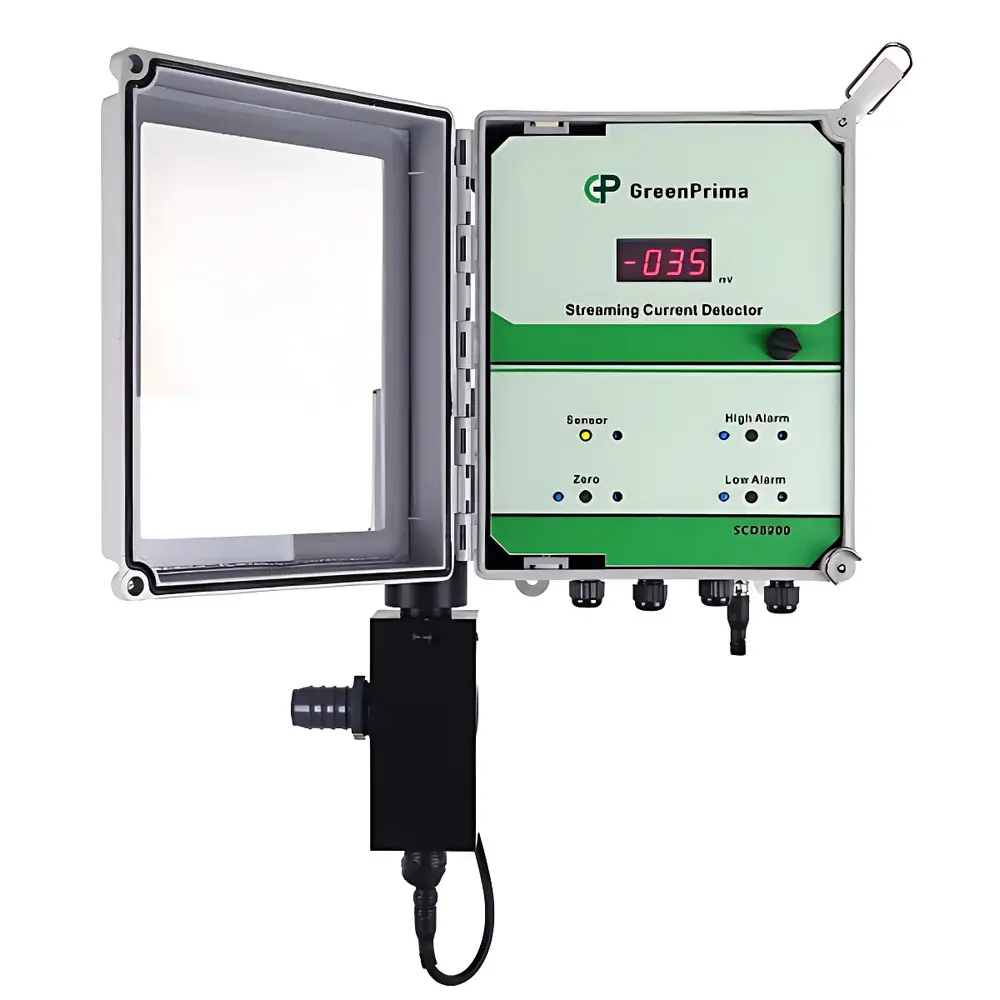
GreenPrima SCD8200 Streaming Current Detector
| Brand | GreenPrima |
|---|---|
| Origin | USA |
| Manufacturer Type | Original Equipment Manufacturer (OEM) |
| Product Category | Imported Instrument |
| Model | SCD8200 |
| Power Supply | 230 VAC |
| Measurement Range | −1000 to +1000 mV |
| Accuracy | ±0.1% of full scale |
| Flow Rate | 1 L/min |
| Response Time | 1 s |
| Output Signals | 4–20 mA, −10 to +10 V, 0–10 V |
| Communication | Modbus RTU (optional) |
| Enclosure Rating | NEMA 4X / IP65 |
| Inlet/Outlet | 1/2″ and 3/4″ barbed quick-connect fittings |
| Sensor Housing Material | Chemically resistant non-metallic polymer |
| Weight | 9 kg |
| Dimensions | 279 mm × 152 mm (11″ × 6″) |
Overview
The GreenPrima SCD8200 Streaming Current Detector is an industrial-grade, continuous online electrokinetic analyzer engineered for real-time measurement of streaming current—a direct indicator of net colloidal and ionic charge in aqueous suspensions. Based on the fundamental principle of electrokinetics, the SCD8200 employs a precision reciprocating piston mechanism within a flow-through sensor chamber to induce controlled shear stress across the sample stream. This mechanical agitation disrupts the electrical double layer surrounding suspended colloids and fine particulates, liberating counter-ions and generating a measurable alternating current between two embedded electrodes. The resulting streaming current signal (in mV) correlates quantitatively with the surface charge density and coagulant demand of the water matrix—enabling closed-loop optimization of coagulant and flocculant dosing in dynamic treatment processes.
Key Features
- Real-time streaming current measurement with 1-second response time and ±0.1% full-scale accuracy
- Robust NEMA 4X/IP65-rated non-metallic enclosure for outdoor and harsh environment deployment
- Integrated piston-driven flow cell ensuring consistent shear rate and stable hydrodynamic conditions
- Dual analog outputs (4–20 mA and ±10 V) plus optional Modbus RTU for seamless integration into PLCs and SCADA systems
- Onboard zero-point and gain calibration controls for field maintenance without external tools
- Self-diagnostic LED indicators for sensor status, flow integrity, and signal health
- Chemically inert wetted materials compatible with chlorine, ozone, ferric chloride, polyaluminum chloride (PAC), and synthetic polymers
- Quick-connect barbed fittings (1/2″ inlet, 3/4″ outlet) supporting 1 L/min nominal flow without auxiliary pumping
Sample Compatibility & Compliance
The SCD8200 is validated for use across municipal drinking water plants, wastewater reclamation facilities, industrial process water circuits, and pretreatment lines for membrane filtration (e.g., RO and NF). It accommodates turbidities up to 500 NTU, total suspended solids (TSS) ≤ 200 mg/L, and pH ranges from 4.5 to 9.5. Sensor performance remains stable in the presence of moderate organic loading and common oxidants. The instrument complies with ANSI/ISA-18.2 for alarm management and supports audit-trail-capable configuration when integrated with FDA 21 CFR Part 11–compliant DCS platforms. Its design aligns with ASTM D2035 (Standard Practice for Coagulation-Flocculation Jar Test Procedures) and ISO 5725 (accuracy and precision of measurement methods) for process control validation.
Software & Data Management
While the SCD8200 operates as a stand-alone analog transmitter, its optional Modbus RTU interface enables bidirectional communication with supervisory control systems. Streaming current data can be logged at user-defined intervals (1–60 seconds), trended alongside coagulant feed rates, turbidity, and pH for multivariate process correlation. When deployed within a GMP or GLP-compliant facility, the device supports electronic signature workflows via upstream HMI/SCADA systems that enforce change control, user access levels, and event logging per 21 CFR Part 11 requirements. No proprietary software is required—configuration and diagnostics are accessible via standard Modbus register mapping.
Applications
- Optimization of coagulant dosing in conventional rapid mix–flocculation–sedimentation trains
- Dynamic control of polymer addition in dissolved air flotation (DAF) and lamella clarifiers
- Early detection of raw water quality shifts (e.g., NOM spikes, algal blooms, seasonal turbidity events)
- Preventive monitoring of fouling potential in reverse osmosis feed streams
- Sludge conditioning control for centrifuge and belt-press dewatering efficiency
- Validation support for coagulation process qualification under ISO 22000 or NSF/ANSI 61 frameworks
FAQ
What physical parameter does the SCD8200 actually measure?
It measures streaming current (in millivolts), a direct electrokinetic response proportional to the net surface charge of colloidal particles and dissolved ionic species under defined shear conditions.
Can the SCD8200 replace jar testing?
No—it does not replace bench-scale jar testing for initial coagulant selection or dose range determination, but it provides continuous, real-time feedback to maintain optimal dosing established during those tests.
Is calibration traceable to national standards?
Yes; factory calibration uses NIST-traceable reference solutions, and field zeroing is performed using deionized water or process-specific baseline samples verified against laboratory electrophoretic mobility measurements.
Does the instrument require regular consumables or replacement parts?
No consumables are required. The piston assembly and electrode housing are designed for >5 years of continuous operation under typical municipal water conditions; only periodic visual inspection and cleaning per OEM guidelines are recommended.
How is the SCD8200 integrated into existing automation infrastructure?
Via 4–20 mA loop-powered analog output for direct connection to PLC analog input cards, or via RS-485 Modbus RTU for digital integration with programmable logic controllers, DCS, or cloud-based IIoT platforms.
Related Products







