
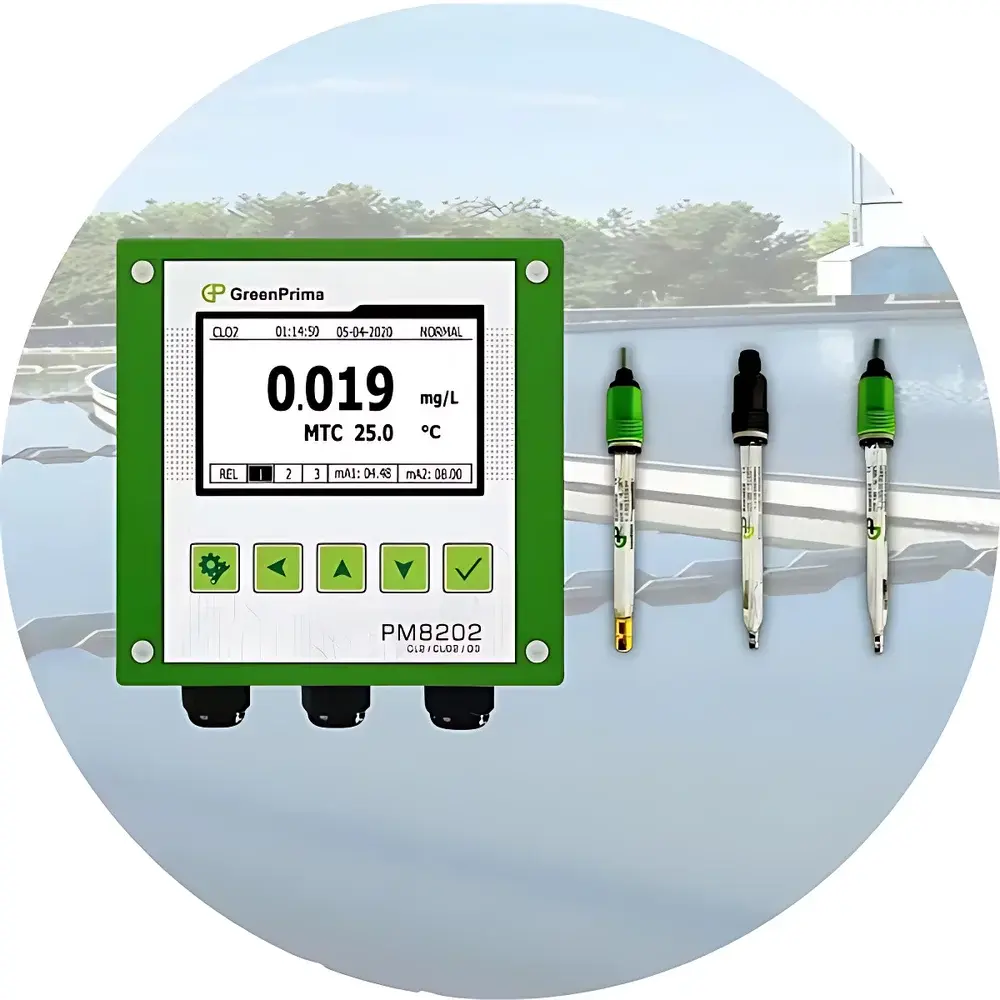
GreenPrima PM820 2CL Residual Chlorine and Chlorine Dioxide Analyzer
| Brand | GreenPrima |
|---|---|
| Origin | United Kingdom |
| Manufacturer Type | Original Equipment Manufacturer (OEM) |
| Product Category | Imported Instrument |
| Model | PM820 2CL |
| Instrument Type | Online Analyzer |
| Measurement Principle | Amperometric Detection at Fixed Potential (Constant Voltage Method) |
| Measured Parameters | Free Chlorine, Total Chlorine, Chlorine Dioxide, Ozone |
| Range | 0.00–20.00 ppm / 0.00–200.00 ppb |
| Accuracy | ±2% of Full Scale |
| Resolution | 0.001 ppm (low range), 0.01 ppm (high range) |
| Temperature Compensation | -10 to 130 °C (NTC10K or PT1000 sensor support) |
| Operating Temperature | -10 to 70.0 °C |
| Storage Temperature | -20 to 70.0 °C |
| Display | Backlit Graphic LCD (Chinese/English Switchable) |
| Data Storage | 600,000 records |
| Power Supply | 90–260 VAC, 50/60 Hz or 24 VDC optional |
| Output Signals | Dual isolated 4–20 mA (0.1% FS accuracy, max loop resistance 500 Ω), RS485 Modbus RTU |
| Relay Outputs | Two programmable Hi/Lo alarms (5 A / 250 VAC / 30 VDC) |
| Cleaning Control | Adjustable interval (0.1–1000 h) and duration (1–1000 s) |
| Enclosure Rating | IP65 |
| Dimensions | 144 × 144 × 108 mm |
| Panel Cutout | 138 × 138 mm |
| Weight | 0.87 kg |
Overview
The GreenPrima PM820 2CL is a high-stability online amperometric analyzer engineered for continuous, reagent-free measurement of residual oxidants in aqueous systems. It operates on the constant-voltage amperometric principle—applying a fixed potential across a dual-electrode sensing cell (Pt/Pt or Au/Au configuration) to selectively detect electroactive species including free chlorine, total chlorine, chlorine dioxide, and ozone. Unlike colorimetric or DPD-based methods, this technique eliminates dependence on chemical reagents, membrane replacement, or sample pretreatment, delivering robust long-term performance in demanding water treatment environments. The system integrates a dedicated flow-controlled cell (BAF615) to ensure laminar, consistent hydraulic conditions—critical for minimizing diffusion boundary layer effects and maintaining measurement repeatability. Designed for 24/7 operation in municipal drinking water distribution, hospital wastewater disinfection, secondary water supply networks, and industrial process water loops, the PM820 2CL meets functional requirements aligned with ISO 9001-certified manufacturing and complies with electromagnetic compatibility standards per IEC 61326-1.
Key Features
- True reagent-free operation: No DPD tablets, buffer solutions, or membrane cartridges required—reducing consumables cost and maintenance frequency.
- Dual-electrode amperometric sensor architecture: Bsens650 (platinum/platinum) or Bsens660 (gold/gold) configurations minimize interference from common ions (e.g., nitrite, bromide) and organic matter.
- Integrated BAF615 flow cell: Maintains stable, pulse-free flow rate independent of upstream pressure fluctuations—ensuring consistent mass transport to the electrode surface.
- Triple-analyte capability: Single instrument measures free chlorine, chlorine dioxide, and ozone via configurable calibration and electrode selection—optimizing CAPEX and footprint.
- Comprehensive temperature compensation: Supports NTC10K or PT1000 probes with automatic or manual compensation across -10 to 130 °C—essential for accurate readings in variable-temperature applications such as hot water circulation systems.
- Industrial-grade connectivity: Dual isolated 4–20 mA outputs (configurable for concentration and temperature), RS485 Modbus RTU interface, and two programmable relay outputs enable seamless integration into SCADA, DCS, and PLC-based control architectures.
- Secure operational interface: Password-protected parameter configuration, adjustable cleaning cycles (0.1–1000 h), and programmable alarm hysteresis prevent unauthorized changes and support preventive maintenance planning.
Sample Compatibility & Compliance
The PM820 2CL is validated for use in potable water, treated wastewater, cooling tower make-up, pharmaceutical process water, and hospital effluent streams with turbidity ≤ 5 NTU and suspended solids < 10 mg/L. It performs reliably in pH ranges from 4.0 to 8.5—covering typical chlorination and chlorine dioxide application windows. While not certified to specific regulatory test methods (e.g., EPA Method 334.0 or ISO 7393-2), its amperometric detection principle is referenced in ASTM D1253 and USP for oxidant monitoring in purified water systems. The analyzer’s data logging (600,000-point memory) and timestamped event tracking—including calibration logs, alarm triggers, and cleaning cycles—support GLP-compliant recordkeeping. Optional 21 CFR Part 11 audit trail functionality is available via firmware upgrade upon request.
Software & Data Management
Local configuration and real-time monitoring are performed via the built-in graphic LCD with intuitive menu navigation in English or Chinese. All operational parameters—including span calibration points, temperature probe type, alarm thresholds, and relay logic—are stored in non-volatile memory. Data export is supported via Modbus register polling; third-party SCADA systems can retrieve historical values, status flags, and diagnostic codes (e.g., sensor fault, low flow, temperature out-of-range). Internal clock synchronization enables time-aligned trend analysis across multiple units in distributed networks. Firmware updates are delivered via USB port using signed binary packages to ensure integrity and traceability.
Applications
- Municipal drinking water: Continuous monitoring at clearwell outlets, booster stations, and point-of-entry locations to verify regulatory compliance with WHO and EU Drinking Water Directive residual disinfectant limits.
- Hospital sterilization systems: Real-time verification of chlorine dioxide concentration in endoscope reprocessing water and ozone levels in laundry disinfection loops.
- Food & beverage processing: Monitoring free chlorine in CIP rinse water and chlorine dioxide in produce wash tanks to meet FDA Food Code and HACCP validation requirements.
- Pharmaceutical water systems: Supporting PW and WFI distribution loop surveillance per USP and Annex 1, where oxidant carryover must be minimized prior to final filtration.
- Industrial cooling water: Detecting residual biocide concentrations to optimize dosing control and mitigate microbiologically influenced corrosion (MIC).
FAQ
What electrochemical principle does the PM820 2CL employ?
It uses constant-potential amperometry, where a fixed bias voltage is applied between working and counter electrodes to drive reduction of oxidants at the electrode surface; resulting current is linearly proportional to analyte concentration.
Can the same sensor measure both free chlorine and chlorine dioxide simultaneously?
No—measurement mode is selected per installation via software configuration and matched with appropriate electrode type (Bsens650 for chlorine, Bsens660 for ClO₂/O₃); cross-sensitivity is mitigated through potential tuning and flow optimization.
Is temperature compensation mandatory for accurate results?
Yes—reaction kinetics and diffusion rates are temperature-dependent; the analyzer requires either automatic (via integrated probe) or manually entered temperature input to apply Nernstian correction algorithms.
How often does the sensor require recalibration?
Field calibration is recommended every 30–90 days depending on water matrix stability; drift verification using standard solutions (e.g., KIO₃ for chlorine, NaClO₂ for ClO₂) is advised before critical compliance checks.
Does the unit support hazardous area installation?
The base model is rated IP65 for general indoor/outdoor use; explosion-proof enclosures (ATEX II 2G Ex d IIB T4) and intrinsically safe variants (IECEx ia IIC T4) are available under custom order codes.







