
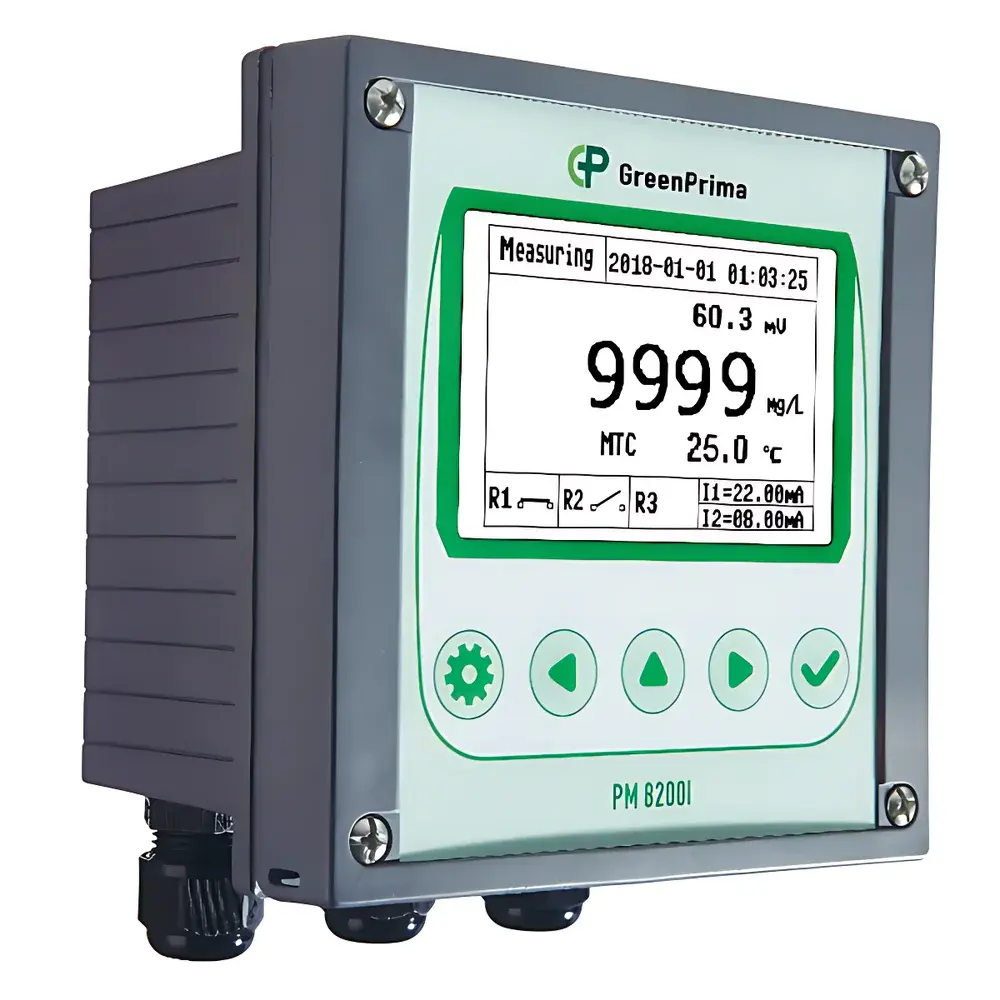
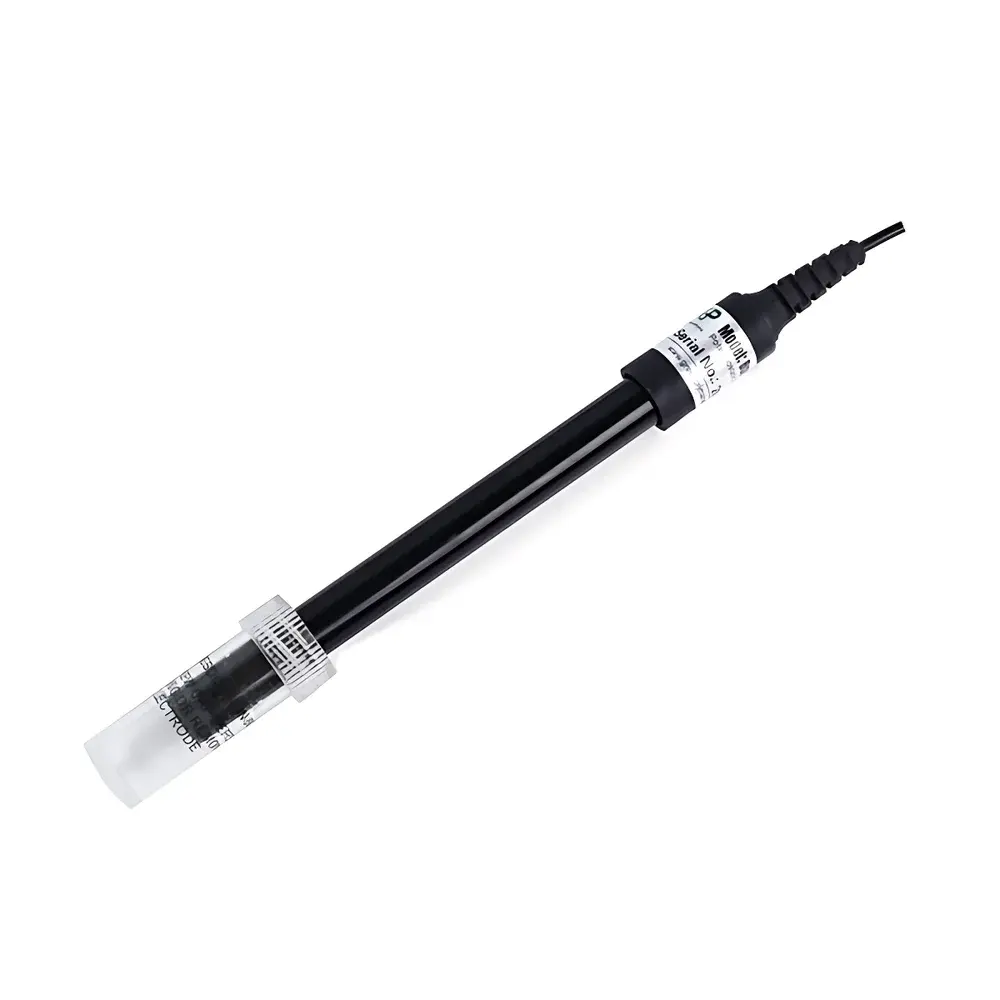
GreenPrima PM8200I Online Water Hardness Analyzer
| Brand | GreenPrima |
|---|---|
| Origin | United Kingdom |
| Manufacturer Type | OEM Manufacturer |
| Origin Category | Imported |
| Model | PM8200I |
| Pricing | Upon Request |
| Measurement Principle | Ion-Selective Electrode (ISE) Method |
| Range | 0.00–20,000 ppm CaCO₃ equivalent |
| Resolution | 0.01 / 0.1 / 1 ppm |
| Accuracy | ±0.01 / ±0.1 / ±1 ppm (depending on range) |
| Temperature Compensation | –10 to 130 °C (manual/automatic |
| Operating Temperature | 0 to 70.0 °C |
| Storage Temperature | –20 to 70.0 °C |
| Display | Backlit dot-matrix LCD with pH, temperature, time, and relay status |
| Output | Dual isolated 4–20 mA (max. loop resistance 500 Ω, accuracy 0.1% FS) |
| Communication | RS485, MODBUS RTU protocol compliant |
| Relay Output | 1 multifunctional relay (for cleaning cycle activation, periodic alarm, fault indication) |
| Data Logging | 600,000 records with timestamped retrieval |
| Enclosure | Fully sealed IP65-rated housing (PPS-coated aluminum alloy & engineering plastics) |
| Mounting Options | Wall-mount, pole-mount, panel-mount |
| Dimensions | 144 × 144 × 106 mm |
| Panel Cutout | 138 × 138 mm |
| Weight | 0.86 kg |
| Power Supply | 90–260 VAC, 50/60 Hz or optional 24 VDC |
| Electrode Model | Bsens740 |
| Electrode Range | 0–40,000 mg/L as CaCO₃ |
| Electrode Resolution | 0.01 mg/L |
| Electrode Accuracy | ±3% FS |
| Electrode Body Material | Polyphenylsulfone (PPS) |
| Electrode Operating Temp. | –5 to 70.0 °C |
| Max. Pressure Rating | 3.5 bar |
| Connection | PG13.5 threaded gland |
| Cable Length | 5 m |
Overview
The GreenPrima PM8200I Online Water Hardness Analyzer is an industrial-grade, continuous-monitoring instrument engineered for precise, reagent-free measurement of total water hardness—expressed as calcium carbonate (CaCO₃) equivalence—in real time. Utilizing a robust ion-selective electrode (ISE) sensing principle, the PM8200I detects divalent cations—primarily Ca²⁺ and Mg²⁺—without chemical titration, colorimetric reagents, or moving fluidic components. This eliminates common failure modes associated with wet-chemistry analyzers, including tubing occlusion, pump wear, reagent depletion, and cross-contamination. Designed for integration into process control loops and regulatory-compliant monitoring systems, the analyzer meets the operational rigor required in GMP, GLP, and ISO 9001 environments. Its dual-channel analog output, MODBUS RTU interface, and audit-ready data logging support seamless connectivity with DCS, SCADA, and LIMS platforms across pharmaceutical, power generation, food & beverage, and industrial boiler applications.
Key Features
- Reagent-free ISE-based hardness measurement ensures zero consumables, minimal maintenance, and long-term calibration stability.
- Dual isolated 4–20 mA outputs configurable for hardness value and temperature—each traceable to NIST-traceable references.
- IP65-rated sealed enclosure with PPS-reinforced housing provides protection against dust ingress and low-pressure water jets, suitable for indoor and semi-outdoor deployment.
- Backlit dot-matrix LCD displays real-time hardness (ppm CaCO₃), temperature (°C), system status, relay states, and timestamped event logs—all accessible without external software.
- Configurable cleaning relay supports automated electrode surface conditioning via air purge, ultrasonic vibration, or mechanical wiper interfaces (external accessories required).
- Onboard data storage retains up to 600,000 timestamped readings with user-defined sampling intervals (1 sec to 24 hrs), supporting retrospective trend analysis and regulatory record retention.
- Full bilingual (English/Chinese) menu navigation with touchless operation logic—backlight auto-dims after 3 minutes of inactivity to extend display lifespan and conserve energy.
Sample Compatibility & Compliance
The PM8200I is validated for continuous measurement in low-to-medium conductivity aqueous streams with turbidity ≤ 5 NTU and suspended solids < 50 mg/L. It operates reliably in clarified feedwater, softened effluent, condensate return lines, cooling tower make-up, and steam generator blowdown. While not intended for raw surface water or high-silica brines, its Bsens740 electrode demonstrates stable response in pH 5.5–9.5 ranges and tolerates transient chlorine residuals ≤ 2 mg/L. The analyzer conforms to electromagnetic compatibility standards per EN 61326-1:2013 and functional safety guidelines aligned with IEC 61508 SIL 2 for basic process monitoring tasks. Data integrity features—including immutable timestamps, cyclic redundancy checksums, and non-volatile memory—support compliance with FDA 21 CFR Part 11 requirements when deployed with appropriate access controls and electronic signature protocols.
Software & Data Management
No proprietary software is required for commissioning or routine operation. Configuration is performed locally via intuitive soft-key navigation or remotely through standard MODBUS RTU commands (function codes 03h, 06h, 10h). Logged data can be exported via serial dump or extracted using third-party MODBUS master tools compatible with Windows/Linux/macOS. All stored records include hardness value, temperature reading, acquisition timestamp, and system error flags—enabling correlation with process events in time-series analytics platforms. Optional firmware updates are delivered via secure USB stick (FAT32 formatted) with SHA-256 verification to ensure firmware authenticity and version traceability.
Applications
- Pharmaceutical water systems: Monitoring purified water (PW) and water-for-injection (WFI) distribution loops per USP and EU Annex 1 guidance.
- Power plant boiler feedwater: Early detection of hardness breakthrough in demineralized water trains to prevent scale formation in HRSGs and turbines.
- Food & beverage production: Ensuring consistent hardness levels in CIP rinse water and ingredient preparation tanks to avoid mineral deposition on heat exchangers.
- Industrial HVAC: Controlling antiscalant dosing in closed-loop chilled water and cooling tower systems based on real-time saturation index calculation.
- Electroplating and anodizing lines: Maintaining low-hardness rinse water to prevent spotting and coating defects on precision metal parts.
- Marine engineering: Monitoring evaporator distillate quality and auxiliary boiler feed in shipboard steam systems per IMO MEPC.227(64) guidelines.
FAQ
Does the PM8200I require daily calibration?
No. Under stable water chemistry conditions, field calibration is recommended every 7–30 days depending on application severity. A two-point calibration (zero and span) using certified hardness standards (e.g., 100 ppm and 1000 ppm CaCO₃) is sufficient.
Can the analyzer operate in pressurized piping systems?
Yes—the Bsens740 electrode is rated for continuous service at up to 3.5 bar (51 psi); however, direct in-line insertion requires appropriate pressure-rated flow cells and isolation valves per ASME B31.1.
Is MODBUS RTU communication compatible with Siemens S7 PLCs?
Yes. The PM8200I implements standard MODBUS function codes and supports baud rates from 4800 to 115200 bps with configurable parity and stop bits—fully interoperable with SIMATIC S7-1200/1500 controllers via RS485 interface modules.
How is temperature compensation handled?
Automatic temperature compensation uses either built-in NTC10K or external PT1000 sensors; the algorithm applies the empirical relationship between ionic activity and thermal kinetic energy per ASTM D1126-22 Annex A1.
What maintenance actions are required quarterly?
Visual inspection of electrode surface for fouling, verification of cable gland integrity, cleaning of display window, and validation of relay actuation timing using a multimeter—documented per internal QA checklist.
Related Products







