
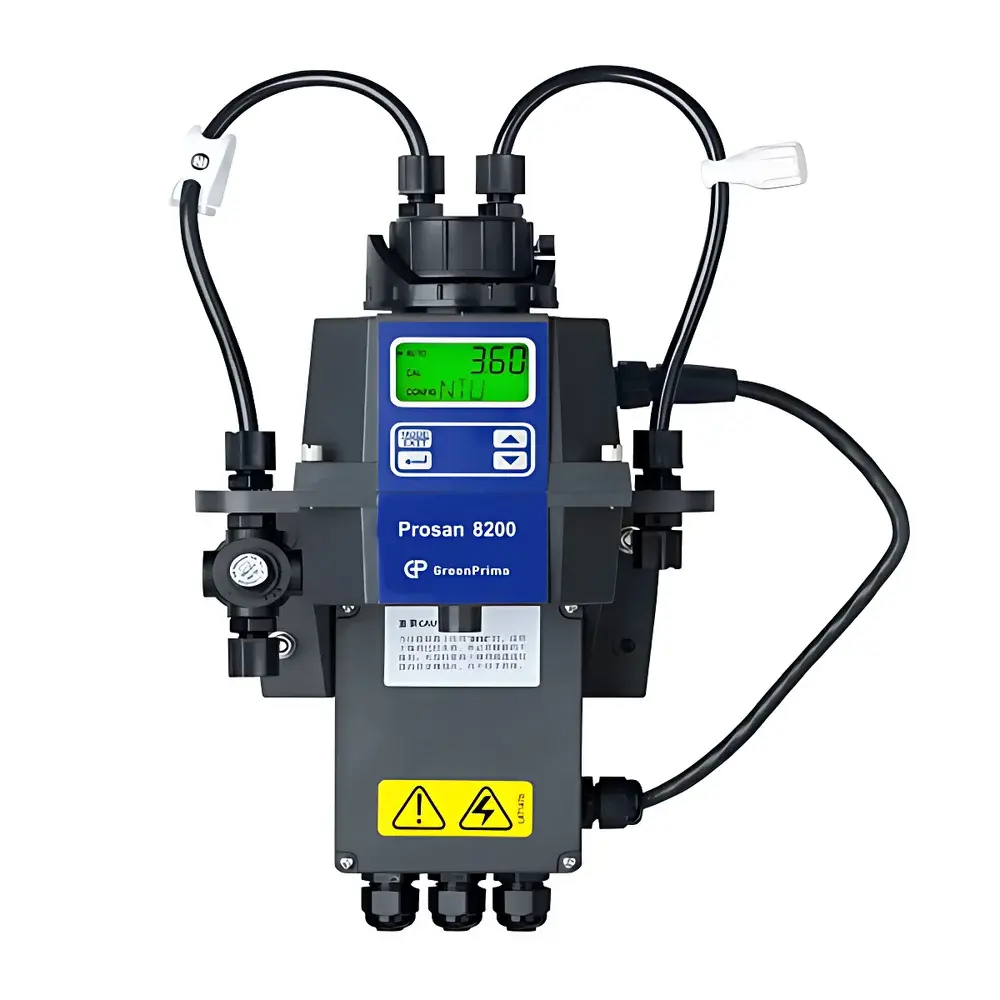
GreenPrima Prosan 8200 In-Line Turbidimeter
| Brand | GreenPrima |
|---|---|
| Origin | USA |
| Manufacturer Type | Original Equipment Manufacturer (OEM) |
| Product Type | In-line |
| Measurement Range | 0–1000 NTU |
| Resolution | 0.0001 NTU |
| Operating Temperature | 0–50 °C |
| Accuracy | ±0.02 NTU (for values <40 NTU) or ±2% of reading (for values <40 NTU) |
| Light Source | White LED (7-year lifetime) |
| Output | 4–20 mA isolated analog output and RS-485/Modbus RTU |
| Enclosure Rating | IP66 / NEMA 4X |
| Wetted Materials | 316 Stainless Steel |
| Power Supply | 100–240 VAC, 47–63 Hz, 80 VA |
| Max. Process Pressure | 200 psi (integrated pressure regulator) |
| Response Time | 5–500 s (full range) |
| Display | Backlit multi-line LCD with menu-driven interface |
| Compliance | EPA Method 180.1 and ISO 7027 |
Overview
The GreenPrima Prosan 8200 In-Line Turbidimeter is an industrial-grade optical sensor engineered for continuous, real-time turbidity monitoring in water and wastewater treatment plants, pharmaceutical process streams, food & beverage production lines, and municipal distribution systems. It operates on the principle of 90° scattered light detection (nephelometry), conforming strictly to the photometric requirements of EPA Method 180.1 and ISO 7027. Unlike laboratory-based or portable instruments, the Prosan 8200 integrates directly into pressurized flow paths via sanitary or threaded process connections, enabling stable, drift-free measurement without sample diversion or bypass loops. Its white LED light source—certified for a minimum 7-year operational lifespan—ensures spectral stability across the visible range (400–700 nm), minimizing wavelength-dependent interference from colored dissolved organic matter (CDOM) or particle composition variability. The instrument’s dual-wavelength compensation logic (implemented via embedded firmware) further enhances robustness against air bubble artifacts and condensation-induced signal noise.
Key Features
- True in-line design with integrated pressure regulation (1–200 psi), eliminating need for external pressure-reducing valves
- Replaceable desiccant cartridge within optical chamber—prevents internal fogging and maintains long-term calibration integrity
- Self-diagnostic system continuously monitors LED intensity, detector gain, temperature drift, and signal-to-noise ratio; logs fault codes with timestamped event history
- Dual-output architecture: galvanically isolated 4–20 mA (HART-compatible) + RS-485 Modbus RTU (addressable up to 247 nodes on shared bus)
- IP66/NEMA 4X-rated enclosure constructed from UV-stabilized polycarbonate and marine-grade 316 stainless steel wetted parts
- Multi-parameter LCD interface with configurable alarm thresholds, unit switching (NTU/FNU/JTU), and real-time trend graphing (last 72 hours)
- Automatic zero and span calibration routines accessible via front-panel menu or remote command—no manual optical alignment required
Sample Compatibility & Compliance
The Prosan 8200 is validated for use with aqueous matrices including potable water, filtered surface water, secondary effluent, membrane permeate, and low-viscosity process liquors (e.g., buffer solutions, purified water USP WFI). It is not recommended for slurries, viscous emulsions (>50 cP), or fluids containing suspended solids >2 mm in diameter. All wetted surfaces comply with USP Class VI biocompatibility and EC 1935/2004 food contact regulations. Electrical safety meets IEC 61010-1 (2nd ed.) for measurement category CAT II, pollution degree 2. The device supports audit-trail-enabled operation when paired with GreenPrima’s optional TurbVision Pro software, satisfying FDA 21 CFR Part 11 requirements for electronic records and signatures in regulated environments.
Software & Data Management
Data acquisition and configuration are managed via TurbVision Pro v3.2 (Windows-based), which provides secure user-role management (Admin/Operator/Viewer), automated report generation (PDF/CSV), and integration with SCADA platforms via OPC UA or Modbus TCP gateways. Raw sensor outputs—including raw detector voltage, temperature-compensated NTU, diagnostic flags, and calibration history—are stored locally in non-volatile memory (16 MB) with circular buffering (retains ≥30 days of 1-minute interval data). Firmware updates are performed over RS-485 using signed binary packages verified via SHA-256 checksums. Remote access requires TLS 1.2 encrypted tunneling through enterprise firewalls; no cloud dependency or vendor-hosted infrastructure is involved.
Applications
- Real-time monitoring of filter performance and breakthrough detection in drinking water treatment plants
- Verification of final rinse clarity in pharmaceutical CIP/SIP cycles per ASTM D4189 and EU GMP Annex 1
- Process control feedback for coagulant dosing in wastewater primary clarification
- Quality assurance of ultrapure water (UPW) distribution loops in semiconductor fab utilities
- Regulatory compliance reporting for US EPA Safe Drinking Water Act (SDWA) Tier 2 reporting requirements
- Leak detection in closed-loop cooling towers via sudden turbidity spikes indicative of particulate ingress
FAQ
Does the Prosan 8200 require periodic lamp replacement?
No. The white LED light source is rated for 7 years of continuous operation under typical ambient conditions (25 °C, 80% RH). End-of-life is flagged automatically via firmware diagnostics prior to luminance decay exceeding ±5%.
Can it be installed in outdoor enclosures?
Yes—provided the external housing maintains ambient temperature between 0–50 °C and relative humidity below 95% non-condensing. Direct sunlight exposure must be avoided; NEMA 4X rating covers rain, dust, and hose-directed water, but not UV degradation of display lens over extended periods.
Is validation support available for GxP environments?
GreenPrima supplies IQ/OQ documentation templates aligned with ASTM D6508 and ISO/IEC 17025 guidelines. On-site PQ execution and 21 CFR Part 11 compliance verification services are offered under separate service agreement.
What maintenance intervals are recommended?
Desiccant cartridge replacement every 12 months; optical window cleaning every 6 months (or more frequently in high-fouling applications); full system verification annually using NIST-traceable Formazin standards (0.1, 10, 100 NTU).



