
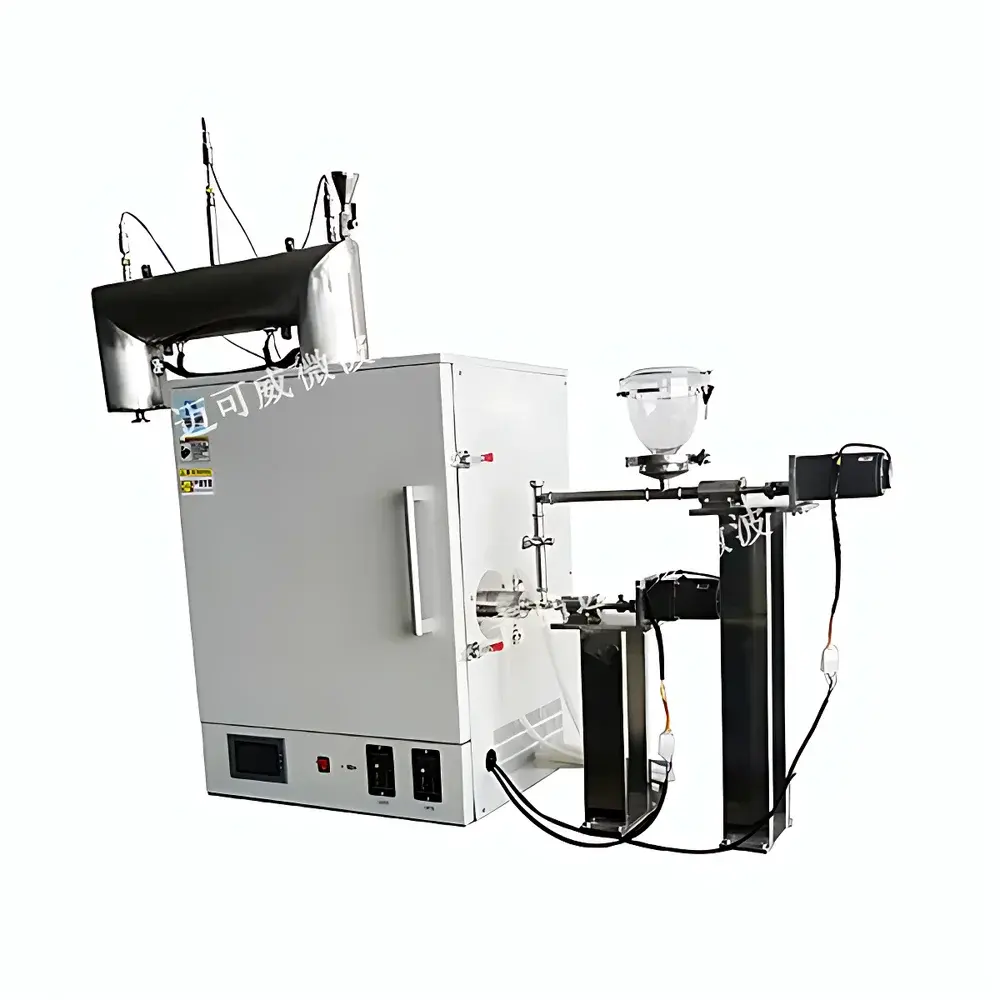
MakeWave MKW-XG-2 Microwave-Assisted Fluidized Bed Fast Pyrolysis Reactor
| Brand | MakeWave |
|---|---|
| Origin | Shandong, China |
| Manufacturer Type | Direct Manufacturer |
| Country of Origin | China |
| Model | MKW-XG-2 |
| Pricing | Available Upon Request |
| Input Power | 3-phase, 380 V / 50 Hz, ~10 kVA |
| Microwave Output Power | 1.6 kW (continuously adjustable) |
| Max Operating Temperature | 800 °C (process-controlled), 1200 °C (quartz vessel rating) |
| Dimensions (L×W×H) | 2.5 × 1.5 × 1.8 m |
| Feed System | Dual-stage 304 stainless steel screw feeder with jacketed water cooling on second stage |
| Fluidization Gas Inlet | Preheated via electrically heated quartz tubing |
| Reaction Vessel | Quartz glass, fitted with high-temp porous gas distributor plate |
| Exhaust Line | 304 stainless steel, externally heated & insulated |
| Temperature Sensing | 0–1200 °C armored thermocouple, inserted directly into fluidized bed zone |
| Control System | PLC-based with HMI touchscreen interface, closed-loop temperature & power regulation, real-time data logging and export (CSV) |
Overview
The MakeWave MKW-XG-2 is a laboratory-scale microwave-assisted fluidized bed reactor engineered for rapid thermal decomposition (fast pyrolysis) of heterogeneous biomass and carbonaceous feedstocks under controlled atmospheres. Unlike conventional resistive-heating fluidized beds, this system employs 2.45 GHz microwave energy to volumetrically heat the fluidized solid phase—enabling rapid, selective, and energy-efficient heating with minimized thermal lag. The reactor operates on Couette-type fluidization principles, where compressed carrier gas (N₂, Ar, CO₂, or steam) enters radially through a high-temperature porous distributor plate at the base of the quartz reaction chamber, suspending fine particulates in a stable, homogeneous fluidized state. Microwave irradiation is delivered via a TE₁₀-mode rectangular waveguide-coupled resonant cavity, ensuring uniform field distribution across the active zone. Temperature is monitored in real time by an armored K-type thermocouple embedded within the fluidized bed, enabling precise closed-loop control over the entire pyrolysis profile—from initial devolatilization (200–400 °C) through primary char formation (500–700 °C) to secondary cracking regimes (>700 °C). Designed for research-grade reproducibility, the MKW-XG-2 supports kinetic studies, catalyst screening, and process parameter optimization aligned with ASTM E2510, ISO 18123, and IEC 61000-4-3 electromagnetic compatibility standards.
Key Features
- Microwave-powered fluidized bed architecture with 1.6 kW continuous power modulation (0–100% range), enabling precise energy input control independent of gas flow or bed mass
- Quartz reaction vessel rated to 1200 °C, integrated with a sintered alumina gas distributor plate capable of withstanding sustained operation up to 800 °C under reducing or inert atmospheres
- Dual-stage 304 stainless steel screw feeder with water-jacketed second stage—ensuring consistent solids delivery while preventing thermal back-conduction into upstream components
- Electrically preheated quartz inlet manifold (up to 300 °C) and externally heated stainless steel exhaust line (up to 250 °C), minimizing condensation of bio-oil vapors and preserving volatile product integrity
- PLC-driven control system with industrial HMI touchscreen interface, supporting programmable ramp-hold pyrolysis profiles, real-time dual-parameter (temperature/power) feedback loops, and timestamped data export in CSV format
- Front-access resonant cavity with RF leakage shielding (<1 mW/cm² at 5 cm per IEEE C95.1), compliant with IEC 62233 and national occupational safety limits for microwave exposure
Sample Compatibility & Compliance
The MKW-XG-2 accommodates a broad spectrum of feedstock morphologies—including wood chips (≤2 mm), rice straw pellets, microalgae biomass, lignin-rich residues, sub-bituminous coal, waste polyethylene, and end-of-life tire crumb—provided particle size distributions fall within the Geldart Group B or D classification for stable fluidization. All wetted surfaces contacting reactive volatiles are constructed from quartz or 304 stainless steel, ensuring chemical inertness during acidic vapor exposure. The system conforms to GLP documentation requirements for lab-scale process development: audit trails for setpoint changes, calibration logs for thermocouples (traceable to NIST standards), and configurable data retention policies support 21 CFR Part 11–compliant electronic records when deployed with validated software extensions. Optional integration with FTIR or GC-MS online analyzers enables real-time syngas composition tracking per ISO 6974-1.
Software & Data Management
The embedded control firmware provides synchronized acquisition of temperature, microwave forward/reflected power, gas flow rate (via optional mass flow controller input), and elapsed time at user-defined intervals (100 ms–10 s resolution). All datasets are stored locally on an industrial-grade SD card and exportable via USB port without proprietary drivers. The HMI interface displays live trend curves for up to four parameters simultaneously, with zoom/pan functionality and overlay capability for comparative runs. For advanced analysis, raw CSV files are compatible with MATLAB, Python (pandas/NumPy), and commercial kinetic modeling platforms such as Reaktoro or Cantera. Firmware updates are performed via secure Ethernet connection using signed binary packages, maintaining system integrity throughout lifecycle maintenance.
Applications
This reactor serves as a platform for fundamental and applied research in thermochemical conversion science. Key use cases include: determination of apparent activation energies for cellulose/lignin depolymerization via isoconversional methods; evaluation of Ni-, Fe-, or CaO-based catalysts for in situ bio-oil upgrading; parametric studies on residence time distribution effects on aromatic selectivity; co-pyrolysis synergy assessment between lignocellulosics and waste plastics; and development of microwave-specific kinetic models distinguishing dielectric loss-driven heating from convective contributions. It is widely deployed in university energy labs, national research institutes (e.g., CAS, NREL collaborators), and industrial R&D centers engaged in circular carbon economy initiatives.
FAQ
What is the maximum recommended fluidization velocity for wood-derived biomass at 600 °C?
For particles averaging 0.5–1.0 mm in diameter, typical minimum fluidization velocities range from 0.12–0.18 m/s under N₂ at 600 °C—calculated using Wen & Yu correlation with measured particle density and sphericity.
Can the system operate under vacuum or positive pressure?
The quartz vessel and flanged connections are rated for operation between –0.08 MPa (gauge) and +0.3 MPa (gauge); however, fluidization stability requires careful adjustment of gas flow dynamics under non-atmospheric conditions.
Is third-party calibration of the thermocouple traceable to international standards supported?
Yes—users may install certified reference thermocouples (e.g., Fluke 1523 with NIST-traceable certificate) for periodic verification; the PLC accepts standard mV inputs and supports linearization tables per ITS-90.
Does the system include provisions for catalyst introduction during operation?
A dedicated side-port with quick-release ferrule fitting allows manual or automated injection of powdered catalysts into the fluidized zone without interrupting gas flow or temperature control.
What safety interlocks are implemented for microwave operation?
Hardware-level interlocks include door position sensing, cavity temperature cutoff (>900 °C), reflected power threshold shutdown (>30% of forward power), and coolant flow monitoring on the screw feeder—each independently wired to the emergency stop circuit.



