
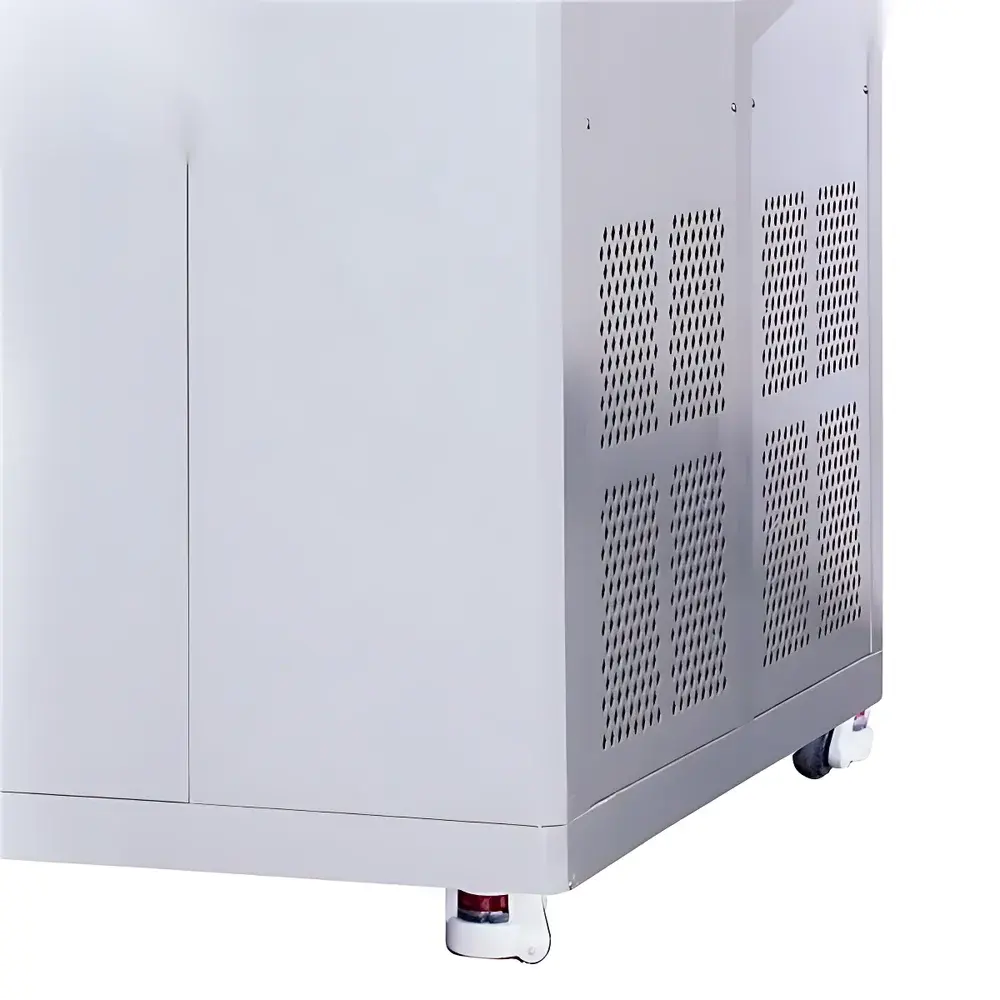
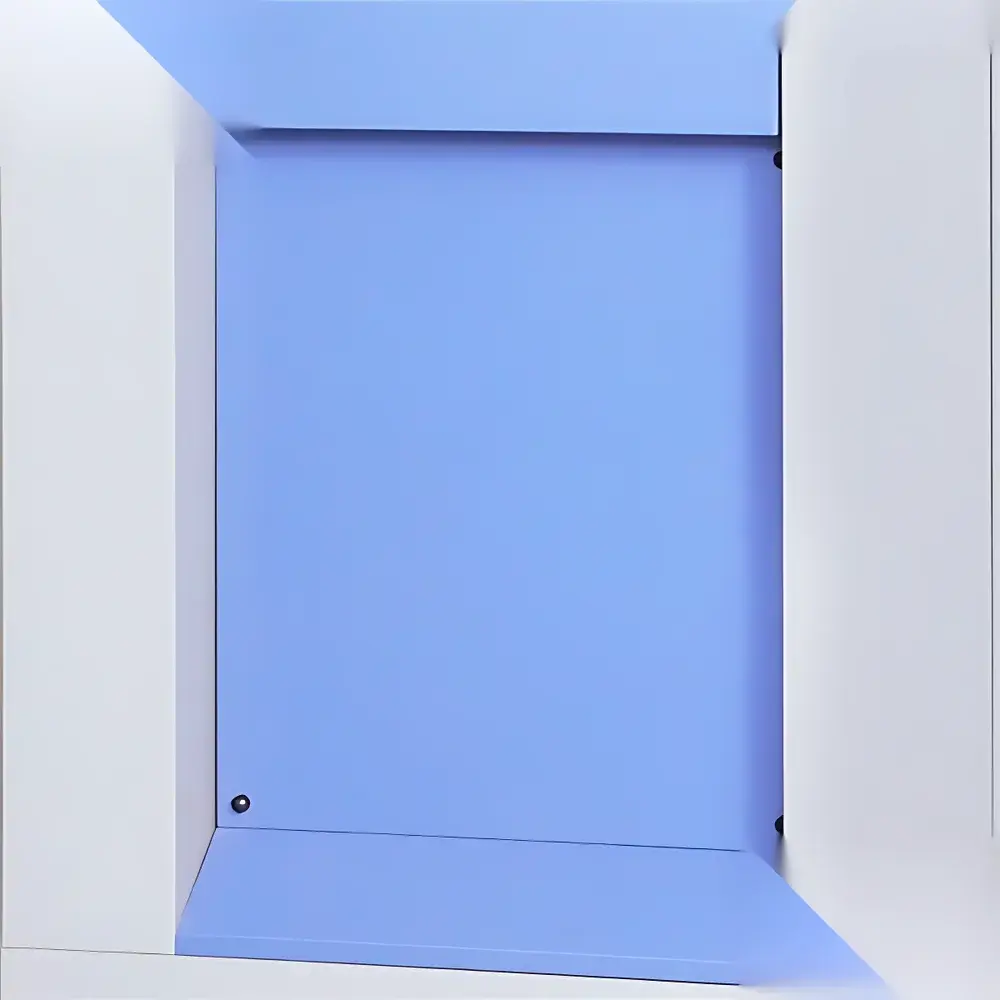
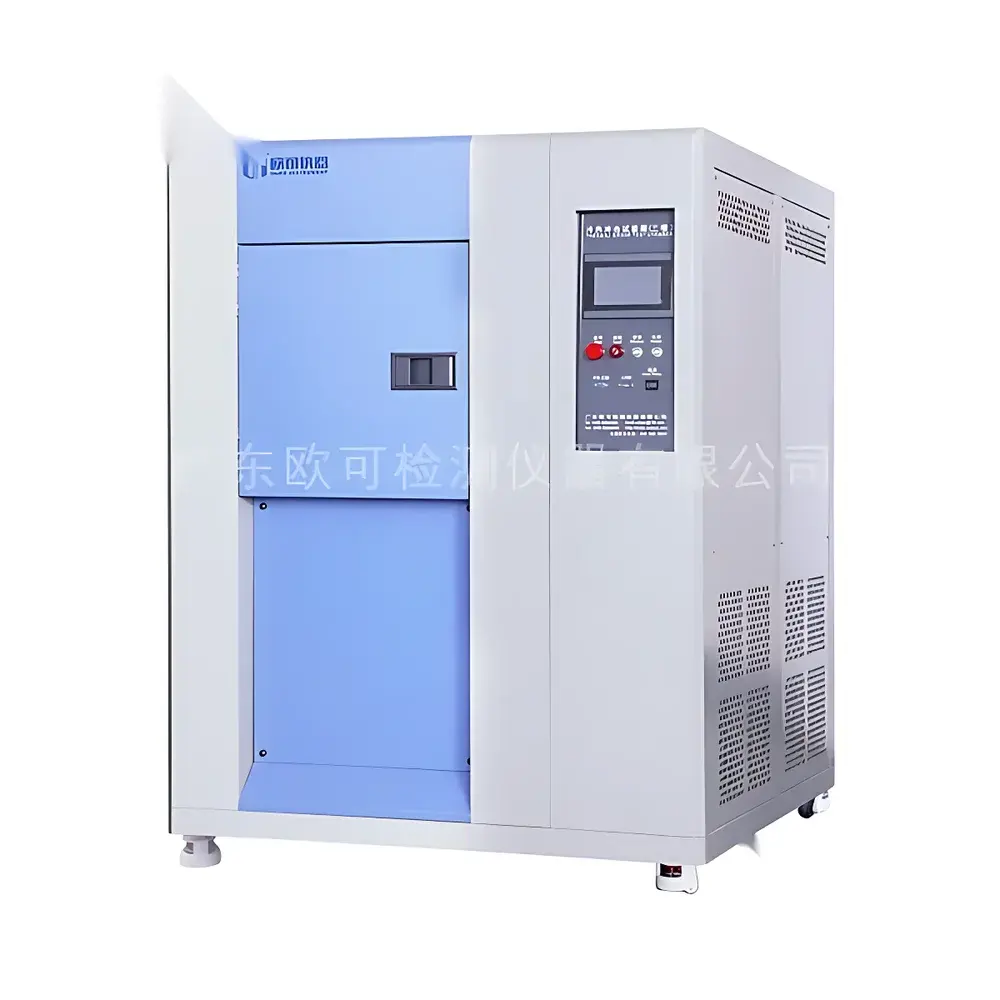
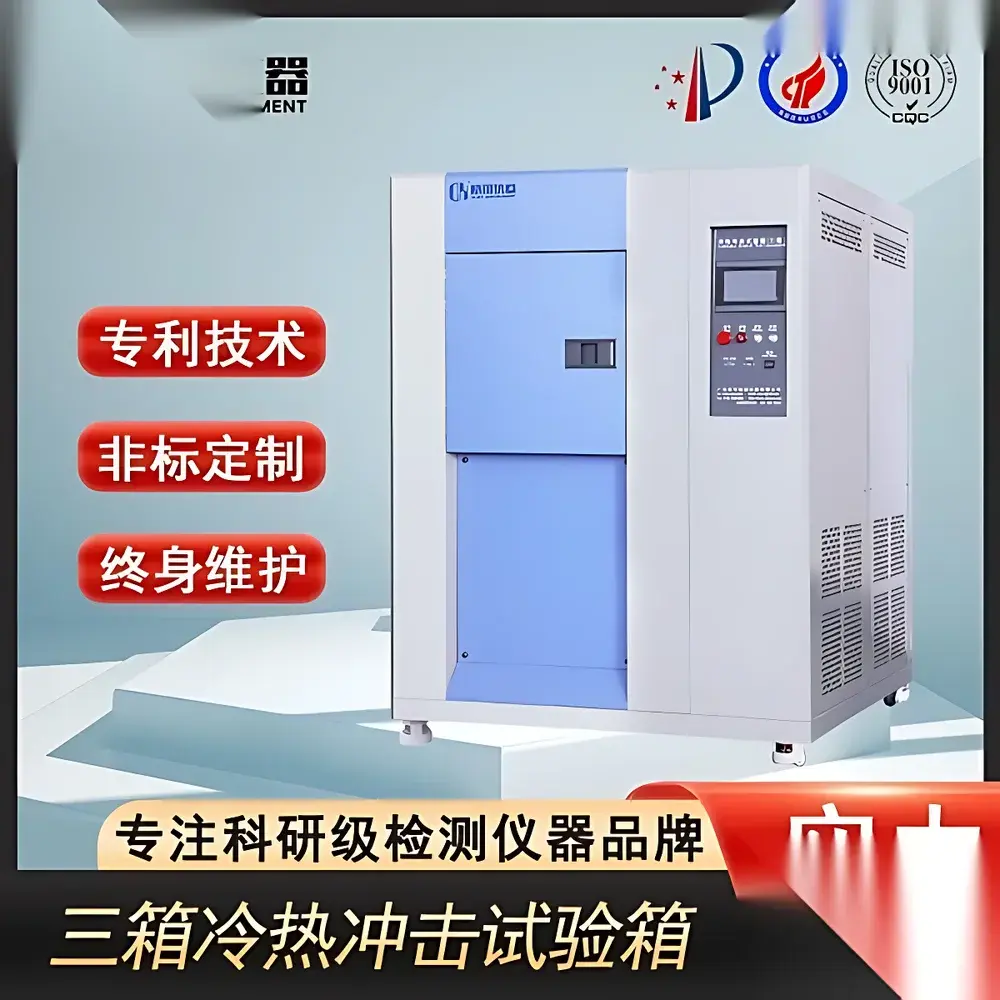
OK-TS Series Thermal Shock Test Chamber (High-Temperature / Low-Temperature Rapid Transition Chamber)
| Brand | OK Instruments |
|---|---|
| Origin | Imported |
| Manufacturer Type | Authorized Distributor |
| Temperature Range (High) | +150 °C standard, up to +200 °C optional |
| Temperature Range (Low) | -10 °C to -40 °C (Type A), -55 °C (Type B), -65 °C (Type C), -80 °C (Type D) optional |
| High-Temp Preheating Range | RT to +180 °C / +200 °C |
| Low-Temp Precooling Range | RT to -75 °C |
| Ramp Rate (Heating) | RT → +180 °C in ≈30 min |
| Ramp Rate (Cooling) | RT → -75 °C in ≈95 min |
| Recovery Time | ≤10 s |
| Temperature Uniformity | ±0.5 °C |
| Temperature Deviation | ±2.0 °C |
| Basket Dimensions (mm) | 400×350×350 to 700×600×600 (model-dependent) |
| External Dimensions (mm) | 1350×1800×1350 to 1600×2100×1650 |
| Drive Mechanism | Pneumatic or electromechanical basket transfer |
| Interior Material | 1.2 mm SUS#304 stainless steel |
| Exterior Material | 1.5 mm galvanized steel with powder coating or optional SUS#304 |
| Insulation | Dual-layer — rigid polyurethane foam + glass fiber |
| Heating System | Helical Ni-Cr alloy heaters with ceramic insulation |
| Communication Interfaces | RS-232, RS-485, USB, LAN (Ethernet) |
Overview
The OK-TS Series Thermal Shock Test Chamber is an engineered environmental test system designed to evaluate material and component reliability under extreme, rapid thermal transitions. Based on the two-chamber (hot/cold) horizontal or vertical basket-transfer principle, it subjects test specimens to repeated, high-fidelity cycling between elevated and sub-zero temperature extremes—mimicking real-world operational stresses encountered in aerospace avionics, automotive power electronics, LED packaging, PCB assembly, and military-grade electronic systems. Unlike conventional temperature cycling chambers that rely on single-chamber air modulation, the OK-TS architecture employs physically isolated high-temperature and low-temperature zones, enabling true thermal shock profiles with minimal thermal inertia. The chamber operates on a validated Couette-style thermal separation model: specimens are rapidly transferred via pneumatically actuated or servo-driven baskets between chambers, achieving transition times ≤10 seconds and minimizing dwell-induced thermal equilibration artifacts. This methodology aligns with ASTM D5229/D5229M (low-temperature impact resistance), IEC 60068-2-14 (change of temperature), and MIL-STD-810H Method 503.7 (temperature shock), supporting qualification-level testing for mission-critical hardware.
Key Features
- Modular dual-zone thermal architecture with independent high-temperature (+150 °C standard, +200 °C optional) and cryogenic (-40 °C to -80 °C selectable) chambers, ensuring zero cross-contamination of thermal environments.
- Pneumatic or electromechanical basket drive system engineered for repeatable ≤10-second transfer cycles, validated per ISO 16750-4 and JEDEC JESD22-A104F requirements for thermal shock acceleration factors.
- Energy-optimized refrigeration control: adaptive compressor load modulation reduces energy consumption by ≥30% versus fixed-heating-balance systems—certified compliant with ISO 50001 energy management principles.
- Pre-integrated liquid nitrogen (LN₂) interface for future field upgrade to ultra-low-temperature operation (≤-65 °C), eliminating need for full chamber replacement during technology lifecycle extension.
- Full 3D parametric CAD modeling and pre-manufacturing virtual assembly validation ensure mechanical integrity, thermal path optimization, and error-free integration of critical subsystems including door seals, basket guides, and sensor mounting points.
- Industrial-grade component sourcing: compressors (Embraco, Bitzer), controllers (Yokogawa UTAdvanced, Omron E5CC), and sensors (PT100 Class A, NIST-traceable calibration) ensure long-term stability and measurement repeatability (±0.5 °C uniformity).
Sample Compatibility & Compliance
The OK-TS accommodates samples ranging from miniature IC packages (QFN, BGA) to full-size automotive ECUs and aerospace flight modules. Standard basket configurations support maximum dimensions up to 700 × 600 × 600 mm (OK-TS-225), with customizable fixtures available for non-standard geometries. Internal SUS#304 construction ensures corrosion resistance against outgassed volatiles from polymer encapsulants or conformal coatings. All models comply with electromagnetic compatibility (EMC) per EN 61326-1 and safety standards IEC 61010-1. Data logging and audit trails meet FDA 21 CFR Part 11 requirements when paired with OK-DataLink software (optional). Calibration documentation includes as-found/as-left reports traceable to NIST or national metrology institutes (NMI), supporting GLP/GMP laboratory accreditation (ISO/IEC 17025).
Software & Data Management
Embedded controller firmware supports programmable multi-step thermal shock profiles—including dwell time, cycle count, ramp rate limits, and conditional branching (e.g., pause on alarm, auto-restart after fault clearance). Real-time data streaming via RS-485, USB, or Ethernet enables integration into centralized MES/QMS platforms (Siemens Opcenter, Rockwell FactoryTalk). Optional OK-DataLink software provides full 21 CFR Part 11 compliance: electronic signatures, role-based access control, immutable audit logs, and automated report generation (PDF/CSV) with timestamped metadata. Historical trend analysis includes statistical process control (SPC) charts (X̄/R, Cpk), deviation heatmaps, and failure mode correlation tagging—essential for root cause analysis in APQP and PPAP submissions.
Applications
- Aerospace: Qualification testing of flight-critical sensors, radar modules, and satellite power converters per DO-160G Section 4.5 (temperature shock).
- Automotive: Validation of ADAS domain controllers, battery management systems (BMS), and EV traction inverters under ISO 16750-4 and LV-124 stress profiles.
- Electronics Manufacturing: SMT solder joint fatigue assessment, die attach delamination screening, and wafer-level package reliability per JEDEC JESD22-A104F and A106B.
- LED & Optoelectronics: Thermal cycling endurance of phosphor-coated emitters, COB arrays, and laser diode housings subjected to rapid ambient shifts.
- Research & Development: Accelerated aging studies of polymer composites, thermal interface materials (TIMs), and MEMS packaging under controlled ΔT gradients (up to 280 K).
FAQ
What temperature ranges are supported, and can the system be upgraded for ultra-low temperatures?
Standard models operate from -40 °C to +150 °C; optional configurations extend to -80 °C and +200 °C. An integrated LN₂ interface allows field retrofitting to ≤-65 °C without structural modification.
How is thermal shock severity quantified, and what standards does the chamber support?
Severity is defined by transition time, dwell duration, and ΔT magnitude. The OK-TS meets IEC 60068-2-14, MIL-STD-810H Method 503.7, and JESD22-A104F, with documented transition performance ≤10 s and temperature stability ±0.5 °C.
Is remote monitoring and data export supported for regulatory compliance?
Yes—RS-485, USB, and Ethernet interfaces enable secure remote access. With OK-DataLink software, users achieve full 21 CFR Part 11 compliance, including electronic signatures, audit trails, and PDF/CSV reporting.
What maintenance protocols are recommended for long-term reliability?
Quarterly verification of door seal integrity, annual NIST-traceable sensor calibration, and biannual refrigerant charge validation are advised. Preventive maintenance kits and OEM-certified service contracts are available.
Can the chamber accommodate custom sample fixtures or non-standard payload geometries?
Yes—custom basket inserts, thermal mass adapters, and fixture-mounting rails are offered. Engineering consultation is included for complex DUT integration (e.g., active biasing, optical access ports).



