
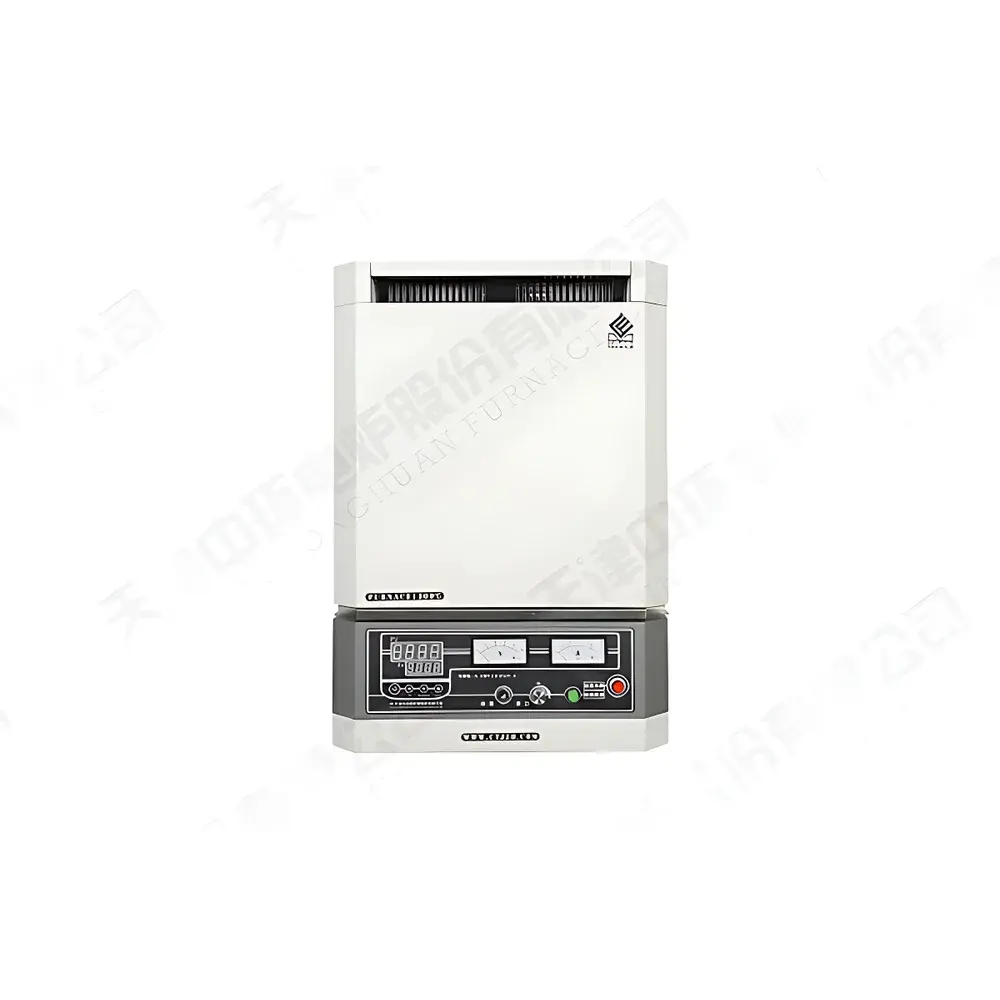
ZHONGHUAN FURNACE ZHX Series 1800°C Benchtop High-Temperature Box-Type Resistance Furnace
| Brand | ZHONGHUAN FURNACE |
|---|---|
| Origin | Tianjin, China |
| Model | ZHX Series (Benchtop) |
| Max Temperature | 1800°C |
| Control Accuracy | ±1°C |
| Max Power | 5 kW |
| Internal Chamber Dimensions | 190 × 180 × 150 mm |
| Heating Element | Silicon Molybdenum (MoSi₂) Rods |
| Insulation Material | Advanced Composite Refractory |
| Cooling | Automatic Surface-Cooling Fan (Activated at ≥50°C Surface Temp) |
| Safety Features | Door-Interlocked Power Cut-off, Over-Temperature Cut-off & Alarm, Earth-Leakage Protection |
| Control Interface | RS-485 Port for PC Integration |
| Optional | Full-Color Touchscreen with Real-Time Curve, Historical Data Logging, and Multi-Furnace Network Control (up to 200 units) |
Overview
The ZHONGHUAN FURNACE ZHX Series is a benchtop high-temperature box-type resistance furnace engineered for precision thermal processing in research laboratories, materials science departments, and quality control environments. Operating on the principle of resistive heating via silicon molybdenum (MoSi₂) rods embedded within a thermally optimized chamber, it delivers stable, uniform temperature fields up to 1800°C — with continuous operation rated at 1750°C. Its core architecture integrates advanced composite refractory insulation, which reduces radiant heat loss by over 40% compared to conventional alumina fiber linings, while maintaining structural integrity and chemical inertness under prolonged exposure to aggressive atmospheres. The furnace is not designed for vacuum or controlled-gas applications but is optimized for ambient-air or inert-gas-purged operation (with optional gas inlet port), making it suitable for sintering, ashing, calcination, and heat-treatment protocols requiring high thermal fidelity and repeatability.
Key Features
- Intelligent dual-mode temperature control system supporting both PID regulation and fuzzy logic algorithms, with auto-tuning capability for dynamic load compensation.
- Programmable ramp-soak profiles: 30-segment scheduling with domestic controllers; 40-segment capability with imported programmable controllers — enabling complex thermal cycles such as slow ramping, dwell stabilization, and multi-step cooling.
- Integrated safety interlocks: mechanical door switch cuts power upon opening; independent over-temperature cutoff circuit triggers automatic shutdown and audible/visual alarm if setpoint exceeds user-defined threshold by >5°C.
- Surface thermal management: built-in thermostatically activated axial fan initiates when external casing temperature reaches 50°C, ensuring operator safety and prolonging cabinet component life.
- Current-limiting and soft-start functionality mitigates inrush current during startup or mid-cycle sample insertion — protecting both MoSi₂ elements and facility wiring infrastructure from thermal stress and voltage sag.
- RS-485 serial interface compliant with Modbus RTU protocol, allowing centralized monitoring and control of up to 200 furnaces via dedicated LabControl software suite (Windows-based, audit-trail enabled).
Sample Compatibility & Compliance
The ZHX furnace accommodates standard ceramic crucibles (alumina, zirconia), graphite boats, and platinum ware — provided they remain within dimensional limits (max 140 × 140 × 140 mm usable space post-heating-element clearance). Its uniformity profile meets ASTM E220-22 requirements for laboratory furnace qualification when calibrated using NIST-traceable thermocouples (Type S or B). While not certified to UL 61010-1 or IEC 61000-6-3 out-of-the-box, the unit complies with GB/T 10066.1–2004 (Chinese national standard for industrial resistance furnaces) and incorporates design elements aligned with GLP/GMP documentation practices — including timestamped event logging (power-on, alarm trigger, program completion) and non-volatile memory retention for critical parameters.
Software & Data Management
The optional PC-based control software provides full remote supervision: real-time temperature curve overlay, historical trend replay, customizable report generation (PDF/CSV), and export-ready audit logs compliant with FDA 21 CFR Part 11 requirements — including electronic signatures, user access levels, and immutable record timestamps. All data is stored locally on the host PC with optional cloud backup integration. The touchscreen HMI variant supports bilingual UI (English/Chinese), graphical representation of thermal gradients across the chamber volume, and configurable alarm escalation (email/SMS via gateway module).
Applications
This furnace serves critical roles in ceramic formulation development (e.g., sintering of SiC, AlN, and rare-earth doped phosphors), metallurgical phase transformation studies, catalyst precursor decomposition, ash content determination per ISO 21667:2021, and pre-firing of sensor substrates. Its low thermal mass and rapid cooldown characteristics (<60 min from 1800°C to 100°C under natural convection) support high-throughput screening workflows. In academic settings, it is routinely employed for solid-state synthesis of battery cathode materials (e.g., LiCoO₂, NMC), where precise thermal history directly influences crystallinity and electrochemical performance.
FAQ
What is the maximum recommended continuous operating temperature?
Continuous operation is rated at 1750°C; short-term excursions to 1800°C are permissible for ≤30 minutes per cycle.
Can this furnace be used under reducing or vacuum conditions?
No — the standard configuration is intended for air or inert-gas (Ar/N₂) purged environments only; vacuum or hydrogen-compatible variants require custom engineering and separate certification.
Is calibration traceable to international standards?
Yes — factory calibration uses NIST-traceable Type S thermocouples; users may perform on-site verification per ISO/IEC 17025 procedures using accredited reference instruments.
How does the current-limiting function extend heating element life?
By capping peak current draw during cold-start and transient loading, it minimizes thermal shock-induced microcracking in MoSi₂ rods — extending service life by up to 35% under typical lab usage patterns.
Does the system support automated data export for LIMS integration?
Yes — CSV-formatted time-series datasets and summary reports can be scheduled for automatic export to network folders or FTP servers, compatible with major LIMS platforms including LabWare and Thermo Fisher SampleManager.
Related Products



