
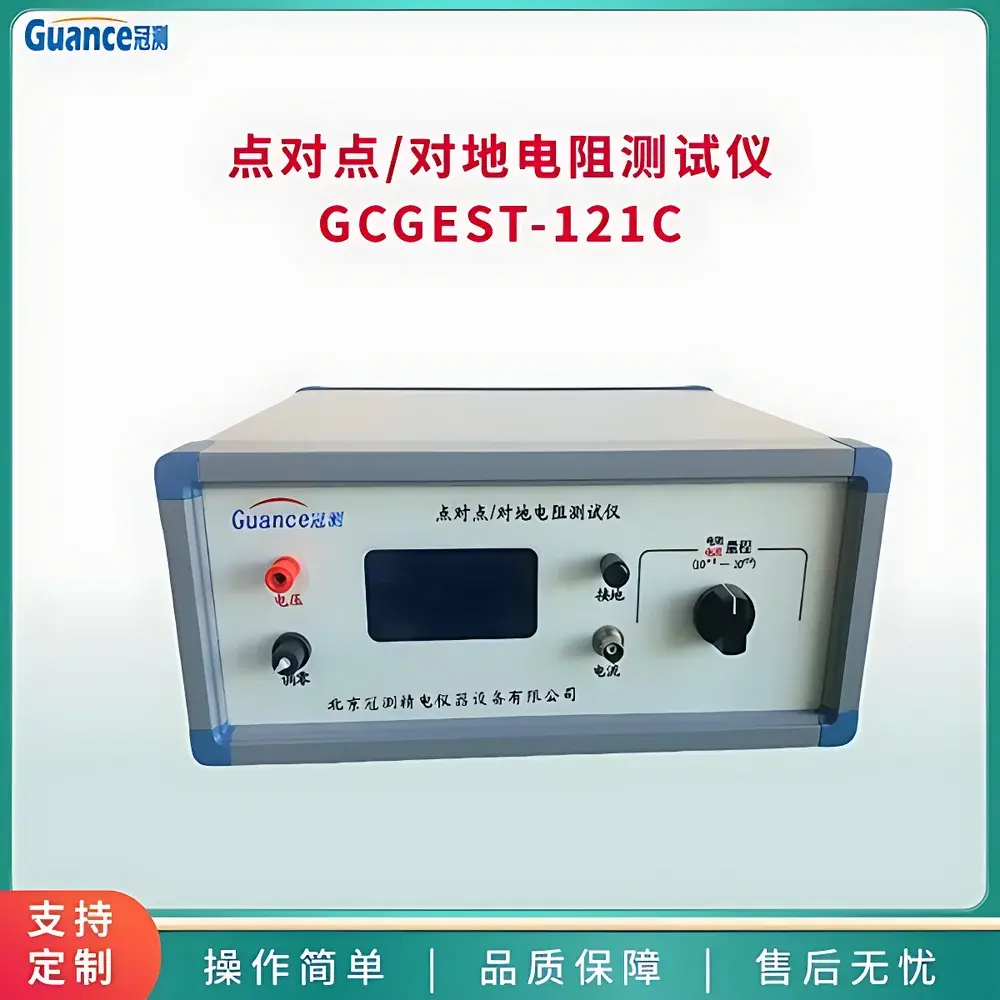
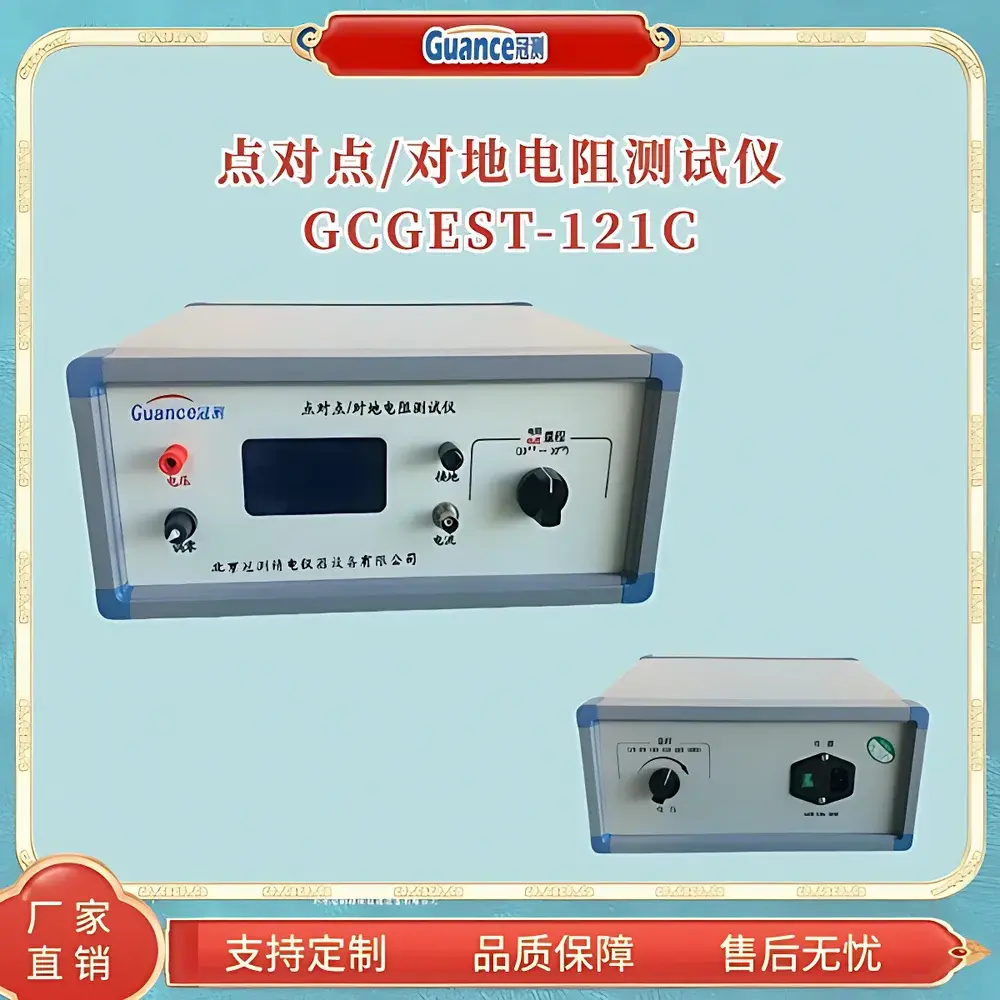
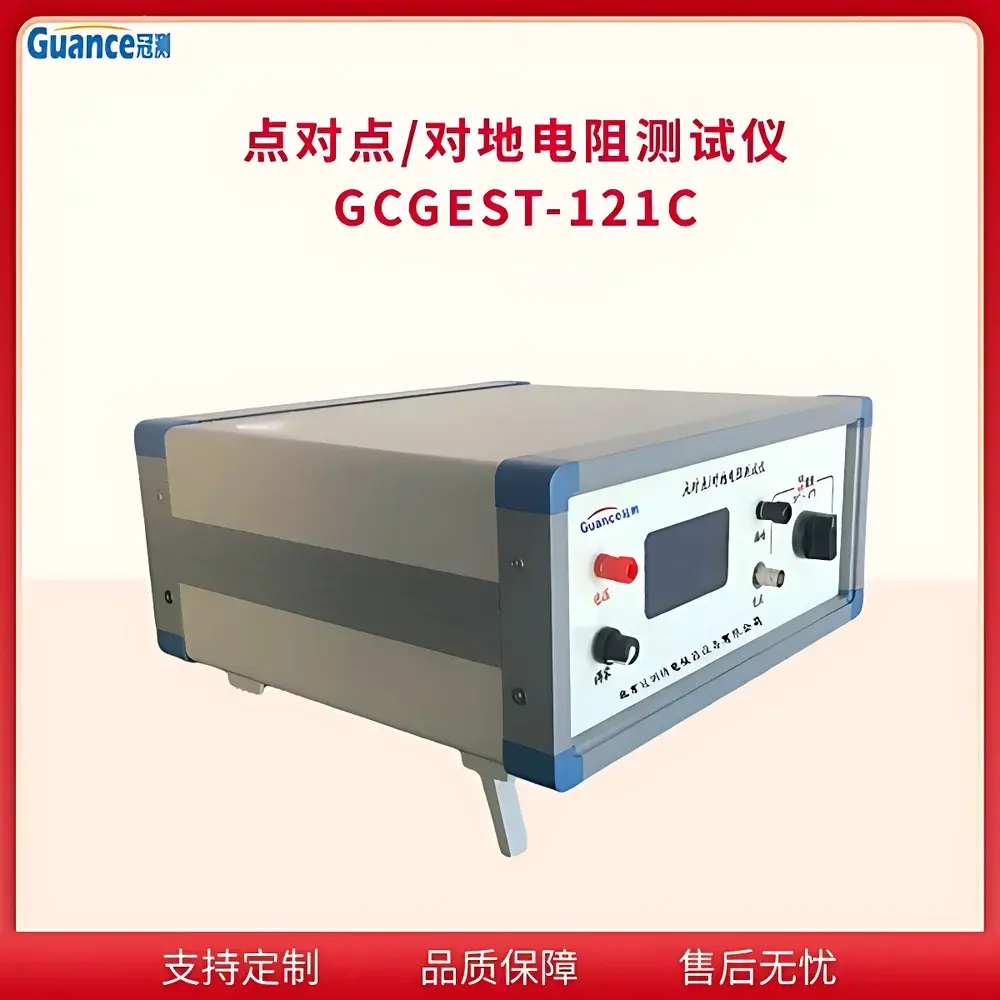
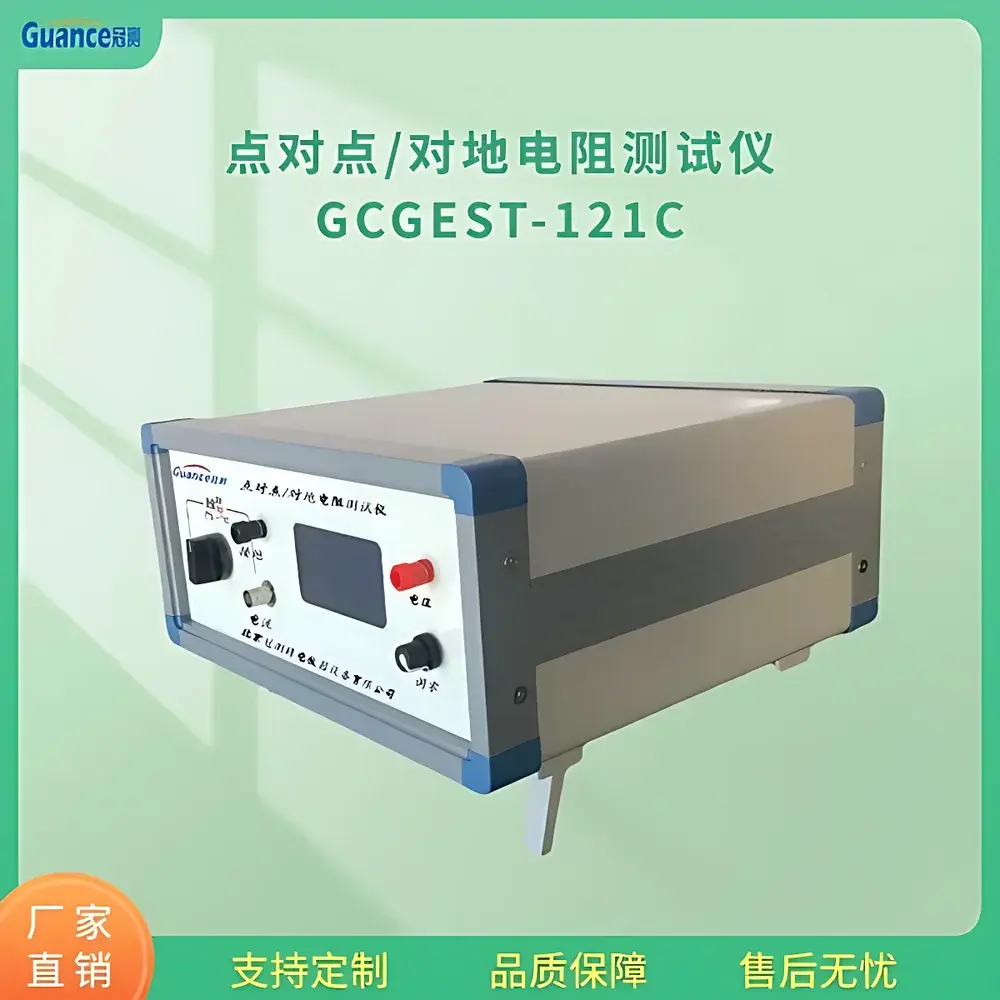
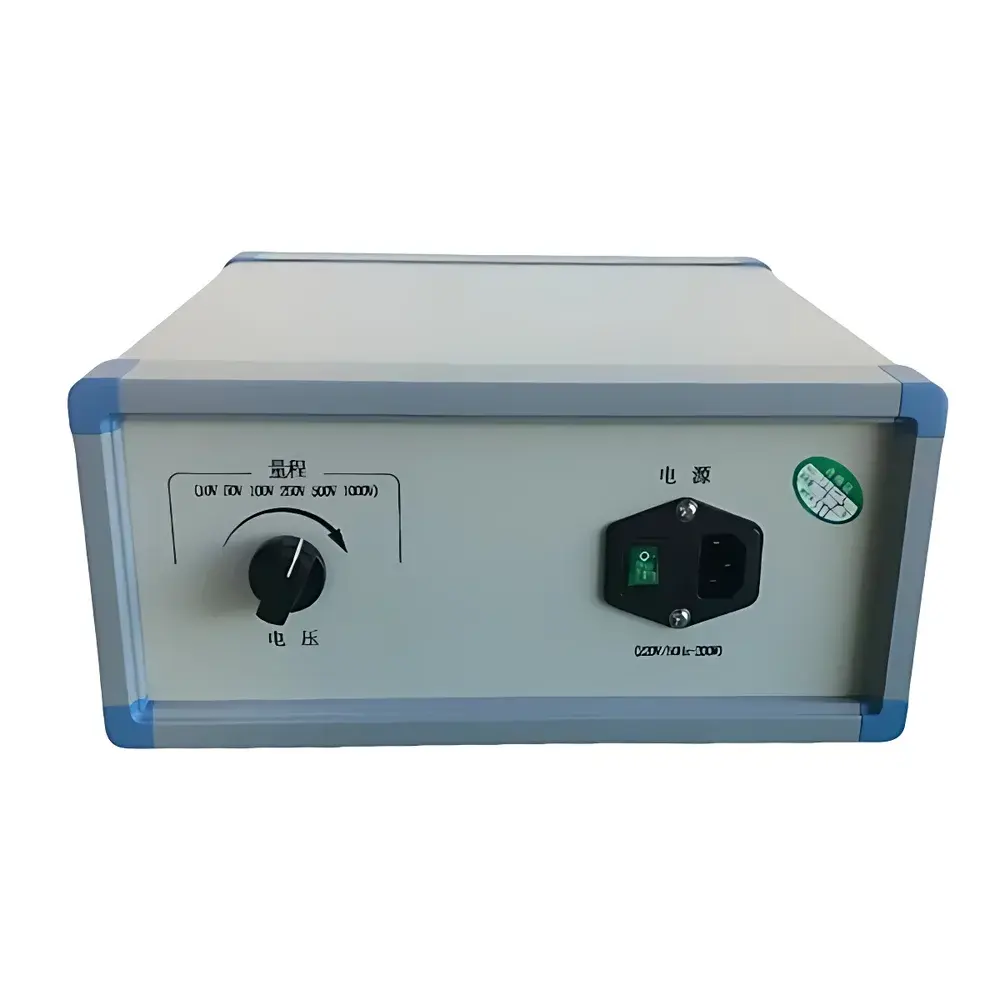
GuanCe Instruments GCGEST-121C Capacitance-Based Surface Resistivity & Electrostatic Performance Analyzer
| Brand | GuanCe Instruments |
|---|---|
| Origin | Beijing, China |
| Model | GCGEST-121C |
| Resistance Measurement Range | 1×10⁴ Ω to 1×10¹⁸ Ω |
| Current Measurement Range | 1×10⁻¹⁶ A to 2×10⁻⁴ A |
| Test Voltages | 10 V, 50 V, 100 V, 250 V, 500 V, 1000 V |
| Accuracy | ±1% (≤1×10¹⁰ Ω), ±5–10% (>1×10¹⁰ Ω) |
| Display | Dual-line LCD showing voltage, resistance, and current simultaneously |
| Power Supply | 220 V AC / 50 Hz |
| Dimensions (L×W×H) | 300 mm × 300 mm × 150 mm |
| Weight | ~5 kg |
| Standard Electrode | 63 mm diameter, 2.5 kg |
Overview
The GuanCe Instruments GCGEST-121C Capacitance-Based Surface Resistivity & Electrostatic Performance Analyzer is a precision-engineered instrument designed for quantitative evaluation of electrostatic dissipation characteristics in conductive, static-dissipative, and insulative materials—specifically optimized for quality control and compliance verification of anti-static floor coatings and related architectural finishes. Unlike conventional moisture analyzers (which rely on capacitance changes induced by water content), the GCGEST-121C operates on a dual-parameter measurement principle: it applies calibrated DC test voltages across standardized electrode configurations and simultaneously acquires both voltage drop and leakage current via high-impedance analog front-end circuitry. Using real-time Ohm’s Law computation (R = V/I), the instrument calculates surface or volume resistivity without reliance on fixed-range multipliers or manual scaling—a critical advancement over legacy electrometer-based systems. Its architecture eliminates nonlinearity artifacts inherent in analog galvanometer-based high-resistance meters, delivering stable, repeatable readings across 14 decades of resistance (10⁴ Ω to 10¹⁸ Ω), essential for validating conformance to SJ/T 11294–2018 Annex A requirements for electrostatic performance testing.
Key Features
- Simultaneous digital readout of applied test voltage, measured resistance, and leakage current on a dual-line LCD display—enabling immediate cross-verification and eliminating transcription errors.
- Multi-voltage DC source (10 V, 50 V, 100 V, 250 V, 500 V, 1000 V) compliant with SJ/T 11294–2018 test protocols for point-to-point, point-to-ground, and person/shoe/floor system resistance measurements.
- Integrated safety interlock: automatic power cutoff upon opening of the shielded test enclosure, satisfying IEC 61010-1 Class II protection requirements for operator safety during high-voltage operation.
- Wide dynamic range current sensing (1×10⁻¹⁶ A to 2×10⁻⁴ A) achieved via low-noise transimpedance amplification and guarded input design—minimizing stray capacitance and electromagnetic interference.
- Compact benchtop form factor (300 × 300 × 150 mm; ~5 kg) with integrated 63 mm diameter, 2.5 kg stainless steel electrodes—designed for reproducible contact pressure and minimal edge effects per ASTM D257 and IEC 60093 guidelines.
Sample Compatibility & Compliance
The GCGEST-121C is validated for use with homogeneous, non-porous, and semi-porous dielectric substrates including epoxy, polyurethane, and acrylic-based anti-static floor coatings, as well as conductive tiles, rubber mats, and ESD-safe workbench surfaces. It supports three standardized test configurations defined in SJ/T 11294–2018 Annex A: (1) point-to-point resistance (Rtt), (2) point-to-ground resistance (Rtg), and (3) human-body voltage decay assessment using optional wrist strap or footwear interface modules. The instrument meets electrical safety requirements per GB 4793.1–2019 (equivalent to IEC 61010-1) and provides traceable measurement capability aligned with ISO/IEC 17025 calibration frameworks. While not FDA 21 CFR Part 11–compliant out-of-the-box, its deterministic digital output format facilitates integration into GLP/GMP audit trails when paired with validated laboratory information management systems (LIMS).
Software & Data Management
The GCGEST-121C operates as a standalone hardware platform with no embedded firmware-based data logging. All measurements are displayed in real time and intended for manual recording or external capture via RS-232 or USB-to-serial interface (optional adapter). For regulated environments, users may integrate the device into validated workflows using third-party acquisition software that supports SCPI command sets for automated voltage stepping, pass/fail threshold comparison, and CSV export. Calibration certificates—including uncertainty budgets per ISO/IEC 17025—are provided with each unit and must be renewed annually against NIST-traceable reference resistors (e.g., Keysight B1500A metrology-grade standards). No proprietary drivers or cloud services are required or supported.
Applications
- Quality assurance of anti-static flooring systems prior to commissioning in cleanrooms, data centers, electronics manufacturing facilities, and pharmaceutical production suites.
- Periodic verification of electrostatic discharge (ESD) control performance in accordance with ANSI/ESD S20.20 and IEC 61340-5-1.
- R&D evaluation of novel conductive fillers (e.g., carbon nanotubes, graphene, metal-coated polymers) in coating formulations.
- Root-cause analysis of ESD-related failures in semiconductor handling environments through comparative resistivity mapping across floor zones.
- Educational demonstration of Ohm’s Law behavior at ultra-high impedance levels—particularly useful for university-level materials science and electrical engineering laboratories.
FAQ
Is the GCGEST-121C suitable for moisture content measurement?
No. Despite “capacitance” appearing in its functional description, this instrument does not measure moisture. It is a high-precision resistivity analyzer designed exclusively for electrostatic performance testing of solid dielectric materials.
Does it support automated data export to Excel or LIMS?
Not natively. Raw readings are displayed only on the front-panel LCD. External data capture requires optional serial interface hardware and user-configured acquisition software.
What calibration standards are recommended?
Annual calibration against certified high-value resistors traceable to NIST or CNAS-accredited labs is mandatory. Recommended standards span 10⁴ Ω to 10¹⁸ Ω with uncertainties ≤0.1% at 100 V bias.
Can it measure人体 voltage decay per ANSI/ESD STM97.2?
Yes—when used with an optional human-body voltage probe and configured per SJ/T 11294–2018 Annex A Section 4.3, it supports decay time measurement under controlled 1 kV charging conditions.
Is the electrode set included with purchase?
Yes. One pair of 63 mm diameter, 2.5 kg stainless steel electrodes is supplied as standard equipment, conforming to the dimensional and mass specifications in SJ/T 11294–2018.





