
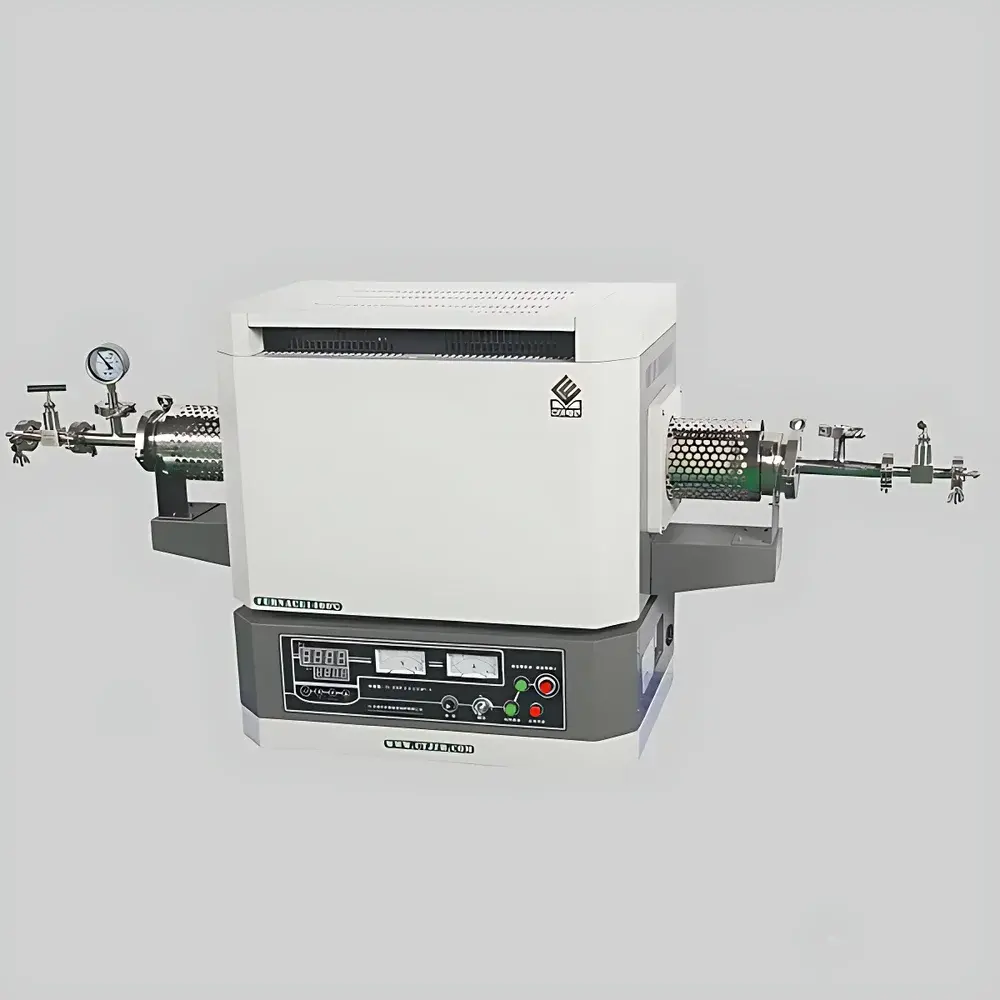
ZHONGHUAN FURNACE 1600℃ Triple-Zone Gradient Tube Furnace
| Brand | ZHONGHUAN FURNACE |
|---|---|
| Origin | Tianjin, China |
| Model | 1600℃ Triple-Zone Gradient Tube Furnace |
| Type | Horizontal Tube Furnace |
| Max Temperature | 1400℃–1600℃–1400℃ (Three Independent Zones) |
| Temperature Uniformity | ±1℃ (at setpoint, steady-state) |
| Power Rating | 8 kW |
| Heating Rate | ≤5℃/min (≤500℃), ≤10℃/min (500–800℃), ≤5℃/min (800–1000℃), ≤3℃/min (1000–1400℃), ≤2℃/min (1400–1600℃) |
| Heating Elements | SiC Rods (1500℃ max surface temp) & MoSi₂ Rods (1700℃ max surface temp) |
| Chamber Dimensions (L×W×H) | 796×1150×650 mm |
| Cooling | Intelligent Air-Cooling System with Thermal-Triggered Fan Activation (activated at ≥50℃ external surface temp) |
| Control Interface | RS-485 port for PC connectivity |
| Programmable Controller | 50-segment domestic PID controller or 40-segment imported intelligent controller with auto-tuning, fuzzy logic, and ramp-soak profiles |
Overview
The ZHONGHUAN FURNACE 1600℃ Triple-Zone Gradient Tube Furnace is a precision-engineered horizontal tube furnace designed for advanced thermal processing under controlled atmosphere or vacuum conditions. It features three independently controlled heating zones—configured as 1400℃ / 1600℃ / 1400℃—enabling precise axial temperature gradients across the reaction tube. This architecture supports critical applications requiring thermal profiling, such as crystal growth, chemical vapor transport (CVT), gradient sintering, and multi-stage annealing protocols in semiconductor fabrication, ceramic engineering, and nanomaterial synthesis. The furnace employs dual-element heating technology: high-strength silicon carbide (SiC) rods for lower-temperature stability and molybdenum disilicide (MoSi₂) rods rated for continuous operation up to 1700℃ surface temperature—ensuring long-term reliability at extreme operating points. Constructed with vacuum-formed polycrystalline mullite fiber insulation, the chamber delivers >50% energy savings versus traditional refractory linings while maintaining exceptional radial and axial temperature uniformity.
Key Features
- Triple-zone independent PID control with ±1℃ thermal stability at setpoint, enabling reproducible gradient generation and isothermal zone isolation.
- Quick-connect flange system with single-clamp gas-tight coupling—eliminates threaded法兰 assembly, reduces installation-induced mechanical stress on quartz or alumina tubes, and accelerates sample loading/unloading cycles.
- Dual-ring sealing technology at both furnace ends ensures leak rates <1×10⁻³ mbar·L/s under vacuum, compatible with low-to-high vacuum systems (10⁻³ to 10⁵ Pa range) and reactive/inert gas environments (N₂, Ar, H₂, NH₃, forming gas).
- Intelligent thermal management: integrated surface temperature sensor triggers forced-air cooling fans when external casing exceeds 50℃, maintaining operator safety and structural integrity during extended high-temperature operation.
- Comprehensive safety architecture including over-temperature cutoff (hardware-independent thermocouple backup), earth-leakage circuit interruption (ELCI), and real-time fault logging with audible/visual alerts.
- RS-485 Modbus RTU interface supporting integration into laboratory-wide SCADA networks—enables remote parameter adjustment, live temperature trace monitoring, automated data export (CSV/TXT), and audit-compliant historical record retention.
Sample Compatibility & Compliance
The furnace accommodates standard OD 60–100 mm quartz, fused silica, or high-purity alumina tubes (custom lengths up to 1200 mm). Its internal dimensions (796 × 1150 × 650 mm W×D×H) support large-diameter substrates, stacked wafer carriers, and multi-compartment crucible assemblies. All electrical components comply with IEC 61000-6-3 (EMC emission limits) and IEC 61000-6-2 (immunity standards). Temperature calibration procedures align with ASTM E220 and ISO/IEC 17025 requirements for accredited thermal testing laboratories. Optional vacuum and mass flow control modules meet GLP/GMP documentation needs—including full electronic audit trails, user-access level management, and 21 CFR Part 11–compliant electronic signatures when paired with validated software platforms.
Software & Data Management
The embedded controller supports 50-segment programmable ramp-soak sequences (domestic firmware) or 40-segment adaptive profiles (imported firmware with self-tuning PID and fuzzy logic optimization). Each segment defines target temperature, ramp rate, dwell time, and output power limit. Data logging records temperature vs. time at 1-second intervals, with timestamped event markers for gas flow changes, vacuum pump activation, or manual interventions. Exported datasets include metadata (operator ID, batch number, furnace serial, ambient conditions) and are compatible with MATLAB, OriginLab, and JMP for statistical process analysis. Remote supervision via Ethernet-to-RS485 gateway allows concurrent control of up to 200 furnaces from a central workstation—ideal for materials R&D scale-up and DOE-based process optimization.
Applications
- Growth of single-crystal semiconductors (e.g., SiC, GaN) using temperature-gradient-driven vapor-phase techniques.
- Controlled pyrolysis and carbonization of polymer precursors into carbon fibers and porous carbons.
- Atmosphere-dependent phase transformation studies in battery cathode materials (e.g., LiCoO₂, NMC, LiFePO₄) under O₂, N₂, or reducing atmospheres.
- Thermal annealing of 2D materials (graphene, TMDs) on insulating substrates with spatially resolved thermal budgets.
- High-temperature catalytic testing with in situ gas switching (e.g., CO oxidation, methane reforming) using integrated MFCs and quadrupole mass spectrometry coupling.
- Pre-sintering and debinding of metal injection molded (MIM) and ceramic injection molded (CIM) green bodies under precisely modulated heating profiles.
FAQ
What tube materials are compatible with this furnace’s maximum operating temperature?
Quartz tubes are rated for continuous use up to 1100℃; high-purity fused silica (Suprasil® grade) may be used up to 1250℃. For full 1600℃ capability, recrystallized alumina (Al₂O₃) or molybdenum tubes are required—subject to appropriate atmosphere compatibility (e.g., Mo requires inert or reducing gas to prevent oxidation).
Can the three zones be operated at different temperatures simultaneously?
Yes—each zone has independent thermocouple feedback, SSR-driven power regulation, and programmable setpoints. Gradient slopes from −50℃/cm to +30℃/cm are achievable depending on tube geometry and insulation configuration.
Is vacuum compatibility certified to specific standards?
The dual-ring flange design achieves ≤1×10⁻³ mbar·L/s helium leak rate per EN 1591-4 when assembled with fluorosilicone O-rings and proper torque sequencing. Vacuum validation reports are available upon request for ISO 10816-3 or ASTM E515 compliance assessments.
Does the system support automated gas blending?
When integrated with optional mass flow controllers (MFCs) and gas mixing manifolds, the furnace accepts analog (0–10 VDC) or digital (Modbus RTU) setpoint inputs—enabling dynamic atmosphere composition control synchronized with temperature ramps.
What maintenance intervals are recommended for heating elements?
SiC rods typically require replacement after ~3000 h at 1400℃; MoSi₂ rods maintain >85% resistivity after 5000 h at 1600℃ in inert atmospheres. Annual inspection of fiber insulation integrity and thermocouple calibration drift (per ASTM E230) is advised for GLP-regulated environments.



