
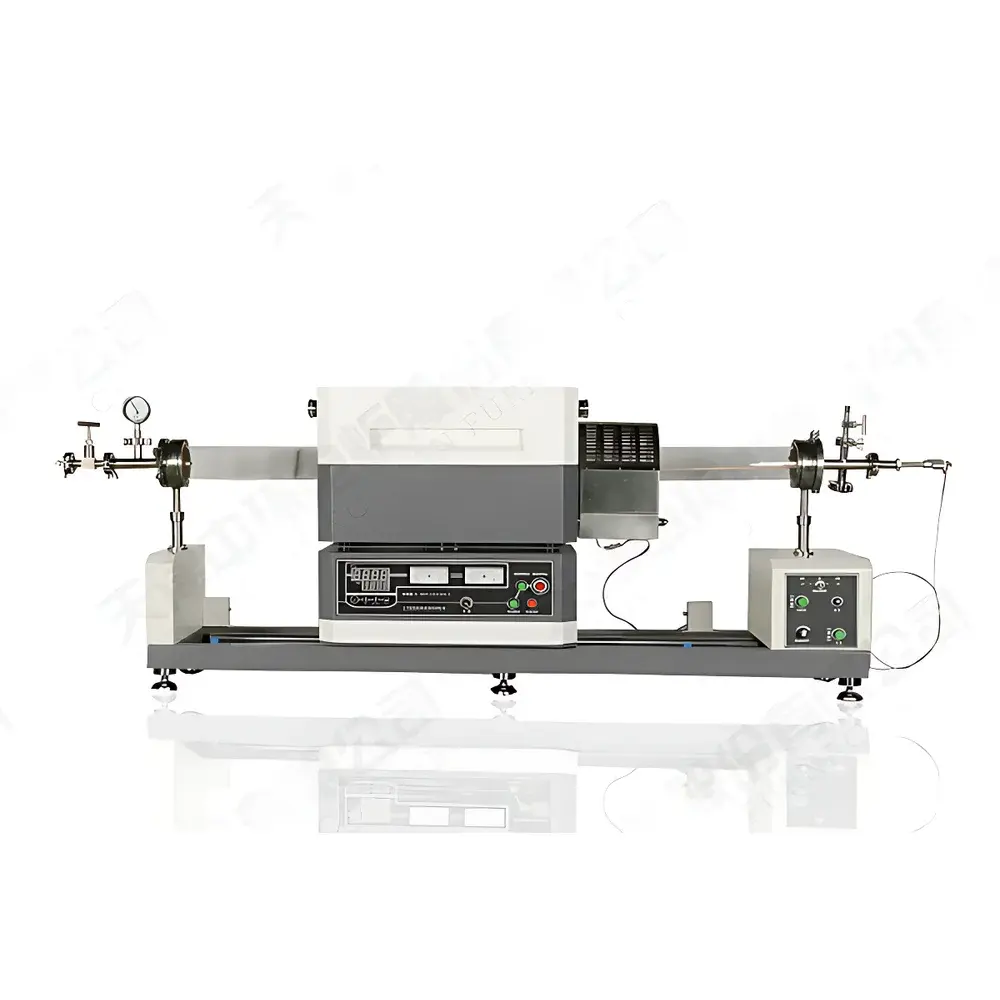
ZHONGHUAN FURNACE 1200℃ Sliding Multi-Zone Tube Furnace
| Brand | ZHONGHUAN FURNACE |
|---|---|
| Origin | Tianjin, China |
| Model | 1200℃ Sliding Multi-Zone Tube Furnace |
| Maximum Temperature | 1200℃ |
| Temperature Control Accuracy | ±1℃ |
| Total Power Rating | 4.8 kW |
| Heating Rate | ≤5℃/min (≤500℃), ≤10℃/min (500–800℃), ≤5℃/min (800–1000℃), ≤2℃/min (1000–1200℃) |
| Heating Element Material | OCr27Al7Mo2 High-Resistance Alloy Wire |
| Internal Chamber Dimensions | 1900 × 360 × 740 mm |
| Heating Zone Configuration | Sliding Dual-Zone with Independent Thermal Control |
| Sealing Technology | Dual-Ring Flange Sealing |
| Cooling System | Auto-Activated Surface-Cooling Fan (Triggered at ≥50℃ surface temperature) |
| Control Interface | RS-485 Port for PC Integration |
| Programmable Controller | 50-Stage Domestic System / 40-Stage Imported System |
| Safety Features | Door-Interlocked Power Cut-off, Over-Temperature Cut-off & Alarm, Earth-Leakage Protection |
Overview
The ZHONGHUAN FURNACE 1200℃ Sliding Multi-Zone Tube Furnace is a high-precision, programmable horizontal tube furnace engineered for controlled-atmosphere thermal processing in research and development laboratories. It operates on resistive heating via OCr27Al7Mo2 alloy wire elements embedded in a vacuum-formed polycrystalline mullite fiber insulation chamber—delivering exceptional thermal uniformity (<±3℃ across the hot zone) and energy efficiency (up to 50% reduction in standby heat loss compared to conventional refractory brick furnaces). Its defining mechanical architecture features a sliding dual-zone configuration: the right-side furnace section pivots rearward up to 110°, enabling unobstructed access to the quartz or ceramic tube without disassembly. This design eliminates torque-induced stress on the tube during loading/unloading and supports rapid experimental iteration under inert, reducing, oxidizing, or vacuum conditions—critical for synthesis of nanomaterials, semiconductor precursors, carbon-based composites, and ceramic matrix materials.
Key Features
- Sliding dual-zone mechanical layout with 110° rearward tilting right furnace section for direct tube access and real-time visual monitoring of sample behavior.
- Dual-ring flange sealing system ensuring leak rates <1×10⁻³ mbar·L/s under vacuum and maintaining stable gas partial pressures during reactive atmosphere processing.
- Intelligent temperature control using PID + fuzzy logic algorithms with auto-tuning capability; supports up to 50 programmable ramp-hold segments (domestic controller) or 40 segments (imported module).
- RS-485 communication interface compliant with Modbus RTU protocol, enabling centralized monitoring and synchronized operation of up to 200 units via industrial SCADA or custom LabVIEW/Python-based platforms.
- Integrated safety architecture: door-actuated contactor cut-off, independent over-temperature limit controller (setpoint adjustable up to 1250℃), and residual-current device (RCD) rated at 30 mA for personnel protection.
- Active surface cooling system triggered automatically when external casing temperature exceeds 50℃, preventing operator contact burns and extending structural integrity of external housing components.
Sample Compatibility & Compliance
This furnace accommodates standard OD 60–120 mm quartz, alumina, or silicon carbide tubes with lengths up to 1800 mm. The internal dimensions (1900 × 360 × 740 mm) support multi-position sample staging and integration with auxiliary modules—including turbomolecular pumping stations (10⁻⁷ mbar base pressure), mass flow controllers (MFCs) for Ar/H₂/N₂/CH₄/O₂ blending, and thermocouple feedthroughs for in-situ temperature profiling. All electrical subsystems comply with IEC 61000-6-3 (EMC emission limits) and IEC 61000-6-2 (immunity requirements). The control firmware supports audit-trail logging per GLP/GMP guidelines when paired with validated data acquisition software, and optional 21 CFR Part 11-compliant electronic signature modules are available upon request.
Software & Data Management
The furnace interfaces natively with ZHONGHUAN’s proprietary FurnaceControl Suite (Windows-based), offering real-time graphing, alarm event logging, and export of CSV-formatted temperature/time/gas-flow datasets. Third-party compatibility includes MATLAB Instrument Control Toolbox, Python’s PySerial + Pandas libraries, and LabVIEW drivers with full VI library documentation. Historical run records—including power consumption profiles, deviation from setpoint, and fault codes—are timestamped, user-tagged, and stored locally with SHA-256 hash verification to ensure data integrity. Remote access is secured via TLS 1.2 encrypted tunneling when deployed behind institutional firewalls.
Applications
- Synthesis and annealing of transition metal oxides (e.g., LiCoO₂, NMC cathodes) under precisely controlled oxygen partial pressure.
- Chemical vapor infiltration (CVI) of carbon fiber preforms using hydrocarbon precursors at 900–1100℃.
- Graphitization of pitch-based fibers and templated mesoporous carbon structures.
- Thermal decomposition studies of MOFs and covalent organic frameworks (COFs) under dynamic gas switching protocols.
- High-temperature sintering of transparent ceramics (e.g., YAG, spinel) with minimized grain boundary segregation.
- Calibration and validation of thermocouples and infrared pyrometers in accredited metrology labs.
FAQ
What tube materials are compatible with this furnace?
Quartz (up to 1100℃), high-purity alumina (up to 1650℃), and silicon carbide (up to 1500℃) tubes are supported; maximum recommended OD is 120 mm.
Can the furnace operate under high vacuum without modification?
Yes—when equipped with a diffusion pump or turbo-molecular pump station and appropriate high-vacuum flanges, it achieves base pressures down to 10⁻⁷ mbar.
Is the temperature controller compliant with FDA 21 CFR Part 11?
The base unit is not Part 11–compliant by default, but an optional validated software package with electronic signatures, audit trails, and role-based access control is available for regulated environments.
How is thermal uniformity verified and documented?
Uniformity mapping is performed per ASTM E220 using nine-point traversing thermocouples; as-built reports include ISO/IEC 17025–traceable calibration certificates for all installed sensors.
Does the sliding mechanism require periodic maintenance?
The pivot hinge assembly uses sealed-for-life stainless steel bearings; no scheduled lubrication is required, and wear inspection is recommended only after 5,000 operational cycles.



