
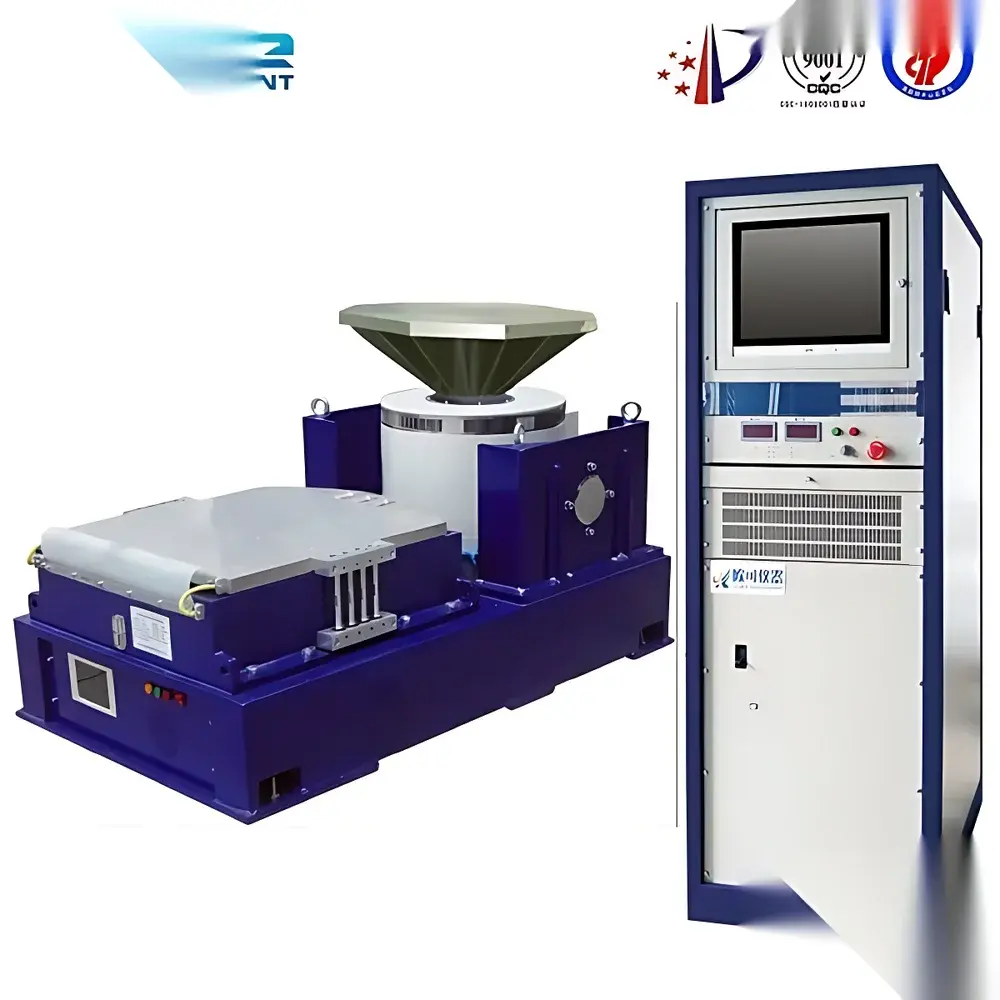
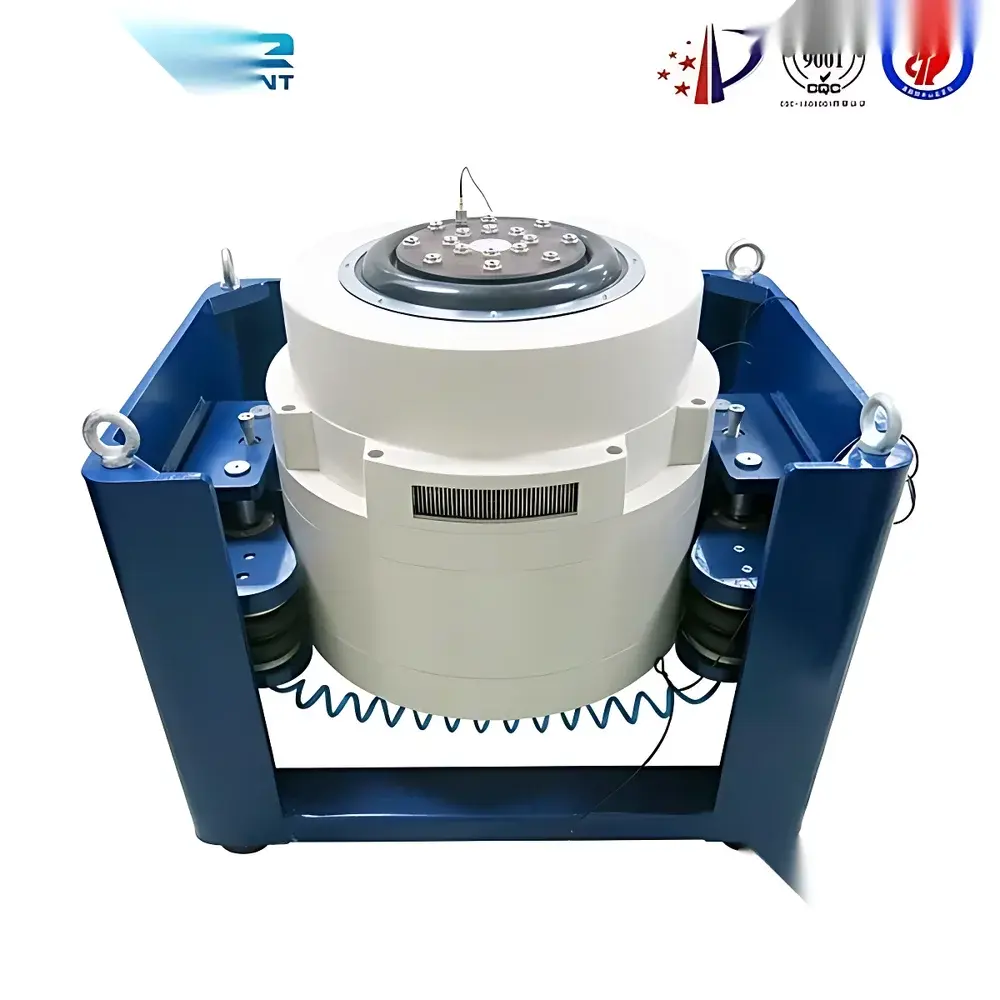
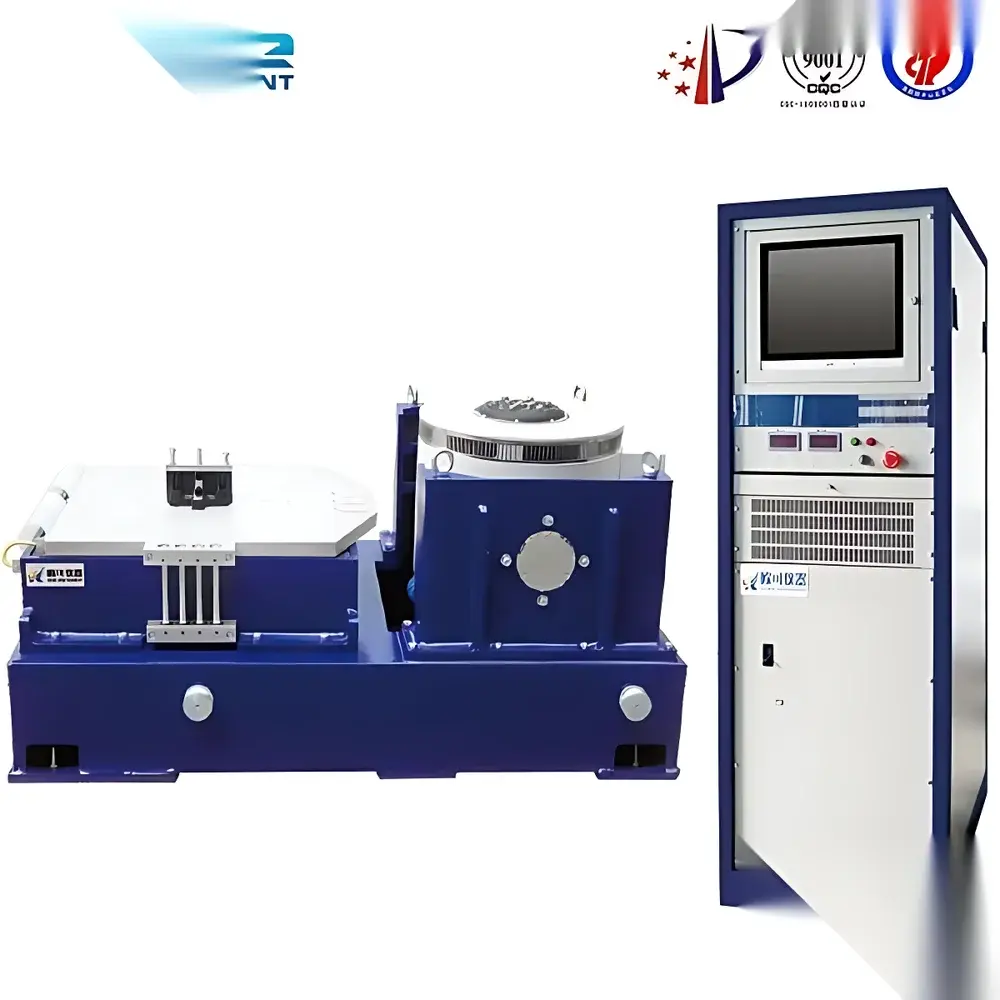
Custom-Built Sweep-Frequency Vibration Shaker System for Structural Dynamics and Reliability Testing
| Brand | OEM / Custom Manufacturer |
|---|---|
| Origin | Imported |
| Supplier Type | Authorized Distributor |
| Price | USD 21,500 (FOB) |
| Frequency Range | 1–5000 Hz |
| Amplitude (p-p) | 0–5 mm adjustable |
| Acceleration Range | 0–20 g (0–196.13 m/s²) |
| Maximum Sinusoidal Force | 2000 kgf (19.6 kN) |
| Frequency Resolution | 0.01 Hz |
| Sweep Mode | Linear & Logarithmic |
| Programmable Test Profiles | Yes |
| Time Setting Range | 1 s to 999 h 59 min 59 s |
| Power Consumption | 3.8 kW |
| Cooling Method | Natural Air Cooling |
| Operating Ambient | −10 °C to +60 °C, 10–95% RH (non-condensing) |
| Sound Pressure Level | ≤60 dB(A) |
Overview
The Sweep-Frequency Vibration Shaker System is an electrodynamic vibration test platform engineered for controlled mechanical excitation across a broad frequency spectrum (1–5000 Hz). It operates on the principle of electromagnetic force generation—where a moving coil within a high-strength magnetic field produces precise, repeatable sinusoidal, swept-sine, or programmable acceleration profiles. Designed for structural dynamics characterization, fatigue life assessment, and early-failure detection, this system supports critical validation protocols in aerospace component qualification, automotive electronic module screening, avionics environmental stress screening (ESS), and telecom hardware robustness verification. Its architecture complies with fundamental mechanical vibration testing standards—including ISO 10816 (vibration severity evaluation), ASTM D999 (shipping container vibration simulation), and MIL-STD-810H Method 514.7 (vibration testing for military equipment)—ensuring data integrity in regulated development environments.
Key Features
- Wide dynamic range: Simultaneous control of acceleration (0–20 g), displacement (0–5 mm p-p), and frequency (1–5000 Hz) with 0.01 Hz resolution for high-fidelity resonance mapping.
- Dual sweep modes: Linear and logarithmic frequency sweeps support both modal analysis and durability testing under realistic operational spectra.
- Programmable test sequencing: Users define multi-step profiles—including dwell, ramp, hold, and random segments—with independent time settings per step (1 second to >999 hours).
- High-force electrodynamic actuator: Rated at 2000 kgf (19.6 kN) peak sinusoidal thrust, enabling full-scale testing of mid-size assemblies such as ECUs, radar housings, and satellite subsystems.
- Thermally stable operation: Natural convection cooling maintains consistent coil temperature during extended duty cycles; validated performance across −10 °C to +60 °C ambient and up to 95% RH (non-condensing).
- Low-noise mechanical design: Acoustic emission limited to ≤60 dB(A) at 1 m distance—suitable for integration into shared laboratory spaces without dedicated acoustic enclosures.
Sample Compatibility & Compliance
The shaker accommodates test specimens up to 100 kg (with appropriate fixture design) and interfaces with standard 19-inch rack-mount or floor-mounted configurations. Fixture mounting follows ISO 5344 mechanical interface guidelines. All vibration profiles are traceable to NIST-calibrated accelerometers and laser Doppler vibrometers. The system supports compliance documentation packages aligned with ISO/IEC 17025 laboratory accreditation requirements and provides audit-ready calibration records per ANSI/NCSL Z540-1. For regulated industries, optional firmware upgrades enable 21 CFR Part 11-compliant user access control, electronic signatures, and immutable test log archiving.
Software & Data Management
Control and analysis are executed via a Windows-based real-time vibration controller software suite supporting IEEE 1451.4 TEDS sensor integration. Capabilities include live FFT spectral monitoring, transmissibility curve generation, resonance search-and-dwell functions, and automated pass/fail reporting against user-defined amplitude or acceleration thresholds. Export formats include CSV, UFF58, and MATLAB .mat for downstream finite element correlation (e.g., modal assurance criterion—MAC—analysis). Raw time-history data is timestamped with microsecond precision and stored in encrypted SQLite databases compliant with GLP/GMP data retention policies.
Applications
- Aerospace: Qualification of flight-critical PCBAs, inertial measurement units (IMUs), and composite panel fastening systems per DO-160 Section 8.
- Automotive: ECU vibration endurance testing per ISO 16750-3 and battery module structural integrity validation under road-spectrum emulation.
- Consumer Electronics: Drop-induced shock response simulation, speaker diaphragm fatigue analysis, and MEMS sensor stability assessment.
- Defense Systems: Environmental stress screening (ESS) of missile guidance electronics and ruggedized communication terminals.
- Research Institutions: Experimental modal analysis (EMA), damping coefficient identification, and nonlinear structural behavior investigation.
FAQ
What standards does this shaker system comply with for certification testing?
It supports test execution per ISO 10816-3, ASTM D999, IEC 60068-2-6, and MIL-STD-810H Method 514.7. Full compliance documentation—including calibration certificates and uncertainty budgets—is provided with each unit.
Can the system perform resonant dwell tests with automatic frequency tracking?
Yes. The controller includes auto-resonance tracking mode that continuously adjusts excitation frequency to maintain peak response during thermal or load-induced drift.
Is third-party calibration and IQ/OQ/PQ validation support available?
Yes. We offer accredited on-site calibration services and GxP-aligned installation qualification (IQ), operational qualification (OQ), and performance qualification (PQ) packages upon request.
What fixture design support is included for custom test articles?
Basic fixture engineering consultation is included. For complex multi-axis or high-transmissibility fixtures, we provide FEA-guided design review and modal testing verification services.
Does the system support remote monitoring and control over Ethernet or USB?
Yes. Real-time control, waveform streaming, and alarm notification are supported via TCP/IP (Ethernet) and USB 2.0 interfaces with API libraries for LabVIEW, Python, and MATLAB integration.
Related Products



