
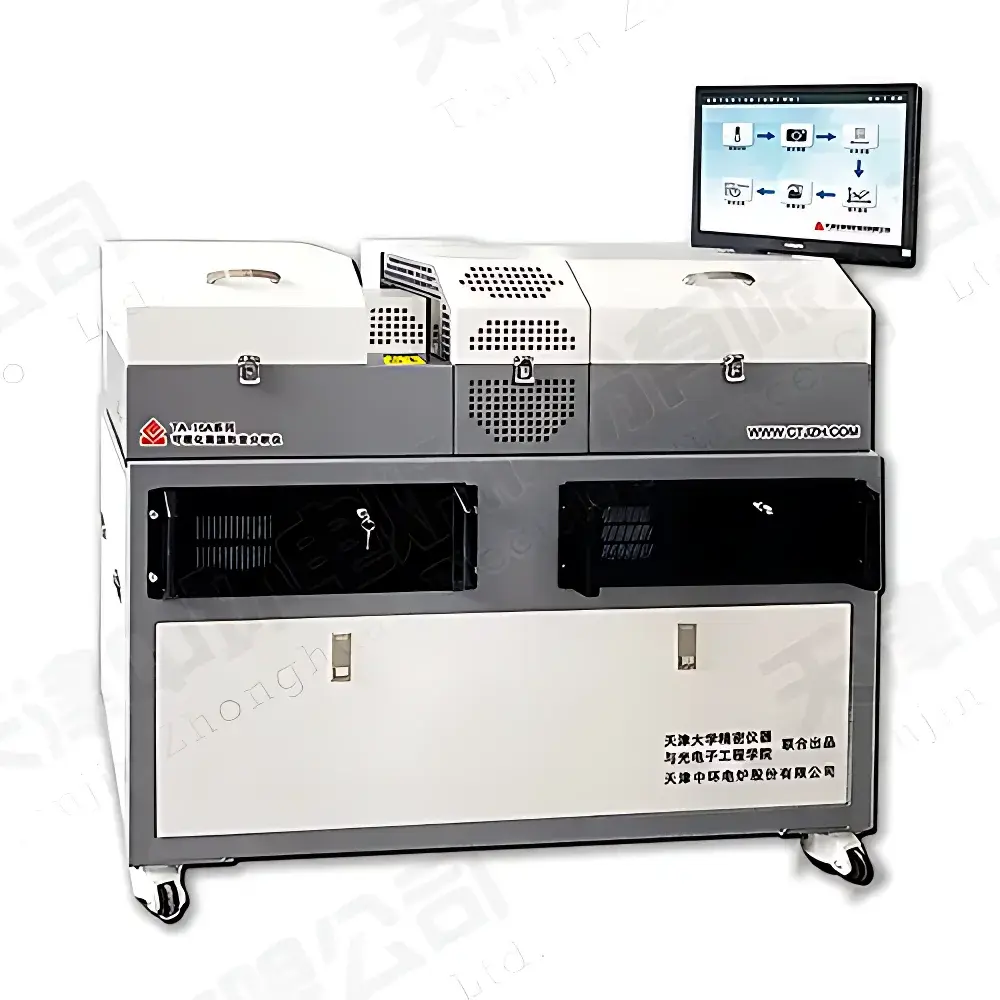
ZHONGHUAN FURNACE TA-16A01 / TA-Z1601 Visual High-Temperature Dilatometer
| Brand | ZHONGHUAN FURNACE |
|---|---|
| Origin | Tianjin, China |
| Model | TA-16A01 / TA-Z1601 |
| Temperature Range | Ambient to 1600 °C |
| Heating Rate | 0–50 °C/min (adjustable) |
| Atmosphere Options | Air, Vacuum, Inert Gas, Oxidizing Atmosphere |
Overview
The ZHONGHUAN FURNACE TA-16A01 / TA-Z1601 Visual High-Temperature Dilatometer is an advanced thermal expansion measurement system engineered for real-time, non-contact dimensional analysis of solid materials during controlled thermal cycling. Unlike conventional push-rod dilatometers—limited to uniaxial linear displacement under mechanical contact—the TA-16A01 employs high-resolution digital imaging coupled with calibrated optical metrology to quantify dynamic changes in height, width, area, and geometric morphology across the full temperature range from ambient to 1600 °C. Its core principle relies on pixel-based image registration and sub-pixel edge detection algorithms applied to time-synchronized thermal video sequences, enabling quantitative strain evaluation without physical probe interaction. This methodology eliminates mechanical loading artifacts, thermal lag errors, and sample constraint effects inherent in contact-based systems, making it particularly suitable for fragile, porous, or low-strength specimens such as ceramic green bodies, metallic foams, glass frits, and sintered compacts. The instrument is designed for rigorous R&D environments where process-relevant thermal behavior—such as densification onset, viscous flow initiation, phase transition-induced shape relaxation, and interfacial wetting dynamics—must be captured with spatial fidelity and temporal resolution.
Key Features
- Optical non-contact measurement: Full-field 2D dimensional tracking (height, width, area) without mechanical load or probe interference
- Extended high-temperature capability: Stable operation up to 1600 °C with programmable 30-segment heating/cooling profiles
- Multi-atmosphere compatibility: Integrated gas inlet/outlet ports support air, N₂, Ar, vacuum (<10⁻² mbar), and controlled oxidizing environments
- Real-time visualization & synchronized data logging: Simultaneous thermal video capture and pixel-to-micron calibrated dimensional output at user-defined frame rates
- Automated feature recognition: Software-assisted identification of critical thermal events—including sintering onset, softening point, hemispherical deformation, sphere formation, and melting threshold
- Robust calibration framework: Built-in reference standard routines for thermal drift compensation and pixel-scale validation using NIST-traceable ceramic or metal references
Sample Compatibility & Compliance
The TA-16A01 accommodates irregularly shaped, low-density, or mechanically delicate samples—including green ceramic compacts, powder metallurgy preforms, aerogels, and thin-film substrates—without requiring machining or mounting fixtures. Sample dimensions are unrestricted within the field of view (typical FOV: 10–40 mm depending on lens configuration), and no contact pressure is applied during measurement. The system complies with foundational metrological practices outlined in ISO 11359-1 (Plastics — Thermomechanical analysis) and ASTM E831 (Standard Test Method for Linear Thermal Expansion of Solid Materials by Thermomechanical Analysis). While not certified for GLP/GMP production environments out-of-the-box, its audit-ready data export structure—including timestamped raw images, metadata logs, and Excel-compatible numerical outputs—supports integration into validated workflows governed by FDA 21 CFR Part 11 when deployed with appropriate IT controls and electronic signature protocols.
Software & Data Management
The proprietary acquisition and analysis suite provides synchronized thermal imaging, real-time contour overlay, and automated dimensional parameter extraction. Each experiment generates a structured project folder containing: (1) time-stamped AVI/MKV video files with embedded temperature metadata; (2) CSV-formatted time-series datasets for height, width, area, aspect ratio, and derived strain metrics; (3) PNG/JPEG snapshots at user-defined thermal milestones; and (4) XML-based experiment configuration files for full procedural reproducibility. Batch processing tools enable comparative analysis across multiple runs—including normalization, derivative curve generation (dL/dT), and statistical aggregation of shrinkage onset temperatures. All exported data retain traceable links to instrument calibration certificates and environmental monitoring logs (e.g., furnace thermocouple readings, atmosphere purity records).
Applications
- Optimization of ceramic sintering cycles by correlating dimensional evolution with thermal profile parameters
- Quantitative assessment of liquid-phase sintering kinetics in metal-ceramic composites and brazing alloys
- In situ characterization of glass transition, devitrification, and viscous flow behavior in oxide and chalcogenide glasses
- Wetting angle estimation and spreading dynamics analysis at solid–liquid interfaces under controlled atmospheres
- Thermal stability evaluation of refractory linings, investment casting shell materials, and nuclear fuel matrix candidates
- Process window definition for additive manufacturing feedstocks subjected to thermal debinding and sintering
FAQ
What sample geometries can be analyzed?
Irregular, asymmetric, porous, or brittle samples—including green tapes, foam monoliths, and irregularly shaped crucibles—are fully supported without modification.
Is vacuum-compatible operation validated to specific pressure levels?
Yes—the chamber is rated for continuous operation down to 1×10⁻² mbar with optional turbomolecular pumping integration.
How is thermal drift compensated during long-duration experiments?
A dual-reference algorithm uses fixed background fiducials and in-situ thermal expansion standards to correct for lens thermal shift and stage expansion artifacts.
Can the system interface with external gas mass flow controllers or vacuum gauges?
Yes—RS-485 and analog 0–10 V I/O ports allow synchronized control and logging of auxiliary process instrumentation.
Are software updates and calibration support provided internationally?
Firmware and application software updates are distributed via secure web portal; remote calibration assistance is available with prior scheduling and local metrology documentation.



