
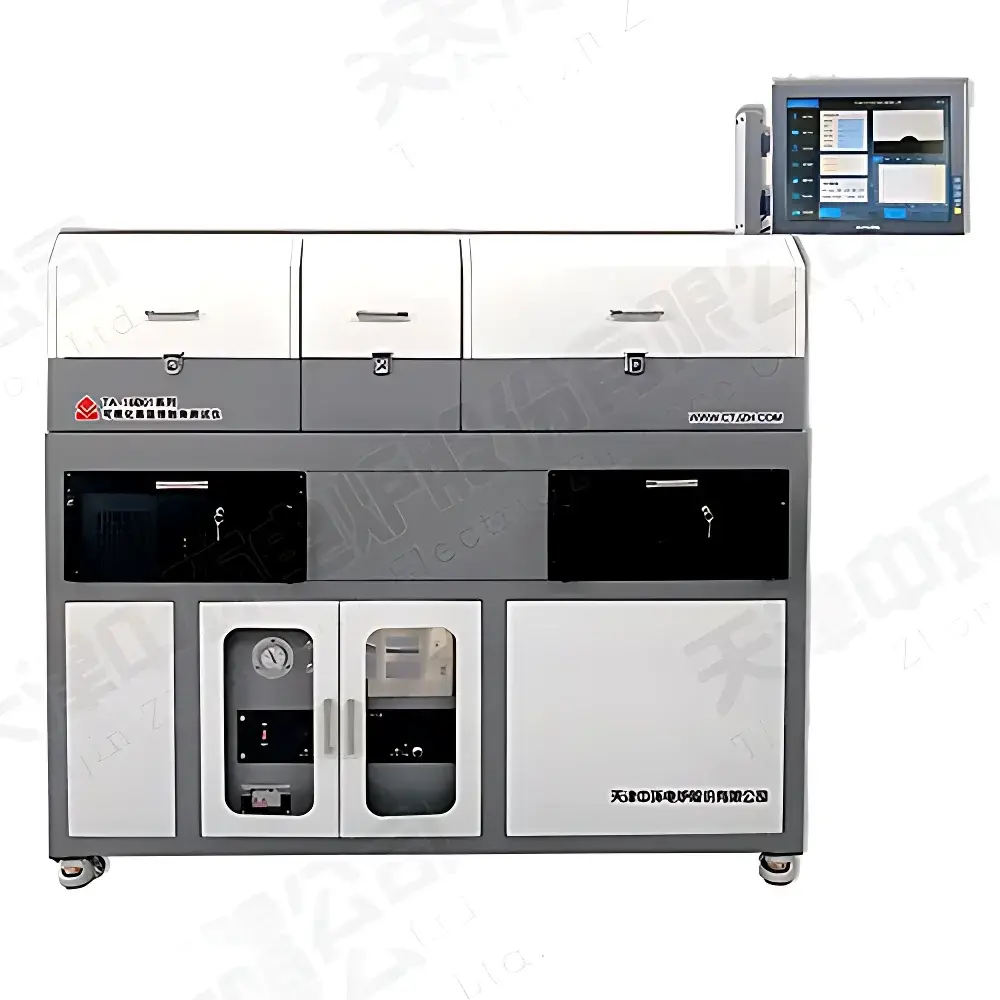
Zhonghuan Furnace TA-Z16B01 High-Temperature Vacuum Contact Angle Analyzer
| Brand | Zhonghuan Furnace |
|---|---|
| Model | TA-Z16B01 |
| Type | Benchtop High-Temperature Vacuum Contact Angle Measurement System |
| Max Operating Temperature | 1600 °C |
| Vacuum Level | ≤1×10⁻³ Pa |
| Atmosphere Control | Oxygen concentration <10⁻² ppm (in controlled inert/vacuum environment) |
| Imaging Speed | ≥30 fps continuous acquisition |
| Contact Angle Measurement Accuracy | ±1° |
| Software | Automated real-time calculation of θ, d, h, v during thermal cycles |
| Compliance | Designed for GLP-compliant lab environments with audit-ready data logging |
Overview
The Zhonghuan Furnace TA-Z16B01 High-Temperature Vacuum Contact Angle Analyzer is an engineered research platform for quantitative interfacial thermodynamics under extreme thermal and environmental conditions. It employs high-resolution side-view optical imaging combined with precision temperature-programmed heating and ultra-high vacuum (UHV) or controlled-atmosphere environments to measure dynamic contact angle evolution between molten phases (e.g., metals, slags, glasses, ceramics) and solid substrates across a continuous temperature range from ambient to 1600 °C. Based on the sessile drop method under non-reactive or oxygen-restricted conditions, the system captures time-resolved morphological changes—including droplet spreading, retraction, deformation, and solidification—enabling rigorous derivation of surface tension, interfacial energy, and wetting kinetics via Young’s equation and its temperature-dependent extensions. Its modular architecture integrates a custom-designed graphite or molybdenum furnace, motorized XYZ sample stage with sub-micron repeatability, telecentric optical path, industrial-grade CCD camera, and synchronized thermal profiling hardware—all calibrated traceably to NIST-traceable reference standards.
Key Features
- Ultra-high-temperature capability: Stable operation up to 1600 °C with programmable 30-segment thermal profiles for complex heat treatments (e.g., ramp-hold-cool sequences)
- High-vacuum and ultra-low-oxygen environment: Base vacuum ≤1×10⁻³ Pa; optional integrated gas purification system maintains O₂ <10⁻² ppm in Ar or He atmospheres
- Real-time optical monitoring: Side-view imaging at ≥30 frames per second with adjustable exposure and gain; supports both static and dynamic contact angle measurement during heating/cooling cycles
- Automated parameter extraction: Software computes contact angle (θ), droplet base diameter (d), height (h), and volume (v) frame-by-frame; outputs time–temperature–θ–γ datasets compatible with thermodynamic modeling
- Modular configuration: Interchangeable furnace liners (graphite, Mo, W), substrate holders (single-crystal wafers, pressed pellets, bulk rods), and optional atmosphere dosing ports for reactive gas studies (e.g., CO/CO₂ mixtures)
- Benchtop footprint with industrial-grade shielding: EMI-suppressed power supply, water-cooled flange interfaces, and ISO Class 5 cleanroom-compatible enclosure options
Sample Compatibility & Compliance
The TA-Z16B01 accommodates diverse solid substrates including sintered ceramic compacts (Al₂O₃, SiC, ZrO₂), metallic foils (Ni, Cu, Ti alloys), single-crystal wafers (sapphire, MgO), and pre-oxidized or coated surfaces. Molten test phases span low-melting eutectics (e.g., Sn–Ag–Cu solder), high-temperature slags (CaO–SiO₂–Al₂O₃ systems), oxide glasses, and refractory metal melts. All measurements adhere to ASTM C1409-22 (Standard Test Method for Contact Angle of Molten Slag on Refractory Surfaces) and align with ISO 2137 (Petroleum products — Determination of penetration of lubricating greases) principles adapted for high-temperature solids. Data integrity meets GLP and GMP requirements: software enforces user authentication, electronic signatures, and 21 CFR Part 11–compliant audit trails for raw image archives, metadata logs, and processed parameter tables.
Software & Data Management
The proprietary analysis suite operates on Windows 10/11 with dual-mode interface: automated batch processing for routine thermal ramps and manual ROI refinement for irregular droplet contours. Image calibration uses pixel-to-micron mapping validated against NIST-traceable stage micrometers. Contact angle algorithms apply ellipse fitting, tangent-based edge detection, and Young–Laplace iterative correction for high-curvature droplets. Export formats include CSV (time-stamped θ/d/h/v), HDF5 (for machine learning preprocessing), and PDF reports embedding annotated video thumbnails. Raw image sequences are stored in lossless TIFF format with embedded EXIF metadata (temperature, vacuum pressure, timestamp, furnace zone setpoints). Optional API integration enables direct linkage to MATLAB, Python (OpenCV/Pandas), or LIMS platforms via RESTful endpoints.
Applications
- Ceramic sintering optimization: Quantifying onset temperatures of densification, grain boundary mobility, and liquid-phase formation via contact angle inflection points
- Electronic packaging R&D: Evaluating solder wettability on metallized AlN or SiC substrates under nitrogen-forming gas, correlating θ(t,T) with intermetallic compound growth kinetics
- CMAS-resistant coating development: Measuring molten silicate slag infiltration angles on thermal barrier coatings (e.g., YSZ, RE₂Zr₂O₇) at 1200–1400 °C
- Metallurgical slag design: Screening flux compositions for steelmaking by tracking CaO–SiO₂–MgO–Al₂O₃ slag wetting behavior on MgO refractories
- Recycled material valorization: Characterizing high-temperature compatibility of coal fly ash–derived glassy phases with alumina crucibles during vitrification
- Fundamental interfacial thermodynamics: Deriving temperature-dependent surface tension (γLV) and solid–liquid interfacial energy (γSL) using Neumann’s triangle method
FAQ
What vacuum level is required to suppress oxide formation during high-temperature contact angle measurement?
For most transition metal and rare-earth oxide systems, ≤1×10⁻³ Pa is sufficient when combined with active oxygen scavenging (<10⁻² ppm O₂); for Ti or Nb-based melts, cryo-pumped UHV (<1×10⁻⁶ Pa) is recommended.
Can the system measure advancing and receding contact angles at elevated temperatures?
Yes—via programmed micro-dosing of melt volume or substrate tilting (with optional motorized goniometer stage), enabling hysteresis quantification up to 1400 °C.
Is calibration traceable to international standards?
All thermal sensors are calibrated per ISO/IEC 17025 by an ILAC-accredited lab; optical calibration uses NIST SRM 2036 stage micrometers.
How is data security handled for regulated industries?
Software implements role-based access control, immutable audit logs, electronic signatures, and encrypted local storage—fully compliant with FDA 21 CFR Part 11 and EU Annex 11 requirements.
What sample geometries are supported beyond flat substrates?
Cylindrical rods (Ø2–8 mm), porous compacts (green or sintered), and fiber arrays can be mounted using custom jigs; edge effects are corrected via 3D contour reconstruction algorithms.



