
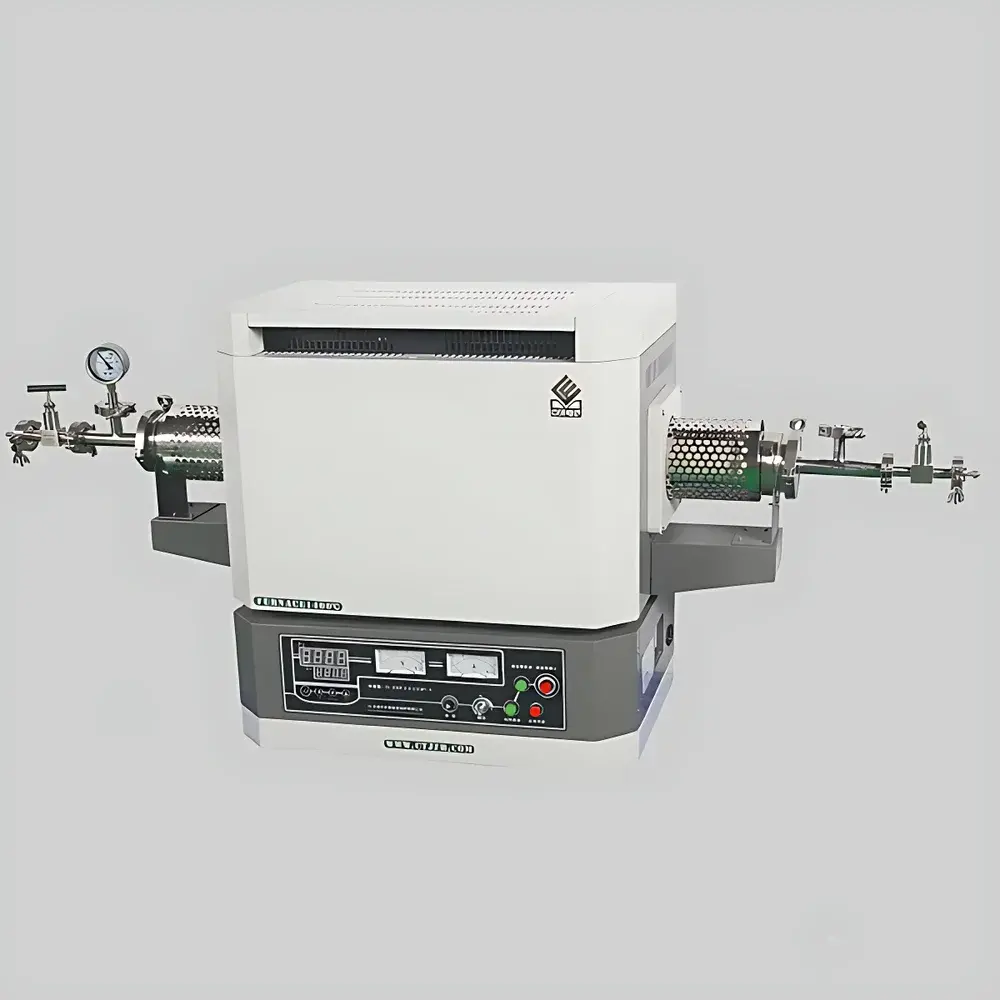
ZHONGHUAN FURNACE 1600°C Dual-Zone Gradient Tube Furnace
| Brand | ZHONGHUAN FURNACE |
|---|---|
| Origin | Tianjin, China |
| Model | 1600°C Dual-Zone Gradient Tube Furnace |
| Maximum Temperature | 1600°C (dual-zone independent control) |
| Temperature Uniformity | ±1°C (within hot zone) |
| Control Accuracy | ±1°C |
| Heating Elements | SiC rods (up to 1500°C) and MoSi₂ rods (up to 1700°C) |
| Power Rating | 7 kW |
| Internal Chamber Dimensions | 796 × 1150 × 650 mm (L × W × H) |
| Heating Rate Profile | ≤5°C/min (≤500°C), ≤10°C/min (500–800°C), ≤5°C/min (800–1000°C), ≤3°C/min (1000–1400°C), ≤2°C/min (1400–1600°C) |
| Sealing Technology | Dual-ring flange sealing system |
| Cooling Safety System | Auto-activated exhaust fan at surface temperature ≥50°C |
| Communication Interface | RS-485 (supports up to 200 units in networked configuration) |
| Compliance | Designed for GLP-compliant lab environments |
Overview
The ZHONGHUAN FURNACE 1600°C Dual-Zone Gradient Tube Furnace is a precision-engineered high-temperature thermal processing system designed for controlled atmosphere and vacuum-based materials synthesis, annealing, sintering, and heat treatment applications. Unlike single-zone tube furnaces, this dual-zone configuration enables independent temperature control across two spatially separated heating zones—allowing users to establish stable axial thermal gradients (e.g., for crystal growth, zone refining, or diffusion studies) or maintain distinct isothermal regions for multi-step thermal protocols. The furnace operates on resistive heating via high-stability silicon carbide (SiC) rods rated to 1500°C and molybdenum disilicide (MoSi₂) elements rated to 1700°C, ensuring robust performance at sustained 1600°C operation. Its vacuum-tight quartz or high-purity alumina tube compatibility supports experiments under inert, reducing, oxidizing, or ultra-low-pressure conditions—critical for semiconductor precursor processing, carbon nanotube synthesis, and advanced ceramic densification.
Key Features
- Dual independent PID-controlled heating zones with real-time temperature monitoring via type S thermocouples, enabling precise gradient formation (0.1–20°C/cm adjustable) or synchronized ramp-soak-hold profiles.
- Optimized thermal architecture featuring vacuum-formed polycrystalline mullite fiber insulation—reducing standby heat loss by >50% versus conventional refractory linings while maintaining radial uniformity within ±1°C over the central 300 mm of the hot zone.
- Quick-connect double-ring flange system with integrated O-ring grooves and torque-limited clamping hardware—eliminating alignment-sensitive bolted assemblies and minimizing mechanical stress on fragile quartz or ceramic tubes during repeated cycling.
- Intelligent surface-cooling protocol: embedded thermal sensors trigger an axial exhaust fan when external casing temperature exceeds 50°C, preventing operator contact hazards and extending cabinet component service life.
- Comprehensive safety interlocks including over-temperature cutoff (hardware-independent relay), ground-fault circuit interruption (GFCI), and door-open power disable—fully compliant with IEC 61000-6-2 EMC immunity and IEC 61010-1 safety standards for laboratory equipment.
Sample Compatibility & Compliance
The furnace accommodates standard OD 60–120 mm cylindrical tubes (quartz, fused silica, or high-purity Al₂O₃), with customizable tube length support up to 1200 mm. Its dual-flange design integrates seamlessly with standard KF-40/KF-50 vacuum fittings and mass flow controllers (MFCs) for gas blending (N₂, Ar, H₂, NH₃, forming gas). Vacuum capability extends to 10⁻³ Pa when paired with optional two-stage rotary vane + turbomolecular pumping systems. All electrical and thermal subsystems meet CE marking requirements; firmware logs—including setpoint history, actual temperature traces, alarm events, and user authentication—are timestamped and exportable in CSV format to satisfy GLP audit trails per ISO/IEC 17025:2017 Clause 7.7 and FDA 21 CFR Part 11 data integrity principles.
Software & Data Management
The embedded RS-485 interface supports Modbus RTU protocol for integration into centralized lab management platforms (e.g., LabArchives, DeltaV, or custom SCADA). Local control is executed via a programmable 50-segment ramp-soak profile engine (with 0.1°C/1s resolution), supporting nested loops, conditional jumps, and dwell-triggered auxiliary outputs (e.g., gas valve actuation upon reaching target T). Optional color TFT touchscreen displays real-time parametric overlays: digital setpoint/actual values, dynamic bar graphs, live trend curves (1–999 min scaling), historical session replay, and configurable alarm dashboards. Data export includes ISO 8601-compliant timestamps, operator ID tagging, and cryptographic hash verification for raw log files—ensuring forensic-grade reproducibility.
Applications
This furnace serves as a core platform for R&D workflows requiring spatially resolved thermal control: directional solidification of perovskite thin films, carbothermal reduction of metal oxides (e.g., SiO₂ → SiC), catalytic cracking studies under graded redox potentials, and post-deposition annealing of CVD-grown graphene on copper foils. It is routinely deployed in university cleanrooms for dopant activation in SiC wafers, national metrology institutes for fixed-point calibration above 1234.93 K (Ag freezing point), and industrial QC labs validating thermal stability of aerospace-grade carbon-carbon composites per ASTM C714 and ISO 21028-2.
FAQ
What tube materials are compatible with the 1600°C operating range?
High-purity fused quartz (up to 1100°C continuous), translucent alumina (Al₂O₃, 99.8%, up to 1600°C), and recrystallized silicon carbide (SiC) tubes are validated for full-range use. Quartz is recommended only for inert or reducing atmospheres below 1200°C.
Can the dual zones operate at different ramp rates simultaneously?
Yes—the controller executes independent heating algorithms per zone, allowing one zone to ramp at 2°C/min while the other holds at 1200°C, enabling complex thermal gradient experiments without external scripting.
Is vacuum bakeout functionality supported out-of-the-box?
The base configuration includes vacuum-rated flanges and pressure-rated seals; integration with a vacuum gauge and pump requires optional accessories (e.g., Pirani + cold cathode gauge kit, oil-free scroll pump).
How is temperature uniformity verified and documented?
Each unit undergoes NIST-traceable mapping using a 5-point axial/radial thermocouple array per IEC 62953; calibration certificates list uniformity deviations at 1000°C, 1300°C, and 1600°C—available upon request.
Does the system support remote validation for regulated environments?
Yes—audit trail export, electronic signature capability (via optional Windows-based client), and configurable password-protected access levels (operator, engineer, administrator) fulfill ALCOA+ data integrity criteria for GMP-regulated labs.



