
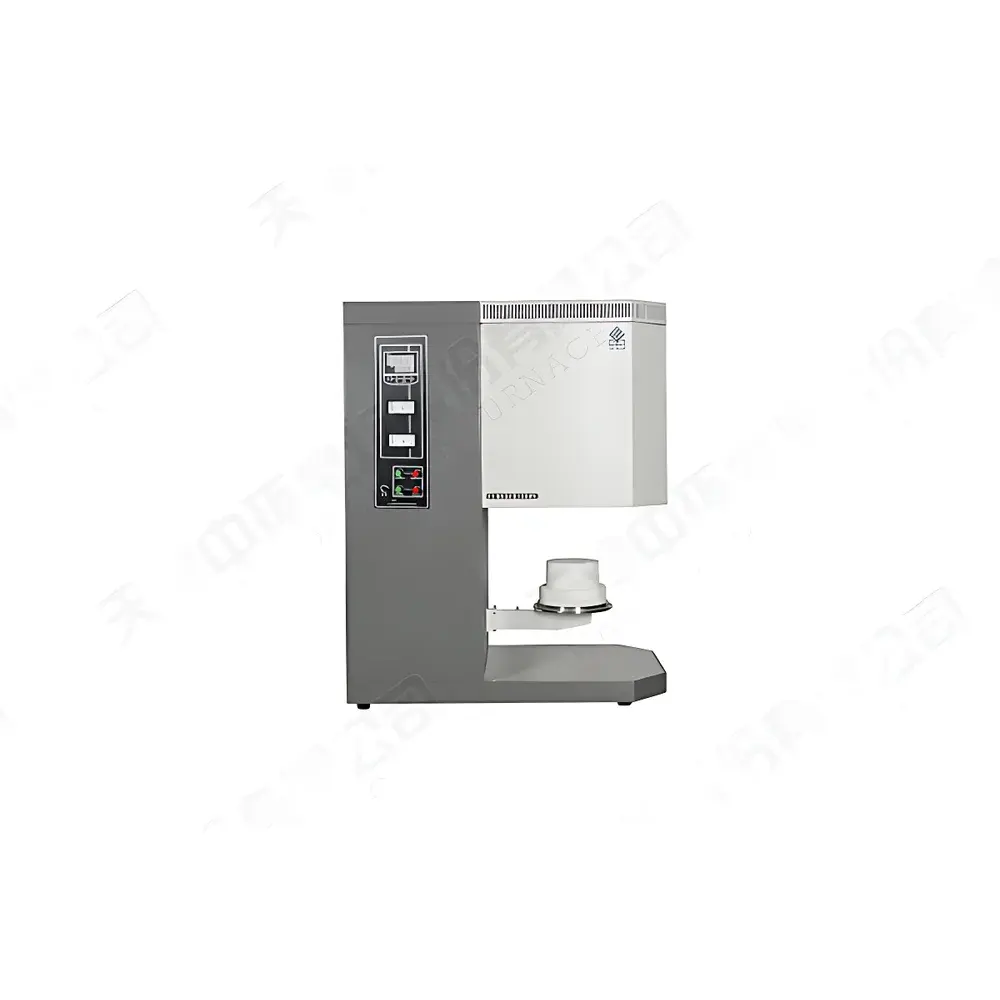
ZHONGHUAN FURNACE SG-G03163 Vertical Lift Crucible Furnace (1600°C)
| Brand | ZHONGHUAN FURNACE |
|---|---|
| Origin | Tianjin, China |
| Model | SG-G03163 |
| Max Temperature | 1600°C |
| Temperature Control Accuracy | ±1°C |
| Rated Power | 6.5 kW |
| Heating Element | Silicon Molybdenum (MoSi₂) Rods |
| Internal Chamber Dimensions | Φ150 × 180 mm |
| Lift Stroke | 320 mm |
| Empty-Chamber Ramp Time to 1600°C | <40 min |
| Chamber Material | Polycrystalline Mullite Fiber (Vacuum-Formed) |
| Cooling System | Auto-Activated Surface-Cooling Fan (Triggered at ≥50°C surface temp) |
| Control System | Domestic 50-Stage Programmable PID Controller (Optional Import 40-Stage) |
| Communication Interface | RS-485 (Modbus RTU compatible) |
| Compliance | Designed for GLP-compliant thermal processing per ISO/IEC 17025 laboratory requirements |
Overview
The ZHONGHUAN FURNACE SG-G03163 is a vertically oriented, lift-type crucible furnace engineered for high-temperature thermal processing in research laboratories, materials synthesis labs, and quality control environments. It operates on the principle of resistive heating via high-purity silicon molybdenum (MoSi₂) rods, capable of sustained operation up to 1600°C in air atmosphere. The furnace employs a vacuum-formed polycrystalline mullite fiber chamber—offering low thermal mass, rapid thermal response, and exceptional temperature uniformity (±3°C across the hot zone at 1600°C). Its vertical lift mechanism enables precise, repeatable access to the crucible without manual handling near high-temperature zones, reducing operator exposure and improving process reproducibility. Designed for integration into controlled thermal workflows, it supports programmable ramp-soak profiles, real-time data logging, and remote supervision—making it suitable for ASTM C1171 (refractory testing), ISO 5659-2 (fire toxicity analysis), and USP heavy metal residue ashing protocols.
Key Features
- Vertical lift door driven by precision mechanical transmission—ensures smooth, vibration-free movement with 320 mm stroke and position repeatability within ±1 mm.
- Energy-efficient chamber construction using polycrystalline mullite fiber insulation—reduces standby heat loss by >50% compared to traditional brick-lined furnaces.
- Intelligent surface-cooling system: integrated thermal sensor triggers axial exhaust fan automatically when external casing temperature reaches or exceeds 50°C—maintaining safe touch-surface conditions during extended operation.
- Dual-stage overtemperature protection: primary hardware cutoff at 1650°C (independent of controller), secondary software-based alarm and shutdown at user-defined setpoint deviation (>±5°C).
- Comprehensive electrical safety architecture including earth-leakage circuit interruption (ELCI) and grounded chassis design compliant with IEC 61000-6-3 EMC standards.
- RS-485 Modbus RTU interface standard-equipped—enables daisy-chain connection to SCADA systems or centralized lab management platforms for multi-furnace orchestration (up to 200 units).
Sample Compatibility & Compliance
The SG-G03163 accommodates cylindrical crucibles up to Φ150 mm × 180 mm height—compatible with alumina (Al₂O₃), silicon carbide (SiC), and graphite crucibles rated for continuous service at 1600°C. Its uniform radial and axial temperature distribution meets ISO 9001 calibration traceability requirements when paired with NIST-traceable thermocouples (Type S or B). The furnace conforms to structural and operational clauses of GB/T 10066.1–2004 (General Safety Requirements for Industrial Resistance Furnaces) and supports audit-ready documentation for GLP and GMP environments—including full-cycle temperature mapping reports, alarm event logs with timestamps, and electronic signature-capable parameter change history.
Software & Data Management
The standard domestic 50-stage programmable controller provides full PID tuning, auto-tuning capability, and non-linear ramp rate definition (e.g., 2°C/min from 1400–1600°C). Optional import-grade controllers offer enhanced noise immunity and tighter loop stability under fluctuating line voltage. All configurations include RS-485 output supporting Modbus RTU protocol for bidirectional communication. Lab-integrated software packages enable real-time temperature curve overlay, comparative profile analysis across batches, CSV-exportable historical records (with millisecond-resolution timestamps), and automated PDF report generation—including pass/fail status against preloaded specification limits. Audit trails comply with FDA 21 CFR Part 11 requirements when deployed with validated user-role authentication and electronic signature modules.
Applications
- High-purity ceramic sintering (e.g., YSZ, AlN, Si₃N₄) requiring strict oxygen partial pressure control during dwell cycles.
- Thermal gravimetric analysis (TGA) sample pre-ashing prior to ICP-MS quantification of trace metals.
- Calibration of high-temperature reference materials (e.g., gold, palladium, and nickel fixed points) per ITS-90 guidelines.
- Heat treatment of refractory metal alloys (Mo, W, Nb) under inert gas purge-compatible configurations (optional quartz tube insert).
- Residue ignition for pharmacopeial assays (USP , EP 2.4.16) where ash content must be determined at precisely controlled 1500–1600°C intervals.
FAQ
What crucible materials are recommended for continuous operation at 1600°C?
Alumina (99.7% purity) and silicon carbide crucibles are validated for uninterrupted use; graphite crucibles require inert gas purging to prevent oxidation.
Is the furnace compatible with nitrogen or argon atmosphere operation?
Yes—optional flanged quartz tube inserts with dual-gas inlet ports support controlled-atmosphere processing up to 1 bar gauge pressure.
How is temperature uniformity verified across the hot zone?
Uniformity is characterized per ASTM E2203 using nine-point thermocouple mapping at 1000°C, 1300°C, and 1600°C; typical deviation is ≤±2.5°C over Φ100 × 100 mm volume.
Can the lift mechanism be interlocked with the temperature controller for safety-critical processes?
Yes—dry-contact outputs are provided for external PLC integration, enabling door-lift inhibition below 100°C or during active ramp phases.
What maintenance intervals are recommended for the MoSi₂ heating elements?
Under normal air-atmosphere cycling (≤5 cycles/day), element replacement is typically required after 1,200–1,500 cumulative hours at ≥1500°C—monitored via resistance drift tracking in the controller log.



