
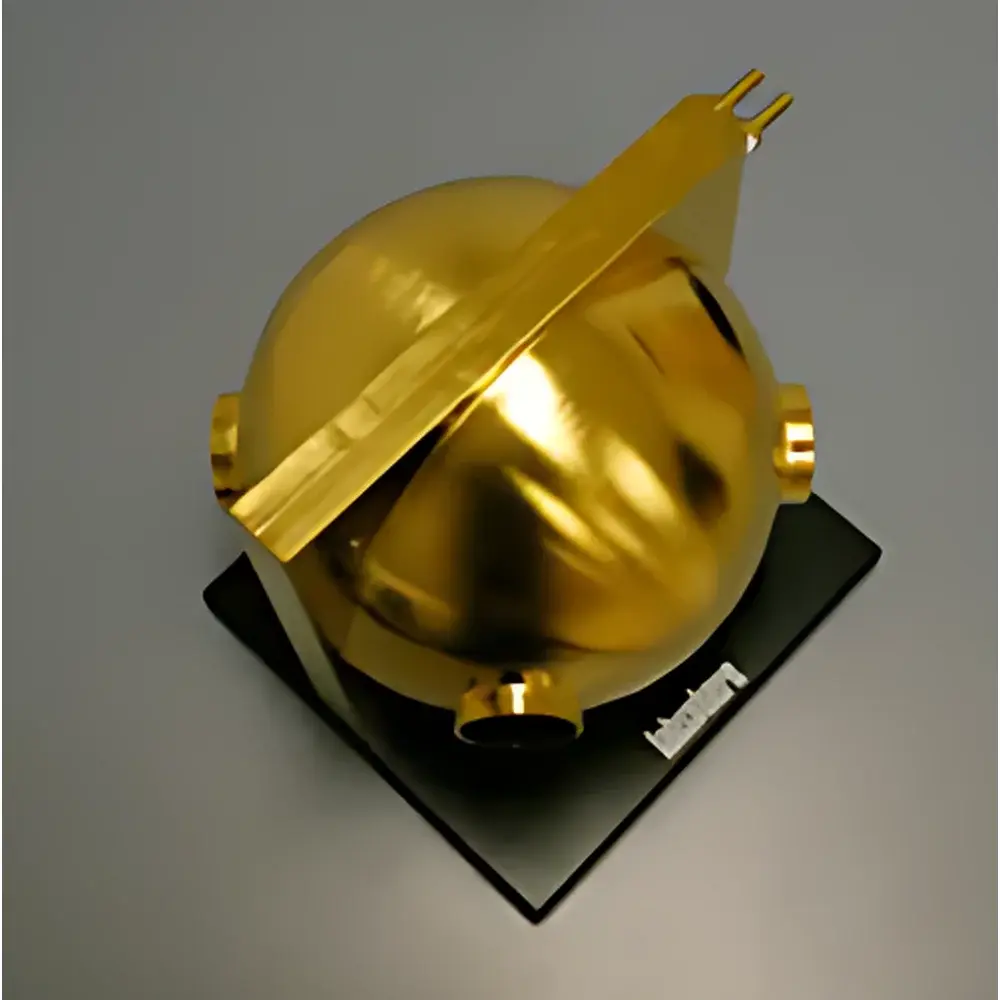
Labsphere GPS High-Power Array Laser Testing System
| Brand | Labsphere |
|---|---|
| Origin | USA |
| Manufacturer Type | Authorized Distributor |
| Origin Category | Imported |
| Model | GPS |
| Configuration | Solid-State Laser Sources & Integrated Measurement Subsystem |
| Optical Coating Options | Spectraflect®, Infragold®, or Spectralon® |
| Wavelength Range | 200–5000 nm (UV-Vis-NIR-MIR) |
| Beam Acceptance Angle | Up to ±40° half-angle |
| Cooling | Optional water-cooling module with user-selectable chiller integration |
| Detector Compatibility | Dual-detector or dual-spectrometer mounting interface |
| Attenuation | Polarization-insensitive neutral-density filtering |
| Target Plate | Integrated laser diffuser plate for beam energy dispersion |
| Thermal Management | Active heat dissipation architecture for sustained high-power operation |
| Compliance | Designed to support ISO/IEC 17025-compliant calibration workflows and GLP/GMP traceability requirements |
Overview
The Labsphere GPS High-Power Array Laser Testing System is a purpose-engineered optical measurement platform designed for the accurate, repeatable, and geometry-independent quantification of total radiant power from high-intensity solid-state laser sources—including diode lasers, CO2 lasers, Nd:YAG systems, and fiber-coupled laser arrays. At its core lies a precision-engineered integrating sphere that operates on the principle of multiple diffuse reflections to homogenize incident radiant flux, enabling spatially invariant power measurement regardless of beam divergence, pointing stability, or polarization state. Unlike collimated power meters or thermal sensors requiring precise alignment, the GPS system eliminates sensitivity to beam positioning errors by accepting incident radiation over a full ±40° half-angle cone—making it especially suitable for characterizing highly divergent or spatially unstable laser outputs common in industrial and R&D environments.
Key Features
- Geometry-Independent Power Measurement: Achieves measurement repeatability <±0.5% (k=2) across beam angles up to ±40° half-angle without repositioning or realignment.
- Polarization-Insensitive Attenuation: Integrated neutral-density filter sets suppress signal saturation while preserving spectral fidelity and eliminating polarization bias—critical for accurate characterization of linearly polarized laser sources.
- Multi-Detector Flexibility: Dual-port configuration supports simultaneous installation of a calibrated photodiode and spectrometer, enabling concurrent broadband power and spectral distribution analysis.
- High-Thermal-Load Architecture: Water-cooled sphere variants incorporate thermally optimized aluminum housing, integrated coolant channels, and a removable laser target plate engineered to distribute localized irradiance and mitigate thermal lensing or coating degradation.
- Modular Coating Selection: Available with three industry-standard diffuse reflectance coatings: Spectraflect® (200–2500 nm), Infragold® (700–20,000 nm), or Spectralon® (250–2500 nm), each certified per NIST-traceable reflectance protocols.
- Traceable Calibration Infrastructure: Factory-calibrated against NIST-traceable standards; supports optional ISO/IEC 17025-accredited calibration certificates with uncertainty budgets per ANSI/NCSL Z540-1.
Sample Compatibility & Compliance
The GPS system accommodates a broad range of solid-state laser configurations—from single-emitter diodes to multi-kilowatt laser arrays—without modification. Its large-diameter sphere variants (up to 300 mm internal diameter) maintain uniform response across UV (200 nm), visible (400–700 nm), NIR (700–2500 nm), and MIR (up to 5000 nm) spectral bands. The system complies with relevant portions of IEC 60825-1 (laser safety), ISO 11554 (laser beam parameter measurements), and ASTM E275 (spectrophotometer terminology). When operated within validated SOPs, it meets data integrity requirements for GLP and GMP environments, including audit-trail-capable software logging aligned with FDA 21 CFR Part 11 principles.
Software & Data Management
Labsphere’s proprietary Ophir StarLab™ and SpectraSuite™ software suites provide native driver integration for GPS-compatible detectors and spectrometers. Real-time power trending, spectral irradiance normalization, and batch-mode calibration file management are supported. All measurement metadata—including timestamp, detector ID, coating type, attenuation factor, and ambient temperature—is embedded in exported .csv and .xml files. For regulated laboratories, optional validation packages include IQ/OQ documentation, electronic signature workflows, and configurable user access levels consistent with ALCOA+ data governance frameworks.
Applications
- Characterization of high-power laser diode bars and stacks used in materials processing and pumping applications
- Output power verification and lifetime testing of industrial CO2 and Nd:YAG lasers under continuous-wave and pulsed operation
- Thermal load profiling during qualification of fiber-coupled laser modules for medical device manufacturing
- Spectral power distribution analysis of tunable and supercontinuum sources in metrology labs
- Calibration transfer between primary radiometric standards and field-deployable laser power sensors
- Development and validation of laser safety interlock systems requiring traceable radiant exposure thresholds
FAQ
What wavelength ranges does the GPS system support?
The system covers 200–5000 nm depending on selected coating and detector combination—Spectraflect® for UV-Vis-NIR, Infragold® for extended IR, and Spectralon® for high-diffuse-reflectance visible/NIR applications.
Can the GPS measure pulsed lasers?
Yes—when paired with fast-response photodiodes or pyroelectric sensors, the system supports pulse energy and average power measurement for pulses as short as 10 ns, provided duty cycle and repetition rate remain within detector specifications.
Is water cooling mandatory for high-power operation?
Water cooling is recommended for continuous operation above 50 W and required for sustained loads exceeding 100 W; air-cooled variants are available for lower-power R&D use cases.
How is calibration traceability maintained?
Each unit ships with a NIST-traceable calibration certificate; annual recalibration services include spectral responsivity mapping and geometric correction factor validation per ISO 12232 Annex D.
Can I integrate third-party spectrometers?
Yes—the dual-port mechanical interface conforms to standard SMA905 and FC/PC fiber coupling geometries, and software APIs support vendor-neutral spectral acquisition via USB or Ethernet.




