
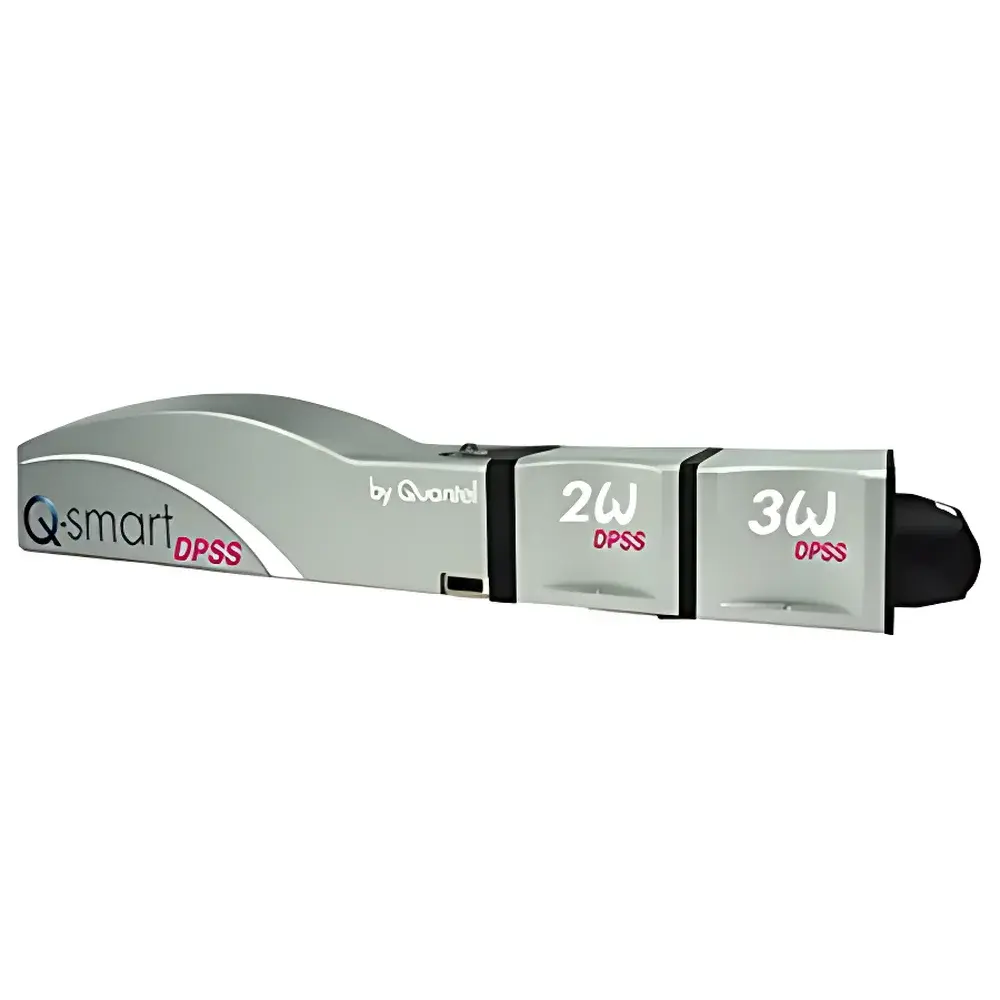
Quantel Q-Smart Series DPSS Laser Systems
| Brand | Quantel |
|---|---|
| Origin | France |
| Product Type | Diode-Pumped Solid-State (DPSS) Laser System |
| Model Series | Q-Smart |
| Wavelength Options | 1064 nm, 532 nm, 355 nm, 266 nm, 213 nm |
| Pulse Energy (1064 nm) | 300 mJ / 200 mJ / 650 mJ |
| Pulse Energy (532 nm) | 160 mJ / 95 mJ / 360 mJ |
| Pulse Energy (355 nm) | 90 mJ / 60 mJ / 200 mJ |
| Pulse Width (1064 nm) | 5–9 ns |
| Pump Source Warranty | 2 years or 2 billion shots |
| Cavity Options | Gaussian or Stable Resonator |
| Cooling | Water-cooled |
| Modularity | Fully modular laser head and power supply architecture |
| Beam Orientation Flexibility | Omnidirectional mounting (including suspended configuration) |
| Control Interface | Remote touchscreen handle with plug-and-play connectivity |
| Phase Matching | Automatic, alignment-free harmonic generation |
Overview
The Quantel Q-Smart Series DPSS Laser Systems represent a high-reliability, industrial-grade family of diode-pumped solid-state lasers engineered for demanding scientific and applied photonics applications. Built upon the robust mechanical and thermal architecture of Quantel’s legacy lamp-pumped Q-Smart platform, this series replaces flashlamp excitation with high-efficiency, long-lifetime laser diode pumping—delivering superior pulse-to-pulse stability, reduced thermal lensing, and extended operational lifetime. The core laser medium is a Nd:YAG crystal, with harmonic generation achieved via nonlinear optical crystals (e.g., KTP, LBO, BBO) to produce fundamental (1064 nm) and harmonically converted outputs (532 nm, 355 nm, 266 nm, and 213 nm). Each system operates in Q-switched mode with pulse widths tightly controlled between 5 and 9 nanoseconds at 1064 nm, enabling precise energy deposition and high peak power delivery essential for time-resolved spectroscopy, ablation, and nonlinear frequency conversion.
Key Features
- Modular Architecture: Fully decoupled laser head, power supply, and cooling unit allow rapid reconfiguration for wavelength switching, cavity replacement, or maintenance without system recalibration.
- Automatic Phase Matching: Integrated motorized crystal positioning and real-time temperature stabilization eliminate manual alignment for harmonic generation—ensuring consistent conversion efficiency across environmental fluctuations.
- Omnidirectional Mounting: Rigid, thermally symmetric laser head design supports installation in any orientation—including inverted or suspended configurations—without performance degradation or beam pointing drift.
- Plug-and-Play Connectivity: Quick-disconnect interfaces for water lines and high-voltage cables enable tool-free separation of laser head and electronics, reducing downtime during service or relocation.
- Flexible Cavity Options: Selectable resonator configurations—including Gaussian (TEM00) and stable multi-mode—optimized for applications requiring diffraction-limited focusability or higher average power handling.
- Diode Pump Reliability: Laser diode arrays rated for ≥2 billion shots or 2 years of continuous operation under specified thermal and drive conditions, backed by Quantel’s industrial warranty framework.
Sample Compatibility & Compliance
The Q-Smart DPSS series is designed for integration into regulated and research-grade environments. Its mechanical stability, pulse repeatability (<±1.5% RMS energy stability over 8 hours), and low timing jitter (<±0.5 ns) support compliance with ISO 17025 calibration requirements for laser-based analytical instrumentation. While not intrinsically certified for medical or aerospace use, the platform meets CE marking directives (2014/35/EU Low Voltage Directive and 2014/30/EU EMC Directive) and conforms to IEC 60825-1:2014 safety standards for Class 4 laser products. Harmonic output wavelengths align with common spectral windows used in LIBS (213 nm, 266 nm), LIDAR (355 nm, 532 nm), and ultrafast OPO pumping (355 nm, 532 nm), facilitating traceable method development per ASTM E2721 (LIBS), ISO 19377 (LIDAR calibration), and USP (laser-based material interaction protocols).
Software & Data Management
Control is managed via Quantel’s Q-Lab™ embedded firmware, accessible through a dedicated touchscreen remote handle or optional Ethernet interface (TCP/IP, Modbus TCP). Real-time monitoring includes pulse energy (via internal photodiode calibration), repetition rate, diode current/voltage, coolant temperature, and cavity alignment status. All operational parameters are logged with timestamped metadata and support export in CSV or HDF5 format for traceability. Audit trail functionality complies with GLP/GMP principles—enabling user access control, session logging, and immutable parameter history. Integration with third-party DAQ systems (e.g., National Instruments PXI, MATLAB Data Acquisition Toolbox) is supported via standard SCPI commands and LabVIEW drivers.
Applications
- Laser-Induced Breakdown Spectroscopy (LIBS): High-energy UV pulses (213 nm, 266 nm) enable efficient ablation of conductive and non-conductive solids with minimal thermal diffusion—ideal for elemental mapping in metallurgy, geology, and nuclear forensics.
- Light Detection and Ranging (LIDAR): Eye-safe 355 nm and high-atmospheric-transmission 532 nm outputs provide optimal signal-to-noise ratio for atmospheric aerosol profiling, wind sensing, and differential absorption LIDAR (DIAL).
- Pulsed Laser Deposition (PLD): Nanosecond UV pulses generate stoichiometric plumes from complex oxide targets (e.g., YBCO, PZT), supporting thin-film growth with atomic-layer control in UHV chambers.
- Laser Shock Peening (LSP): High-peak-power 1064 nm pulses induce compressive residual stresses in turbine blades and biomedical implants—improving fatigue life and corrosion resistance.
- Ti:Sapphire Pumping: Frequency-doubled (532 nm) and tripled (355 nm) outputs serve as reliable pump sources for ultrafast oscillator-amplifier systems operating in the 700–1000 nm range.
- OPO Pumping: Stable 355 nm and 532 nm beams drive nanosecond OPOs for tunable mid-IR generation (3–12 µm), applicable in gas sensing and molecular fingerprinting.
FAQ
What cooling method is required for continuous operation?
Water cooling is mandatory; systems require deionized water at 18–25 °C with flow rate ≥4 L/min and pressure drop <1.5 bar.
Can the laser be operated in single-shot mode with external TTL triggering?
Yes—full synchronization is supported via negative TTL input (≤5 V, 50 Ω impedance) with jitter <0.5 ns and delay resolution of 10 ns.
Is remote software control available over Ethernet?
Yes—Q-Lab™ supports Ethernet-based SCPI command sets, Python API wrappers, and integration with LabVIEW, MATLAB, and EPICS control frameworks.
Are calibration certificates provided for pulse energy measurement?
Each unit ships with NIST-traceable calibration data for fundamental and harmonic outputs, valid for 12 months from date of shipment.
What is the maximum repetition rate for QS DPSS-9-100 at 355 nm?
The QS DPSS-9-100 operates up to 10 Hz at full 200 mJ 355 nm output; derating applies above 5 Hz to maintain thermal stability and pulse fidelity.





