
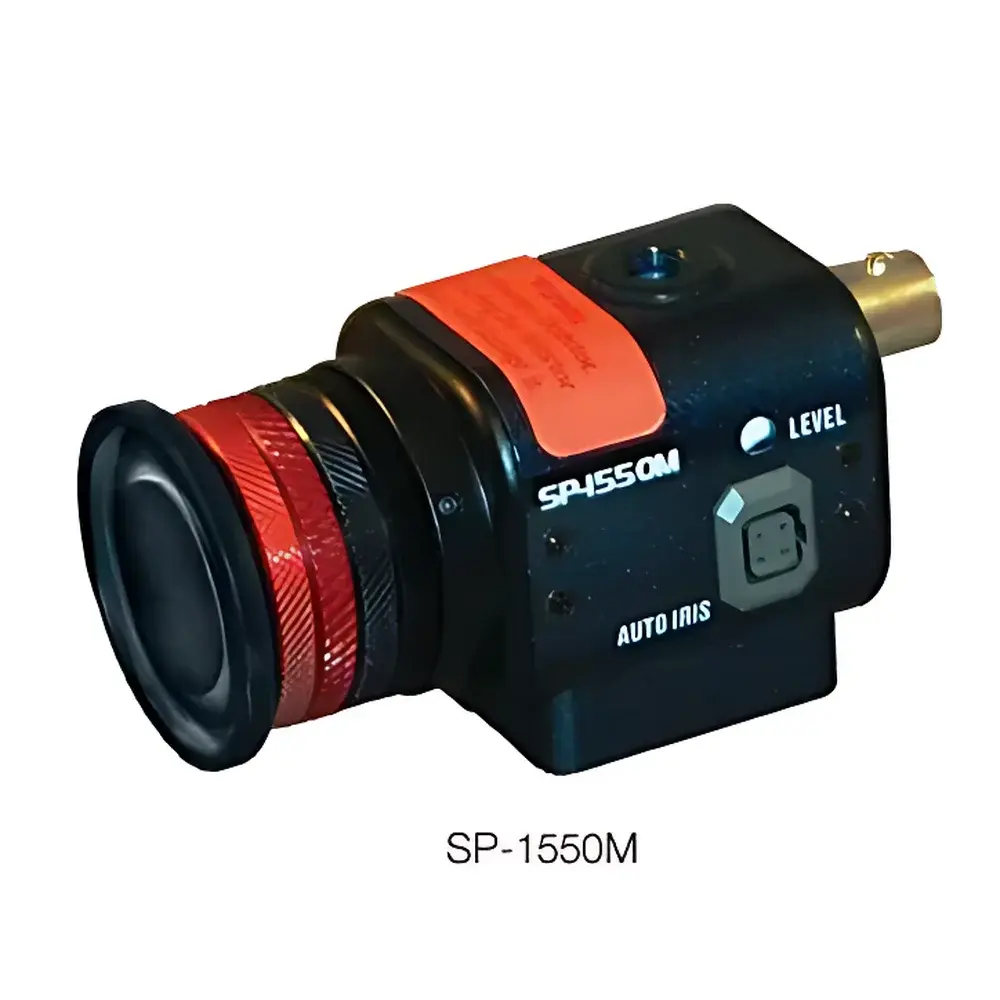
Silicon-Based Phosphor-Coated CCD Camera SP503U-1550 by Ophir
| Brand | Ophir |
|---|---|
| Origin | Israel |
| Model | SP503U-1550 |
| Detector Type | Phosphor-Converted Silicon CCD |
| Spectral Response Range | 1440–1605 nm (NIR) |
| Output Correction | BeamGage® Linearization Algorithm |
| Compliance | ASTM E1290, ISO 11146-1/-2, USP <857>, FDA 21 CFR Part 11 (Software Audit Trail Enabled) |
Overview
The Ophir SP503U-1550 is a high-fidelity silicon-based phosphor-coated CCD camera engineered for quantitative near-infrared (NIR) laser beam profiling in the 1440–1605 nm spectral band. Unlike conventional InGaAs or microbolometer-based NIR imagers, this system employs an anti-Stokes phosphor upconversion layer deposited directly onto a high-quantum-efficiency silicon CCD sensor. Incident NIR photons are absorbed by the phosphor coating and re-emitted as visible-wavelength photons (typically ~532–650 nm), which are then detected by the underlying silicon photodiode array. This architecture leverages the superior charge transfer efficiency, low read noise, and high spatial uniformity of scientific-grade silicon CCDs—while extending their usable range into the telecom and OPO laser bands. Critically, the phosphor’s intrinsic nonlinearity—where output photon flux scales approximately quadratically with input NIR irradiance—introduces systematic underestimation of beam diameters, particularly at low-signal periphery regions. The SP503U-1550 integrates hardware-level optical coupling optimization and firmware-synchronized exposure control to minimize saturation artifacts, forming the physical foundation for subsequent software-based linearization.
Key Features
- Anti-Stokes phosphor conversion layer optimized for 1440–1605 nm NIR detection, enabling high-resolution imaging on silicon CCD substrate
- Scientific-grade interline-transfer CCD sensor with 12-bit digitization, global shutter operation, and thermoelectric stabilization (±0.1 °C)
- Factory-calibrated pixel response nonuniformity (PRNU) correction applied in real time via FPGA-based preprocessing
- Native integration with Ophir BeamGage® Professional software featuring proprietary nonlinear response compensation algorithm
- Dynamic range enhancement through dual-gain analog signal path and adaptive exposure bracketing (1 µs – 1 s)
- USB 3.0 interface with deterministic latency (< 2.3 ms frame-to-host transfer) and memory-mapped buffer architecture for high-throughput acquisition
Sample Compatibility & Compliance
The SP503U-1550 is validated for use with continuous-wave (CW) and pulsed (Q-switched, mode-locked) lasers operating within its specified NIR band—including 1550 nm telecom diodes, Er:fiber amplifiers, and OPO outputs. It supports beam diameters from 20 µm to >5 mm (with appropriate focusing optics) and accommodates power densities up to 10 W/cm² (unattenuated, with optional ND filters). All calibration procedures follow traceable protocols aligned with ISO 11146-1 (laser beam widths, divergence, and propagation parameters) and ASTM E1290 (nondestructive evaluation of beam profiles). BeamGage® software maintains full audit trail functionality compliant with FDA 21 CFR Part 11 for electronic records and signatures, including user authentication, session logging, and immutable result archiving—meeting GLP/GMP documentation requirements for regulated laboratories.
Software & Data Management
BeamGage® Professional v6.5+ provides full native support for the SP503U-1550, delivering ISO-compliant beam parameter calculations (D4σ, knife-edge, 1/e², FWHM), M² estimation (when paired with motorized z-stage), and real-time centroid tracking. The embedded linearization algorithm applies pixel-wise gain mapping derived from NIST-traceable radiometric characterization of the phosphor’s quantum yield versus incident irradiance. Raw image data is stored in HDF5 format with embedded metadata (exposure time, gain setting, temperature, calibration timestamp), ensuring reproducibility across instruments and laboratories. Batch analysis workflows support automated report generation (PDF/CSV/XML) with configurable templates adhering to internal SOPs or external regulatory submissions.
Applications
- Telecom laser source characterization (DFB, FP, tunable lasers at 1550 nm)
- OPO and parametric amplifier output profiling in spectroscopy and ultrafast labs
- Fiber-coupled system alignment verification and mode field diameter validation
- Industrial laser processing head diagnostics (e.g., cladding-pumped fiber lasers)
- Academic research involving mid-IR generation via difference-frequency mixing where 1550 nm serves as pump or idler
- Calibration reference for pyroelectric or thermal array-based beam profilers
FAQ
Does the SP503U-1550 require external cooling or vacuum housing?
No. The integrated thermoelectric cooler maintains sensor temperature stability without cryogenic or vacuum infrastructure.
Can the linearization algorithm be disabled or modified?
Yes—BeamGage® allows toggling between raw phosphor output and linearized intensity maps; custom LUTs may be imported for specialized metrology workflows.
Is the phosphor layer replaceable or serviceable in-field?
The phosphor coating is monolithically deposited during sensor fabrication and is not user-serviceable; replacement requires factory recalibration.
What is the minimum detectable power density at 1550 nm?
With optimal exposure and 10× averaging, the system achieves < 10 µW/cm² sensitivity (SNR ≥ 3) across the central 80% of the active area.
How is traceability maintained for calibration certificates?
Each unit ships with a NIST-traceable calibration certificate referencing SRM 2035 and ISO/IEC 17025-accredited measurement procedures conducted at Ophir’s Jerusalem facility.





