
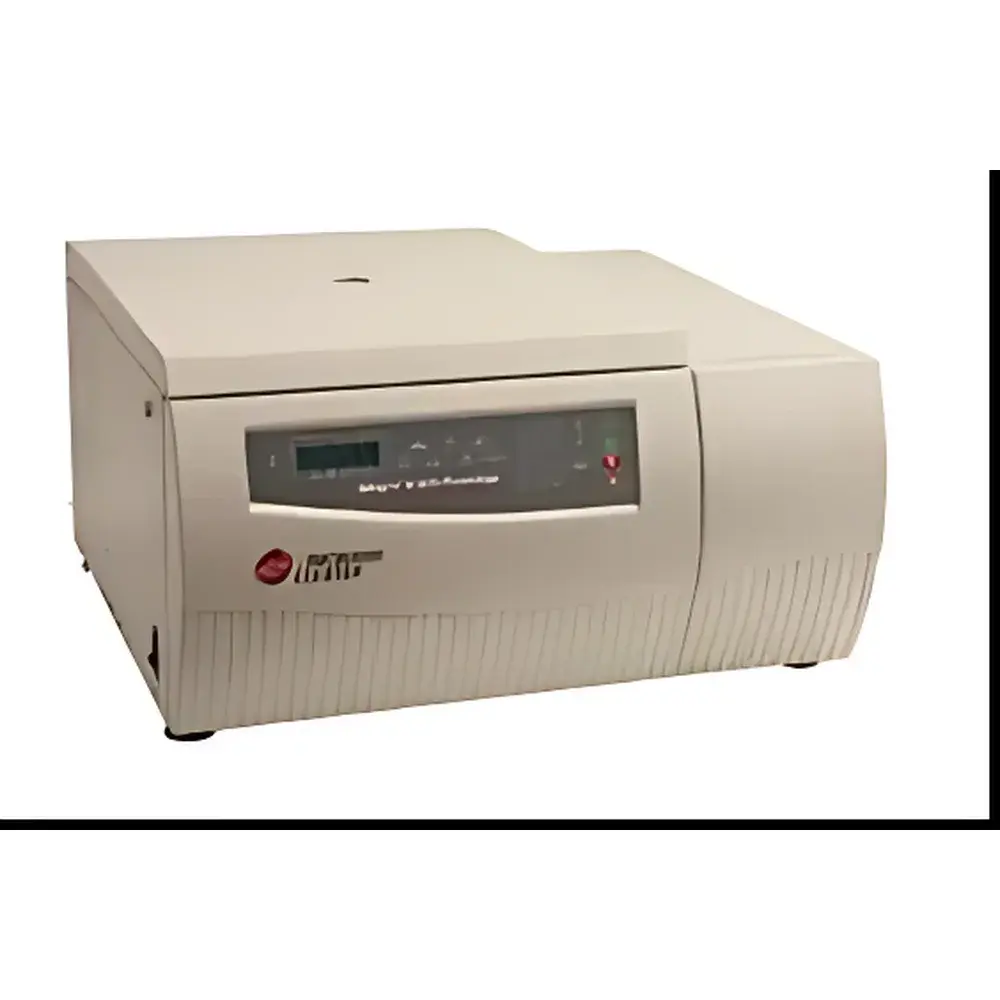
Beckman Coulter Allegra X-15R Benchtop Refrigerated Centrifuge
| Brand | Beckman Coulter |
|---|---|
| Origin | USA |
| Equipment Type | Benchtop Refrigerated Centrifuge |
| Model | Allegra X-15R |
| Centrifugation Category | Low-Speed Centrifuge (up to 10,200 rpm) |
| Rotor Configuration | Horizontal (Swinging-Bucket) |
| Maximum Capacity | 6 × 100 mL or 4 × 750 mL |
| Max Speed | 10,200 rpm (for microtubes) / 4,750 rpm (for 750 mL bottles) |
| Max RCF | 11,400 × g / 5,250 × g |
| Temperature Range | –10 °C to +40 °C |
| Cooling Time | ≤4 min (from ambient to +4 °C) |
| Dimensions (W × H × D) | 34.3 × 76.2 × 62.2 cm |
| ARIES™ Auto-Balancing Rotor Capability | ±50 g imbalance tolerance |
| Compliance | Designed for GLP/GMP environments |
Overview
The Beckman Coulter Allegra X-15R is a high-capacity benchtop refrigerated centrifuge engineered for reproducible, low-speed separation of biological suspensions under precise thermal control. Utilizing horizontal (swinging-bucket) rotor architecture and optimized airflow dynamics, it delivers consistent sedimentation performance across large-volume samples—up to 3 L per run—without compromising temperature stability or mechanical integrity. Its refrigeration system achieves rapid cooling (≤4 minutes from ambient to +4 °C), minimizing sample degradation during pre-run equilibration. The instrument operates on the fundamental principle of sedimentation velocity centrifugation, where differential particle migration under controlled gravitational force enables separation of cells, organelles, and macromolecular complexes based on size, density, and shape. Designed for routine laboratory workflows in cell culture, microbiology, blood banking, and bioprocessing, the Allegra X-15R bridges the gap between benchtop convenience and preparative-scale throughput.
Key Features
- High-capacity horizontal rotor configuration supporting up to 4 × 750 mL bottles or 6 × 100 mL tubes per run—enabling true 3-liter batch processing in a single spin cycle.
- ARIES™ (Automatic Rotor Imbalance Error Sensing) technology allows safe operation with up to ±50 g mass imbalance across buckets—eliminating the need for manual balancing scales and reducing setup time by >70%.
- Intuitive direct-input interface: users enter speed (rpm), time (min/sec), and temperature (°C) without navigating nested menus—critical for high-throughput labs requiring rapid protocol execution.
- Advanced refrigeration system maintains setpoint accuracy within ±1 °C across full operational range (–10 °C to +40 °C), with active rotor cavity cooling even at low speeds to prevent heat accumulation during extended runs.
- Robust mechanical architecture includes brushless drive motor, reinforced stainless-steel chamber, and vibration-dampening suspension—ensuring long-term reliability under daily use conditions.
Sample Compatibility & Compliance
The Allegra X-15R accommodates standard polycarbonate and polypropylene centrifuge bottles (e.g., Corning® 750 mL, Nalgene® 100 mL), as well as conical tubes, cell culture flasks (T-175, T-225), and custom vessels compatible with its horizontal rotor geometry. It meets ISO 13485 design requirements for medical device manufacturing environments and supports compliance with Good Laboratory Practice (GLP) and Good Manufacturing Practice (GMP) frameworks. When paired with Beckman Coulter’s CentriLog™ software (optional), the system provides electronic audit trails, user access controls, and data export logs aligned with FDA 21 CFR Part 11 requirements for regulated laboratories.
Software & Data Management
While the Allegra X-15R operates autonomously via its front-panel interface, optional integration with CentriLog™ software enables centralized protocol management, remote monitoring, and secure data archiving. CentriLog™ records run parameters—including actual vs. setpoint temperature, rotor ID, elapsed time, and real-time RCF—into timestamped, tamper-evident files. Export formats include CSV and PDF for integration into LIMS or ELN systems. All stored data retains full traceability to operator ID, instrument serial number, and calibration history—supporting internal audits and regulatory inspections.
Applications
- Cell harvesting: Direct centrifugation of adherent or suspension cultures in T-flasks or roller bottles—reducing transfer steps, minimizing contamination risk, and preserving viability.
- Blood component separation: Efficient isolation of platelets, leukocytes, or plasma from whole blood using standardized protocols (ASTM F2212, CLSI H20-A3).
- Microbial pelleting: Recovery of bacterial, yeast, or fungal biomass from fermentation broths at scalable volumes without ultracentrifugation.
- Virus and exosome pre-concentration: Initial clarification and pellet enrichment prior to ultracentrifugal purification or filtration-based downstream processing.
- Tissue homogenate clarification: Removal of cellular debris and nuclei from lysates prior to subcellular fractionation or protein extraction.
FAQ
What is the maximum volume capacity per run?
The Allegra X-15R supports up to 3 liters total volume—configured as 4 × 750 mL bottles or 6 × 100 mL tubes—depending on selected rotor.
Does the instrument support continuous temperature monitoring during runs?
Yes—the built-in thermistor continuously measures chamber temperature and adjusts compressor output in real time to maintain setpoint within ±1 °C.
Can I use non-Beckman rotors with this centrifuge?
No. Only Beckman Coulter-certified horizontal rotors (e.g., GH-3.8, JS-5.3) are validated for safety, performance, and regulatory compliance with the Allegra X-15R platform.
Is ARIES™ balancing available for all rotor types?
ARIES™ functionality is exclusive to designated swinging-bucket rotors equipped with dynamic counterbalance mechanisms—specifically the GH-3.8 and JS-5.3 models.
How does the Allegra X-15R meet regulatory documentation requirements?
With CentriLog™ software enabled, the system generates compliant audit trails, electronic signatures, and immutable run records—fully traceable to user, date/time, and instrument configuration per 21 CFR Part 11 Annex 11 guidelines.



