
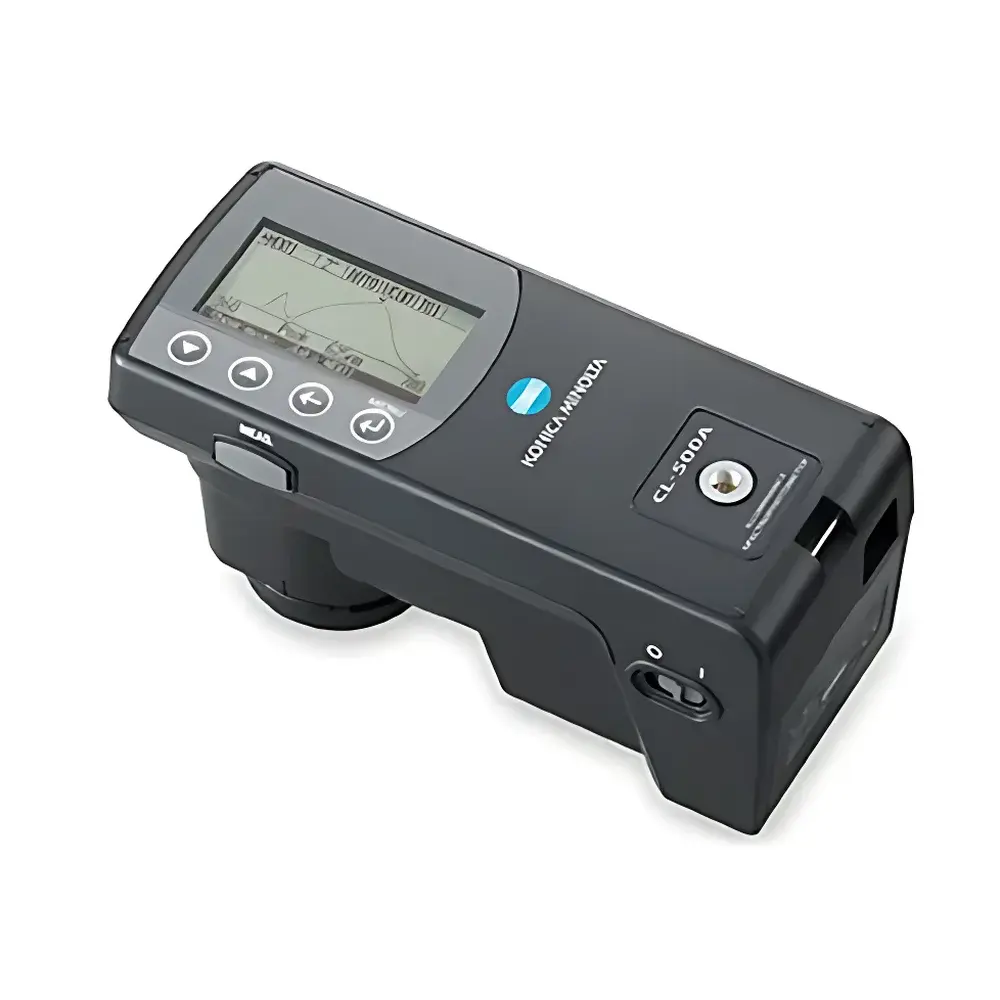
Konica Minolta CL-500A Spectroradiometric Illuminance Meter
| Brand | Konica Minolta |
|---|---|
| Origin | Japan |
| Model | CL-500A |
| Spectral Range | 360–780 nm |
| Wavelength Interval | 1 nm |
| Spectral Bandwidth (FWHM) | ~10 nm |
| Wavelength Accuracy | ±0.3 nm (at 435.8, 546.1, 585.3 nm per JIS Z8724) |
| Illuminance Range | 0.1–100,000 lx |
| Illuminance Accuracy | ±2% ±1 digit (Std A source) |
| Chromaticity Accuracy (xy) | ±0.0015 (10–100,000 lx), ±0.002 (5–10 lx) |
| Repeatability (2σ, Std A) | Ev: 0.5% + 1 digit |
| xy | 0.0005 (500–100,000 lx) to 0.004 (5–30 lx) |
| f₁′ (Relative Spectral Responsivity) | ≤1.5% |
| f₂ (Cosine Correction Error) | ≤3% |
| fₜ / fₕ (Temp./Humidity Drift) | Ev: ±3% |
| xy | ±0.003 |
| Measurement Time | 0.2 s (Ultra-fast, PC-connected), 0.5–27 s (Auto-exposure) |
| Dimensions | 70 × 165 × 83 mm |
| Weight | 350 g |
| Battery Life | 6 h (fully charged) |
| Compliance | JIS C 1609-1:2006 Class AA, DIN 5032-7 Class B |
Overview
The Konica Minolta CL-500A Spectroradiometric Illuminance Meter is a handheld, high-fidelity optical measurement instrument engineered for precision spectral characterization of modern light sources. Unlike conventional photometric lux meters, the CL-500A employs a grating-based spectroradiometric architecture with a linear CCD sensor array—enabling direct acquisition of full spectral power distribution (SPD) across 360–780 nm at 1 nm resolution. This spectral foundation supports traceable calculation of photometric, colorimetric, and radiometric quantities in accordance with CIE, ISO, and JIS standards. Its design targets rigorous evaluation of solid-state lighting—including LEDs, OLEDs, and organic EL devices—where narrowband emission peaks, spectral discontinuities, and metamerism demand high-resolution SPD analysis rather than filtered photodiode approximations. The instrument satisfies JIS C 1609-1:2006 Class AA and DIN 5032-7 Class B requirements for illuminance meters, ensuring metrological validity in both R&D laboratories and field deployment.
Key Features
- Full-spectrum acquisition (360–780 nm, 1 nm data interval) via integrated diffraction grating and CCD array
- Simultaneous computation of CIE 1931 xy and 1976 u’v’ chromaticity coordinates, correlated color temperature (CCT), Duv, dominant wavelength (λd), purity (Pe), and CIE general (Ra) and special (R1–R15) color rendering indices
- High angular response fidelity: cosine correction error (f2) ≤ 3% per JIS C 1609-1
- Low spectral mismatch: relative spectral responsivity deviation (f1′) ≤ 1.5%, critical for accurate LED and narrowband source assessment
- Multi-mode exposure control: ultra-fast (0.2 s, PC-linked), fast (0.5 s), slow (2.5 s), and adaptive auto-exposure (0.5–27 s)
- Onboard storage for 100 measurement records; USB 2.0 interface for real-time data streaming and firmware updates
- Integrated rechargeable Li-ion battery supporting up to 6 hours of continuous operation
Sample Compatibility & Compliance
The CL-500A is validated for quantitative optical assessment of diverse light-emitting technologies—including phosphor-converted white LEDs, monochromatic LEDs, OLED panels, fluorescent lamps, HID sources, and ambient daylight. Its spectral bandwidth (~10 nm FWHM) and wavelength accuracy (±0.3 nm at NIST-traceable calibration lines) ensure reliable SPD reconstruction even for sources with steep spectral edges or multi-peak emission profiles. The instrument conforms to JIS C 1609-1:2006 Class AA (equivalent to IEC 60825-1 Annex D for illuminance meter classification) and DIN 5032-7 Class B, establishing its suitability for quality assurance in lighting manufacturing, architectural lighting design verification, display backlight validation, and photobiological safety pre-screening. Environmental operating limits (−10 to +40 °C, RH ≤85% non-condensing) support robust use in production floors, outdoor site surveys, and climate-controlled labs.
Software & Data Management
The bundled CL-S10w software provides comprehensive post-acquisition analysis and workflow automation. It enables real-time visualization of SPD curves, chromaticity diagrams (CIE 1931 and 1976), CCT vs. Duv plots, and CRI bar charts. For LED binning applications, CL-S10w implements configurable color tolerance zones (e.g., MacAdam ellipses, ANSI C78.377 quadrangles) to automatically classify measured samples into user-defined chromaticity bins—a critical capability for production line sorting and batch consistency auditing. The software supports synchronized multi-instrument operation: up to ten CL-500A units can be connected simultaneously via USB hub for spatial illuminance uniformity mapping or temporal stability monitoring across large-area light fields. Audit trails, timestamped metadata export (CSV, XML), and user-defined report templates comply with GLP-aligned documentation practices. Optional CL-SDK permits integration into custom QA/QC platforms and automated test sequences under ISO/IEC 17025 or FDA 21 CFR Part 11 environments.
Applications
- LED product development: SPD validation, CRI optimization, binning consistency verification
- Lighting system commissioning: illuminance uniformity mapping, CCT homogeneity analysis across luminaires
- Display and signage QA: backlight spectral fidelity, white point stability under dimming
- Architectural daylighting studies: spectral composition of natural/artificial hybrid illumination
- Photobiological safety screening: preliminary assessment of blue-light hazard (S009/E:2022) weighted irradiance
- Educational and metrology labs: hands-on training in spectroradiometry, CIE colorimetry fundamentals
FAQ
What spectral standard does the CL-500A use for CRI calculation?
It applies CIE 15:2018 and JIS Z 8726-1:2019 methodologies, computing Ra and R1–R15 using the CIE 1964 10° standard observer and CIE illuminant D65 as the reference.
Can the CL-500A measure pulsed or modulated light sources?
Yes—its shortest integration time (0.2 s in ultra-fast mode) supports stable measurement of low-frequency PWM-driven LEDs; for high-frequency modulation (>200 Hz), external triggering synchronization is recommended.
Is user calibration supported, and what traceability does it maintain?
Field recalibration is possible via CL-S10w using NIST-traceable reference lamps (e.g., tungsten halogen standard lamps); calibration coefficients are stored in non-volatile memory with full audit logging.
How does the instrument handle high-dynamic-range scenes (e.g., >100,000 lx)?
It uses automatic exposure control with neutral density compensation logic—no external filters required—and maintains linearity across its full 0.1–100,000 lx range per JIS C 1609-1.
Does the CL-500A meet requirements for ISO/IEC 17025 accredited testing?
When operated with documented calibration certificates (traceable to NMI-Japan or NIST), maintained environmental logs, and CL-S10w audit-trail exports, it fulfills technical requirements for inclusion in accredited scope—subject to laboratory-specific uncertainty budgeting and procedural validation.





