
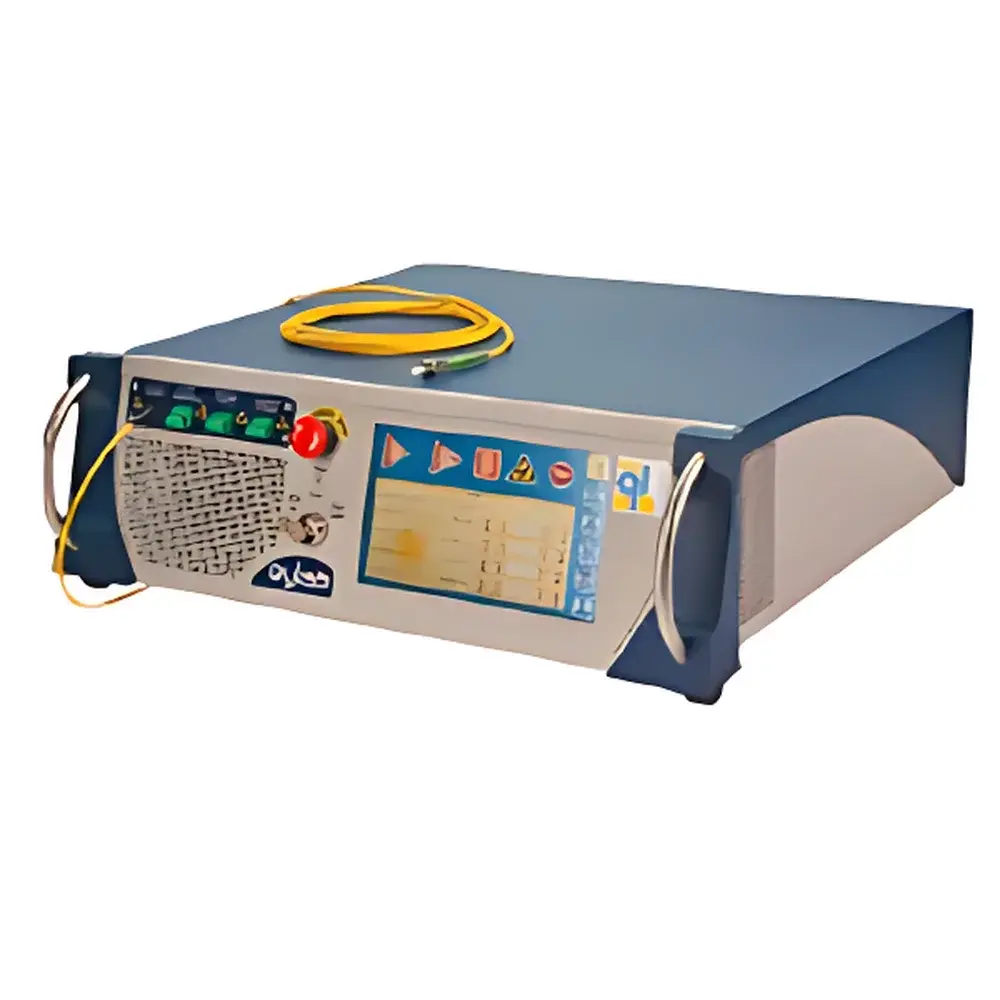
Quantel EYLSA Series Single-Frequency Fiber Laser System
| Brand | Quantel |
|---|---|
| Origin | France |
| Model | EYLSA |
| Wavelength Options | 532 nm, 556 nm, 767 nm, 780 nm, 1064 nm, 1550 nm |
| Output | Single-mode polarization-maintaining fiber (PM) or free-space collimated beam |
| Linewidth | < 2 MHz (down to 50 kHz) |
| Output Power | 1–30 W (model-dependent) |
| Tuning Range | Up to 300 GHz (temperature-tuned) |
| Power Stability | < ±1% (typ.) |
| Intensity Noise | < 0.1% RMS (DC–1 MHz) |
| Beam Quality | TEM₀₀, M² < 1.3 |
| Polarization Extinction Ratio | ≥17 dB |
| Control Interface | Integrated touchscreen, key-switch activation |
Overview
The Quantel EYLSA Series is a family of single-frequency, continuous-wave (CW) fiber lasers engineered for ultra-stable operation in demanding quantum optics laboratories. Based on monolithic waveguide or microcavity seed architectures and integrated fiber amplification, the EYLSA platform delivers narrow-linewidth emission with exceptional frequency and amplitude stability—without requiring external seed sources, amplifier stages, or active vibration isolation platforms. Its core design principle leverages robust all-fiber or hybrid free-space/fiber architectures to ensure long-term reliability under variable environmental conditions. Each variant operates at wavelengths critical for laser cooling and trapping of alkali atoms (e.g., 780 nm for Rb, 767 nm for K, 532 nm for Sr⁺), optical lattice clocks (556 nm, 767 nm), and Bose-Einstein condensate (BEC) formation. The system’s fundamental architecture complies with the metrological requirements of primary quantum experiments: low phase noise, high side-mode suppression ratio (>50 dB), and deterministic thermal tuning behavior traceable to calibrated temperature setpoints.
Key Features
- Single-frequency CW output with intrinsic linewidths as narrow as 50 kHz (model-dependent), achieved via stabilized waveguide or microcavity seed elements and low-noise fiber amplification
- Direct polarization-maintaining (PM) single-mode fiber output (e.g., PM780) or collimated free-space beam (M² < 1.3), enabling seamless integration into vacuum-compatible optical setups
- Integrated touchscreen HMI with key-switch power activation—no manual alignment, no warm-up drift compensation required for routine operation
- Combined current and temperature tuning: fine current tuning (up to 8 GHz) + coarse thermal tuning (up to 300 GHz), enabling precise absolute frequency referencing against atomic transitions
- Optional electro-optic modulation (EOM) module for simultaneous generation of cooling and repumping beams from one fiber output, with independently adjustable power ratio up to 1 W total
- Self-contained architecture: laser head, driver electronics, thermal management, and control unit housed in a single chassis; no external water cooling or rack-mounted PSUs required
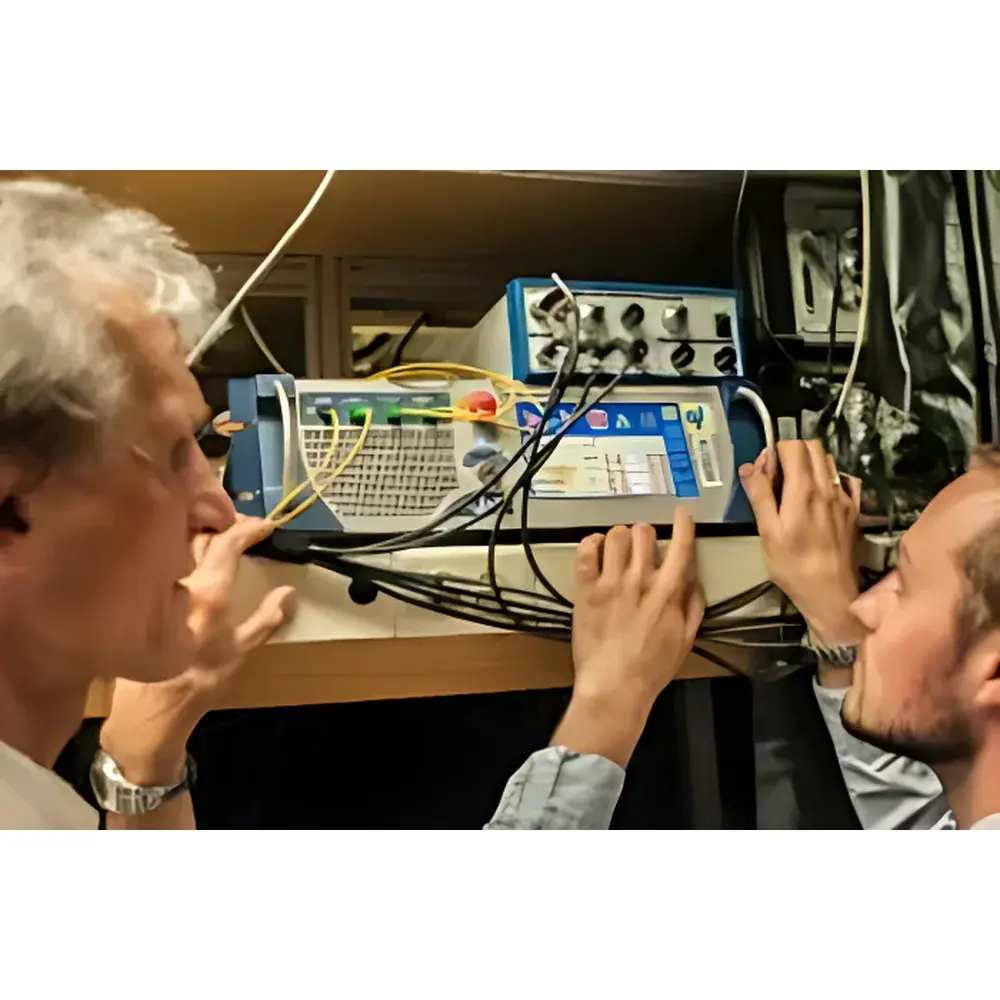
- Thermal and mechanical robustness: designed for operation on standard optical tables without active stabilization—validated for use in mobile cold-atom labs and university teaching environments
Sample Compatibility & Compliance
The EYLSA Series supports experimental configurations involving neutral atom traps (magneto-optical traps, dipole traps), ion traps, optical lattice clocks, and cavity quantum electrodynamics (cQED) systems. Its wavelength options align with established atomic transitions: 780 nm (⁸⁷Rb D₂ line), 767 nm (³⁹K D₁), 532 nm (⁸⁸Sr⁺ S₁/₂ ↔ P₁/₂), and 1064 nm (high-power dipole trapping). All models meet CE marking requirements for electromagnetic compatibility (EMC Directive 2014/30/EU) and low-voltage safety (LVD Directive 2014/35/EU). The embedded firmware implements non-volatile parameter storage and time-stamped operational logs, supporting GLP-compliant experiment documentation. While not FDA-cleared (as a research-grade instrument), its intensity noise performance (<0.1% RMS, DC–1 MHz) and power stability (<±1%) conform to ISO 11146-1:2019 beam characterization standards and are routinely cited in publications adhering to APS, OSA, and IOP journal guidelines.
Software & Data Management
The EYLSA’s embedded controller runs a real-time Linux-based OS with deterministic I/O latency (<100 µs loop response). The touchscreen GUI provides direct access to laser diode current, TEC setpoint, output power monitoring, and interlock status—no PC dependency for basic operation. For advanced integration, a TCP/IP API (SCPI-compliant) enables remote scripting via Python, LabVIEW, or MATLAB. All parameter changes—including tuning sweeps—are logged with UTC timestamps and stored onboard (16 GB internal flash). Audit trails include user ID (via optional network authentication), command source (local touchscreen vs. remote IP), and hardware fault codes. Data export formats include CSV and HDF5, compatible with analysis pipelines used in quantum metrology labs. The system does not implement FDA 21 CFR Part 11 electronic signature functionality, as it is not intended for regulated clinical or pharmaceutical manufacturing environments.
Applications
- Laser cooling and trapping of alkali atoms (Rb, K, Na) and alkaline-earth ions (Sr⁺, Ca⁺)
- Bose-Einstein condensation (BEC) in dual-species or spinor configurations
- Optical atomic clocks based on forbidden transitions (e.g., Sr, Yb, Al⁺)
- Coherent population trapping (CPT) and stimulated Raman adiabatic passage (STIRAP)
- High-finesse cavity-enhanced spectroscopy and cavity ring-down measurements
- Quantum simulation using ultracold atoms in optical lattices
- Frequency metrology and absolute frequency calibration against NIST-traceable references
FAQ
Is the EYLSA laser suitable for ultra-high-vacuum (UHV) chamber integration?
Yes—models with fiber-coupled output (e.g., EYLSA-L-780, EYLSA-L-767) are routinely mounted directly on UHV viewports using PM fiber feedthroughs rated to 10⁻¹⁰ mbar. Free-space variants require external collimation but maintain beam pointing stability <5 µrad over 8 hours.
Can multiple EYLSA units be phase-locked for interferometric applications?
The EYLSA does not include built-in optical phase-lock electronics; however, its low phase noise (<1 rad RMS, 10 Hz–10 MHz) and tunability make it compatible with external Pound-Drever-Hall or digital PLL systems. Third-party locking modules from Toptica or Vescent are commonly deployed.
What maintenance is required during typical lab operation?
No periodic alignment or gas replenishment is needed. Recommended annual verification includes output power calibration against a NIST-traceable photodiode and thermal sensor drift check—typically performed by Quantel-certified field engineers.
Does the system support analog modulation inputs for fast frequency or intensity control?
Yes—each model features a 0–10 V analog input for current modulation (bandwidth: DC–100 kHz) and a separate TTL input for enable/disable gating with <100 ns rise time.
How is wavelength accuracy validated across the tuning range?
Wavelength calibration is performed at factory using a high-resolution wavemeter (Bristol 621A, ±0.3 pm accuracy) and referenced to iodine or molecular absorption lines. Users receive a certificate of conformance with uncertainty budget per ISO/IEC 17025.





