
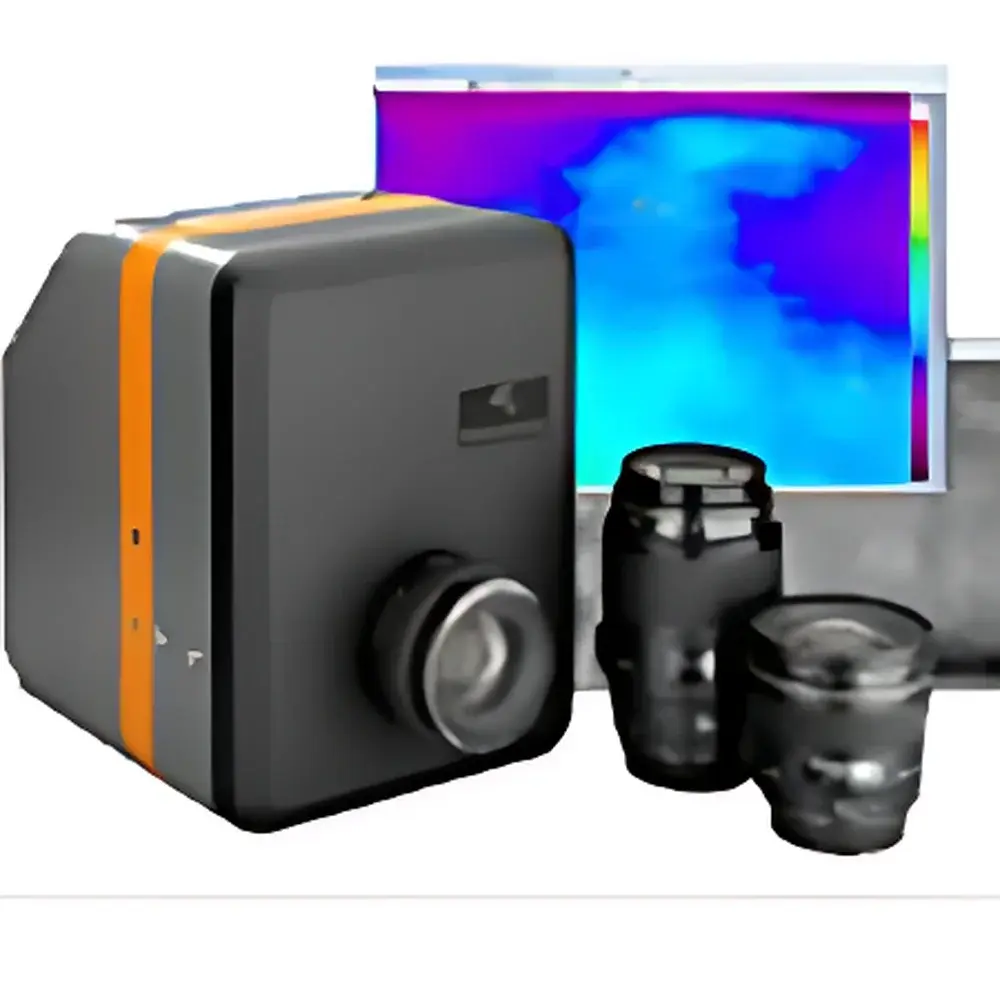
Radiant Vision Systems PM-G Imaging Colorimeter and Luminance Meter
| Brand | Radiant Vision Systems |
|---|---|
| Origin | USA |
| Model | PM-G |
| Sensor Resolution | 1536 × 1024 px (standard), 3072 × 2048 px (high-res option) |
| Dynamic Range | 14-bit (16,384 gray levels) |
| Luminance Range | 0.001 to 10¹⁰ nit (with ND filters) |
| Photometric Accuracy | Luminance (Y) ±3%, Illuminance ±3%, Chromaticity (x,y) ±0.003 |
| Short-Term Repeatability | Luminance <±0.5%, Chromaticity ±0.0006 |
| Lens Options | Motorized 35 mm, 50 mm, and 100 mm macro lenses with auto-focus and auto-iris |
| Measurement Speed (100 cd/m²) | Luminance-only: 2.3 s (G2/G3 mode) |
| Luminance + Chromaticity | 8 s (G2/G3 mode) |
| FOV | 40°×27° (35 mm), 30°×20° (50 mm), 15°×10° (100 mm macro) |
| Display | 125 mm diagonal LCD touchscreen (800×600) |
| Interface | USB 2.0/3.0, Gigabit Ethernet |
| Dimensions | 181 × 238 × 230 mm (H×W×D) |
| Weight | 4.9 kg |
| Operating Temperature | 0–30 °C |
| Operating Humidity | 20–70% RH (non-condensing) |
| Compliance | NIST-traceable calibration, ISO 11664, CIE S 014, ASTM E308, USP <1058> for analytical instrument qualification |
Overview
The Radiant Vision Systems PM-G Imaging Colorimeter and Luminance Meter is a high-precision, motorized imaging photometer engineered for quantitative measurement of luminance, chromaticity, and spatial uniformity across flat-panel displays, automotive HMI surfaces, LED arrays, and other self-emissive or reflective light sources. Unlike spot-based photometers, the PM-G captures full-field two-dimensional radiometric and photometric data in a single acquisition using a scientific-grade CCD sensor calibrated traceably to NIST standards. Its core measurement principle combines spectrally corrected silicon photodiode response (CIE 1931 photopic V(λ) and color-matching functions) with pixel-level spatial registration, enabling simultaneous evaluation of brightness distribution, color uniformity, Mura defects, hotspots, and angular emission profiles. Designed for integration into automated test stations or use as a benchtop metrology tool, the PM-G operates independently via its integrated 125 mm LCD touchscreen interface—eliminating dependency on external PCs during setup, focusing, and preliminary analysis.
Key Features
- Motorized optical system with precision auto-focus, auto-iris, and lens selection—ensuring consistent f-number, depth-of-field, and geometric registration across measurement sessions.
- Triple-lens configuration (35 mm, 50 mm, 100 mm macro) pre-calibrated for full working distance range—from near-field micro-display inspection to mid-range instrument cluster evaluation—without recalibration.
- Dual-resolution sensor options: standard 1536 × 1024 px (1.6 MP) and high-resolution 3072 × 2048 px (6.3 MP), both delivering 14-bit dynamic range (16,384 intensity levels) for high-fidelity contrast analysis.
- On-device touchscreen interface (800 × 600) with real-time histogram, false-color mapping, region-of-interest (ROI) tools, and live focus assist—enabling rapid setup and validation without host software.
- Sub-second luminance-only acquisition at 100 cd/m² (2.3 s in G2/G3 mode), scalable to full tristimulus color capture in under 8 seconds—optimized for high-throughput production line verification.
- Gigabit Ethernet and USB 3.0 interfaces support deterministic data transfer, remote control via TCP/IP, and seamless integration with LabVIEW, Python (Radiant’s .NET SDK), and MES/SCADA platforms.
Sample Compatibility & Compliance
The PM-G supports measurement of emissive and transmissive devices including OLED, MicroLED, LCD, and Mini-LED displays; automotive digital instrument clusters and head-up displays (HUDs); illuminated control panels; and backlight units (BLUs). It accommodates samples from 500 mm monitor-sized surfaces through interchangeable lenses and adjustable working distances (100 mm to 2 m typical). All factory calibrations are performed per ISO/IEC 17025-accredited procedures and include spectral responsivity characterization, spatial non-uniformity correction, and temperature-stability validation. The system meets requirements for photometric traceability under CIE S 014/E:2022 and colorimetric compliance with ISO 11664-1:2019 and ASTM E308-23. For regulated environments, Radiant’s ProMetric Software optionally supports 21 CFR Part 11-compliant audit trails, electronic signatures, and IQ/OQ/PQ documentation packages aligned with USP and GMP Annex 11 guidelines.
Software & Data Management
The PM-G is fully compatible with Radiant’s TrueTest™ and ProMetric® Software suites, which provide comprehensive analysis workflows—including luminance uniformity (min/max/mean deviation), delta-u’v’, CCT spatial gradients, defect detection (threshold-based pixel outlier identification), and automated pass/fail reporting against user-defined limits. Data export supports CSV, TIFF, HDF5, and XML formats, with metadata embedding per EXIF and DICOM standards. Batch processing, script-driven automation (via Python or VB.NET), and database logging (SQL Server, Oracle) enable scalability across R&D labs and Tier-1 manufacturing facilities. Calibration files are digitally signed and version-controlled; firmware updates preserve historical calibration validity per ISO/IEC 17025 clause 5.6.3.
Applications
- Display manufacturing: Pixel-level luminance and chromaticity mapping for yield analysis and process feedback control.
- Automotive electronics: Instrument cluster readability assessment under varying ambient conditions; HUD virtual image quality evaluation.
- R&D validation: Angular intensity distribution (Lambertian vs. directional emission), viewing angle dependence of CCT, and temporal stability testing (flicker, drift).
- Quality assurance: Automated Mura detection, bezel uniformity verification, and edge-to-edge brightness profiling per IEC 62341-6-3.
- Regulatory testing: Compliance verification against ENERGY STAR, VESA DisplayHDR, and ISO 9241-307 (visual ergonomics) standards.
FAQ
Does the PM-G require external PC hardware to operate?
No—the integrated LCD touchscreen enables standalone operation for focusing, exposure control, image preview, and basic photometric analysis. A PC is required only for advanced reporting, batch automation, or integration with enterprise systems.
Can the PM-G measure reflectance or transmittance?
Not natively. It is optimized for absolute radiance/luminance and chromaticity of self-luminous or backlit sources. For reflectance, a calibrated light source and reference white tile are required in conjunction with ProMetric Software’s relative measurement mode.
Is NIST-traceable calibration included with purchase?
Yes—each unit ships with a certificate of calibration traceable to NIST Standard Reference Materials (SRMs), including spectral responsivity, spatial uniformity, and photometric linearity data valid for 12 months.
How is thermal drift managed during extended measurements?
The PM-G incorporates active thermal stabilization of the sensor and optical path, validated to maintain luminance repeatability within ±0.5% over 8-hour continuous operation at 25 °C ambient.
What lens configurations support macro-scale inspection of small-area emitters?
The 100 mm macro lens provides 15° × 10° FOV and sub-100 µm spatial resolution at 300 mm working distance—ideal for individual OLED subpixel or micro-LED die characterization.





